Every Formula 1 season has a hidden first chapter. Long before the lights go out at the opening Grand Prix, teams spend days lapping a circuit with no points on offer, no trophies to lift, and often no clear picture of who is truly fastest. That chapter is F1 testing, and it quietly shapes almost everything that follows.
If you have ever seen a car circling with a metal grid bolted behind its front wheels, or wondered why the team topping the timesheets in February can struggle by March, this guide is for you.
Below, we explain what F1 testing is, the different types, the rules that limit it, and how to read the results like someone who works in the paddock.
What Is F1 Testing?
F1 testing is any on-track running that teams do outside an official race weekend to develop, check and understand their cars.
It covers pre-season testing before the championship begins, the post-season test after the final race, tyre development running for Pirelli, short filming days and private sessions in older cars.
Unlike a Grand Prix, a test produces no result that counts. Lap times are published, but no points are awarded. The real output is data on aerodynamics, power unit behaviour, tyre wear, cooling and reliability, gathered from hundreds of sensors on every car.
A helpful way to picture it: testing is the dress rehearsal for a very expensive performance, where the script is still being rewritten while the actors are on stage.
Why F1 Testing Matters So Much
Track time is scarce in modern Formula 1, so every lap in testing has a job to do. Teams arrive with five clear goals.
- Prove reliability. A failed part in testing is an inconvenience. The same failure at a Grand Prix costs points. Teams want to find weak spots in cooling, hydraulics, gearboxes and energy systems before they matter.
- Confirm correlation. Cars are designed in wind tunnels, computer simulations and driver-in-the-loop simulators. Testing tells engineers whether the real car behaves as those tools predicted. When the numbers match, development moves fast. When they do not, a team may spend months chasing the gap.
- Find a setup window. Ride height, wing levels, suspension stiffness and differential settings all interact. Testing helps teams find a baseline they can fine-tune at each circuit.
- Learn the tyres. Pirelli’s compounds behave differently on each new car. Teams study warm-up, wear and the temperature window in which each compound works best.
- Bring drivers up to speed. A driver who has changed teams needs time to learn new controls, new engineers and a new way of working. Even returning drivers must relearn a car that has changed over the winter.
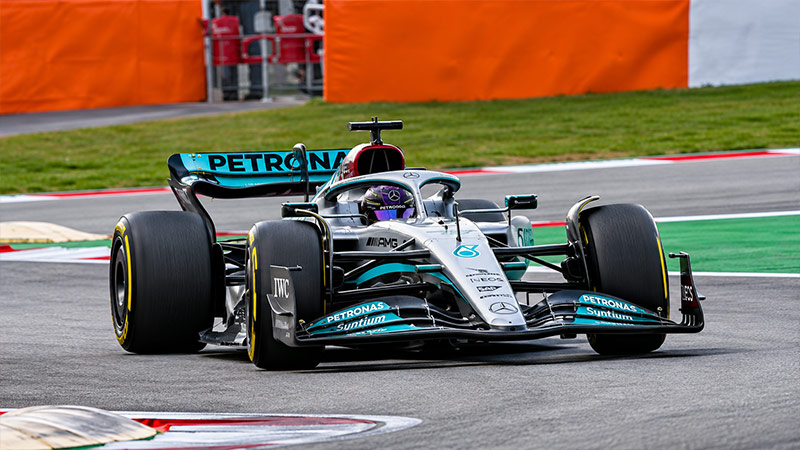
History shows the stakes. In 2022, the last major rules change before 2026, several teams only discovered how severe the bouncing known as porpoising was once they reached pre-season testing in Barcelona. Some spent much of that season recovering.
The Main Types of F1 Testing
Testing in Formula 1 is not one event. It is a set of tightly defined formats, each with its own purpose and limits.
| Type of testing | When it happens | Who usually drives | Key limits |
|---|---|---|---|
| Pre-season testing | Late January to February | Race drivers | Three days in a normal year; nine in 2026; four from 2027 |
| Post-season test | Days after the final race, at Yas Marina | Race drivers and young drivers | One day; young driver cars go to drivers with two or fewer Grand Prix starts |
| Pirelli tyre tests | Spread through the year | Team drivers, running for Pirelli | Used to develop tyres, not the team’s own car |
| Filming days | Any time of year | Any team driver | Distance capped at 200 km |
| Testing of Previous Cars (TPC) | Through the year | Reserve, junior and race drivers | Cars at least two years old; 20 days per team per year; race drivers capped at 1,000 km |
| Rookie practice running | Friday practice at race weekends | Drivers with two or fewer Grand Prix starts | Four first practice sessions per team per season |
Pre-season testing
This is the version most fans know. Teams bring their brand-new cars to a single circuit, usually Bahrain in recent years, and run for several days before the first race. From 2023 to 2025, teams had just three days of official running. For the 2026 rules overhaul, that figure tripled to nine.
The post-season test
Usually two days after the final round in Abu Dhabi, teams stay on at Yas Marina for one more day of running. In December 2025, this test did double duty. Race drivers ran modified 2025 cars on Pirelli’s 2026 tyres, while a second car per team went to a young driver with no more than two Grand Prix starts.
Tyre development tests
Pirelli cannot build tyres without real cars to run them on, so teams lend cars and drivers for dedicated sessions through the season.
While developing its 2026 range, Pirelli ran 12 two-day sessions across eight circuits before a final day in Abu Dhabi. These sessions often use mule cars: older chassis modified to imitate the loads of a future car.
Testing of Previous Cars (TPC)
TPC lets teams run cars that are at least two years old. It is mainly used to train reserve and junior drivers, but it also helps race drivers settle in after a team switch.
The rules are strict: a maximum of 20 TPC days per team each calendar year, a 1,000 km cap for current race drivers, and only one car in use on a given day. Even older cars fall under separate historic car rules and are often seen at demonstrations and festivals.
Rookie practice sessions
Because mid-season testing is so limited, the FIA uses race weekends to give young drivers real experience. Every team must run a rookie, defined as a driver with two or fewer Grand Prix starts, in first practice four times a season, twice in each car.
What Actually Happens on a Test Day
From the grandstand, testing can look like cars simply going round and round. Inside the garage, every minute follows a detailed run plan.
A typical day at the 2026 Bahrain tests ran from 10am to 7pm local time, with an unofficial lunch break in the middle. Within that window, a team usually works through these stages:
- Installation laps. The first laps of the day check that every system works, from fuel and hydraulics to electronics and brakes.
- Aero measurement runs. You may spot large metal grids, called aero rakes, mounted on the car. They carry dozens of pressure sensors that map how air flows around the bodywork. Teams also brush on flow-vis, a bright fluorescent paint that dries in streaks and shows the direction of airflow across a surface.
- Short performance runs. Low fuel and softer tyres show what the car can do over a single lap.
- Long runs. Heavy fuel and harder tyres simulate a race stint, revealing tyre wear and how consistent the car is.
- Race-day rehearsal. Teams practise pit stops, race starts and procedures with the new car.
Back at the factory, engineers watch the data live and suggest changes in real time. A good day can deliver well over a full race distance. A bad one can be spent in the garage chasing a single fault.
Most teams split each day between their two drivers. With only three days available in a normal year, that left each driver with roughly a day and a half. The move to four days from 2027 means drivers will no longer need to share a day.
The Rules: Why F1 Limits Testing
It was not always like this. Through the early 2000s, top teams tested almost without limit. Some ran dedicated test teams and owned private circuits, turning money directly into lap time.
To rein in spiralling costs, in-season testing was largely banned from 2009, and track running has been tightly controlled ever since.
Today, testing sits inside a wider set of cost controls:
- The cost cap. Since 2021, a budget cap limits what teams can spend, so every test day has to justify its price.
- Aerodynamic testing restrictions. Wind tunnel time and computer simulation runs are rationed on a sliding scale. Teams lower in the championship get a larger allowance than the leaders, which helps the grid close up.
- Tighter TPC rules. From 2025, teams were limited to 20 TPC days and one nominated car, and could not test at a circuit within 60 days of it hosting a race. For 2027, further limits apply to TPC running at circuits on the next year’s calendar.
With real track time so restricted, teams invest heavily in simulators. They help enormously, but there is still no substitute for a real car on a real circuit.
How to Read F1 Testing Lap Times Without Being Fooled
Testing timesheets are some of the most misread numbers in sport. A car at the top can be well off the pace in reality, and the reverse is just as common. Here is why.
- Fuel loads are secret. Teams never reveal how much fuel they carry. A common paddock rule of thumb is that every 10 kg of extra fuel costs around three tenths of a second per lap.
- Tyre compounds vary. One car may be on the softest compound while another runs the hardest, and the gap between them can exceed a second.
- Engine modes differ. Power units can run in cautious modes to protect reliability, hiding true performance.
- Conditions change. Grip improves as rubber builds up on the track, and in Bahrain the cooler evening hours are usually quicker than the hot afternoon.
- Sandbagging exists. Some teams deliberately hide speed to avoid showing their hand.
So what should you watch instead? Focus on lap counts, because mileage signals reliability. Compare long-run pace between teams on similar tyres.
Notice how settled a car looks through fast corners, and listen to what drivers say, and avoid saying, in interviews.
The team that quietly completes the most laps often has a stronger season than the one that sets a headline time.
F1 Testing in the 2026 Era and What Comes Next
The 2026 season brought the biggest rules reset in decades, with new chassis and power unit regulations arriving together. Testing expanded to match, from three days to nine.
| Test | Venue | Dates | Format |
|---|---|---|---|
| Test 1 | Circuit de Barcelona-Catalunya | 26 to 30 January 2026 | Private shakedown; each team could run on three of the five days |
| Test 2 | Bahrain International Circuit | 11 to 13 February 2026 | Official test, open to media, with live timing |
| Test 3 | Bahrain International Circuit | 18 to 20 February 2026 | Official test, open to media, with live timing |
The extra Barcelona days were a cushion against bad January weather, a lesson learned after snow disrupted pre-season running in 2018.
The week also showed how much early mileage matters. Williams skipped Barcelona altogether, so the first Bahrain test was the first time all 11 teams, including newcomer Cadillac, ran their new cars together.
For 2027, testing returns to a single event. Teams will have four days at the Bahrain International Circuit from 24 to 27 February 2027, one more than the usual three, because the FIA judged the current cars complex enough to need it.
The season is then scheduled to open at the same venue on 12 to 14 March, although the calendar could still change.
Conclusion
F1 testing is where every season truly begins. It is the stage where teams prove reliability, check that their factory predictions hold up on track, learn the tyres and give drivers the miles they need.
From a nine-day marathon in 2026 to a single four-day test in Bahrain for 2027, the format keeps changing, but the purpose stays the same: arrive at the first race ready to win.
Remember that lap times tell only part of the story. Watch the mileage, the long runs and the quiet confidence in the garage.