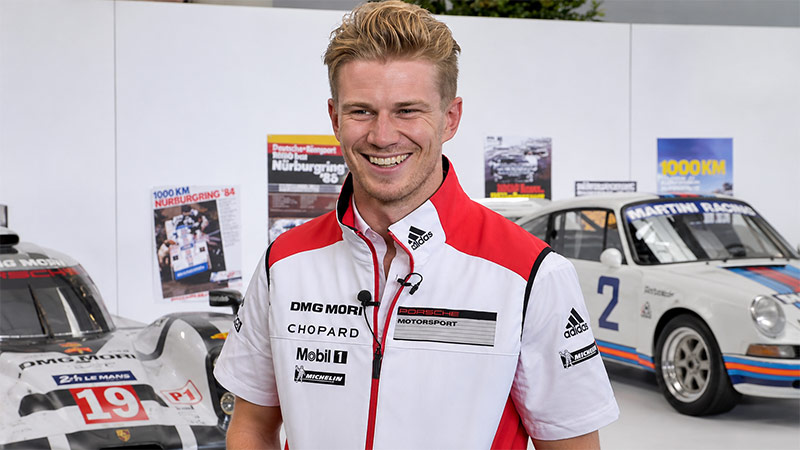
Nico Hülkenberg is German. He was born on 19 August 1987 in Emmerich am Rhein, a riverside town in the state of North Rhine-Westphalia, and he has raced under the German flag for his entire career, from junior karting to his current Formula 1 seat with Audi.
That is the quick answer. Yet the question keeps coming up, and for understandable reasons. His hometown sits right on the Dutch border, he speaks fluent Dutch, he lives in Monaco, and he has driven for teams with British, French, American and Swiss roots. Add the most famous podium drought in modern F1, and you have a driver whose story deserves more than a flag beside his name.
Nico Hülkenberg Quick Facts
Every key detail points to the same answer: German by birth, upbringing and racing licence.
| Detail | Information |
|---|---|
| Full name | Nicolas Hülkenberg |
| Nationality | German |
| Date of birth | 19 August 1987 (age 39) |
| Birthplace | Emmerich am Rhein, North Rhine-Westphalia (then West Germany) |
| Languages | German, Dutch, French, English |
| Residence | Monaco |
| Nickname | “The Hulk” |
| Car number | 27 |
| 2026 team | Audi |
| 2026 teammate | Gabriel Bortoleto (Brazil) |
| Career highlights | 2009 GP2 champion, 2015 Le Mans winner, first F1 podium at the 2025 British Grand Prix |
Where Is Nico Hülkenberg From? Why Some Fans Think He Is Dutch
Emmerich am Rhein sits on the lower Rhine, right where Germany meets the Netherlands. In a border town, switching languages is part of daily life, and Hülkenberg grew up fluent in Dutch as well as German.
He later added French and English, which is why he moves so easily between interviews in the paddock.
His early racing deepened the Dutch link. Through his key karting seasons, including his 2002 German Junior title and his 2003 German Kart Championship, he raced for a team called CRG Holland.
Fans who saw “Holland” on the entry lists, or heard him chatting in Dutch, often assumed he was from the Netherlands.
He is not. His family roots are firmly in Emmerich, where his father, Klaus Dieter Hülkenberg, owns the freight forwarding firm Hülkenberg Spedition.
Nico even trained as a freight forwarding agent in the family business before racing took over. Growing up beside the border shaped his language skills, not his nationality.
Racing for Germany: The Junior Years
His nationality is more than a line on his licence. Long before Formula 1, Hülkenberg was winning titles that carried Germany’s name.
- Karting (1997–2004): He started at age 10, became German Junior Karting Champion in 2002, then German Kart Champion in 2003.
- Formula BMW ADAC (2005): He won the German title in his first season, taking eight wins from 20 races.
- A1 Grand Prix (2006–07): Driving for A1 Team Germany, in a series where every car represented a nation, he won nine races and scored 128 points. That delivered the championship to Germany, 35 points clear of New Zealand.
- Formula 3 Euro Series (2008): He became champion with seven wins, a year after winning the 2007 Masters of Formula 3.
- GP2 Series (2009): He won the title as a rookie, becoming only the third driver to do so after Nico Rosberg and Lewis Hamilton.
The A1GP title is the clearest proof of his national identity. His nine wins made him the most successful driver in the series’ history, and he almost single-handedly won Germany the crown.
There is a strong German thread off the track too. His early manager was Willi Weber, Michael Schumacher’s long-time manager, who compared him to a young Schumacher. Weber also gave him the nickname “The Hulk”, inspired by the way his personality changed once he was behind the wheel.
Nico Hülkenberg’s F1 Career Under the German Flag
Across 268 Grand Prix starts, as of the 2026 Mexico City Grand Prix, Hülkenberg has always raced as a German, whatever the nationality of his team.
| Years | Team | Highlight |
|---|---|---|
| 2026 | Audi | Part of the German manufacturer’s first works F1 line-up |
| 2025 | Kick Sauber | First F1 podium: third at the British Grand Prix |
| 2023–2024 | Haas | Full-time comeback; 11th in the 2024 standings |
| 2020, 2022 | Racing Point / Aston Martin | Stand-in for Sergio Pérez, Lance Stroll and Sebastian Vettel |
| 2017–2019 | Renault | Seventh in 2018, his best championship finish |
| 2014–2016 | Force India | Ninth in 2014 with 96 points |
| 2013 | Sauber | Tenth overall, outscoring his teammate 51 to 6 |
| 2012 | Force India | Led the Brazilian Grand Prix before a late collision |
| 2010 | Williams | Pole position at the Brazilian Grand Prix as a rookie |
Two moments stand out. In 2015, he won the 24 Hours of Le Mans at his first attempt with Porsche, another German manufacturer, sharing the car with Nick Tandy and Earl Bamber.
It was Porsche’s first overall Le Mans win since 1998, and it made him the first active F1 driver to win the race since 1991.
The second came a decade later. At a rain-soaked 2025 British Grand Prix, he climbed from 19th on the grid to third, holding off Lewis Hamilton in the closing laps.
It ended a record 239-start wait for a podium and gave Sauber its first top-three finish in 13 years. Rivals across the paddock lined up to congratulate him.
How He Fits Among Germany’s F1 Drivers
Germany is one of Formula 1’s great racing nations. Michael Schumacher won seven world titles, Sebastian Vettel won four, and Nico Rosberg became champion in 2016. Hülkenberg has not matched that silverware, but his place in the story is unique.
When Vettel retired at the end of 2022 and Mick Schumacher left Haas, Hülkenberg became Germany’s only full-time driver in Formula 1.
He even took Mick Schumacher’s seat at Haas for 2023, just months after standing in for Vettel at Aston Martin. With no new German arriving for 2026, he remains the country’s sole representative on the 22-car grid.
That makes him the flag-bearer for a nation with deep motorsport heritage, and it gives German fans a driver of their own to follow every race weekend.
The Audi Era: A German Driver for a German Team
In 2026, his nationality became central to his career story. Audi named Hülkenberg as its first Formula 1 driver in April 2024. He spent 2025 at Sauber helping prepare the team, then moved into the full Audi works era in 2026, when the team began racing with its own power unit.
His German passport was part of the appeal. Former Sauber driver Valtteri Bottas said openly that Audi had made it clear it wanted a German driver, and Hülkenberg brought that plus more than a decade of development experience.
His 2026 season so far, as of the Mexico City Grand Prix:
- 13 points and 15th place in the drivers’ standings
- Best finishes of eighth at the Dutch and Singapore Grands Prix
- Further points in Hungary, Spain and the Singapore sprint
- A contract that runs until at least the end of 2027
It has not been a smooth debut year. After the Hungarian Grand Prix he described the first half as encouraging while admitting the car still had fragile areas to fix. In July, team boss Mattia Binotto moved to end speculation that Hülkenberg could lose his seat.
Common Misconceptions About Nico Hülkenberg’s Nationality
Most of the confusion comes from where he lives, who he races for and the languages he speaks. Here is how each myth stacks up.
- “He is Dutch.” No. He was born in Germany and grew up beside the Dutch border, which is why he speaks Dutch fluently.
- “He is Monegasque.” No. He lives in Monaco, a popular home base for many F1 drivers, but where a driver lives does not change his nationality.
- “He is Swiss.” No. Much of his team’s work happens in Hinwil, Switzerland, Sauber’s long-time base, but he races as a German.
- “He is Lithuanian.” No. His wife, fashion designer Eglė Ruškytė, is Lithuanian. The couple married in 2022 and have a daughter born in 2021.
- “Hulkenberg and Hülkenberg are two different people.” No. The umlaut (ü) is the original German spelling, and many English-language outlets simply drop it.
Conclusion
Nico Hülkenberg is German, born and raised in Emmerich am Rhein, and he has carried his country’s colors across more than 260 Grand Prix starts.
His border-town upbringing gave him fluent Dutch, his home in Monaco and his years with foreign-based teams blurred the picture, but his nationality never changed.
From A1GP glory for Germany to a Le Mans win with Porsche and a long-awaited Silverstone podium, his journey reflects patience, skill and resilience.
Now, as the senior driver in Audi’s first works Formula 1 project, he proudly represents Germany on the grid. Want more driver profiles, team guides and race analysis?