In the high-stakes environment of professional football evaluation, few events carry as much weight as the annual Scouting Combine.
For defensive leaders, the ability to blend raw power with elite closing speed is the benchmark for success in the modern era.
When Devin Lloyd arrived at the 2022 event, he was already established as a premier talent from the University of Utah, but his performance in Indianapolis provided the empirical data necessary to solidify his status as a first-round selection.
The evaluation of a linebacker’s potential often begins with their ability to cover ground. In an era where offenses prioritize horizontal stretch plays and vertical threats from the tight end position, a linebacker’s speed is not merely an asset; it is a requirement for survival.
Lloyd’s journey from a versatile high school athlete to the centerpiece of the Jacksonville Jaguars’ defense provides a masterclass in how athletic testing correlates with professional longevity and impact.
The Gold Standard: Analyzing the 40-Yard Dash
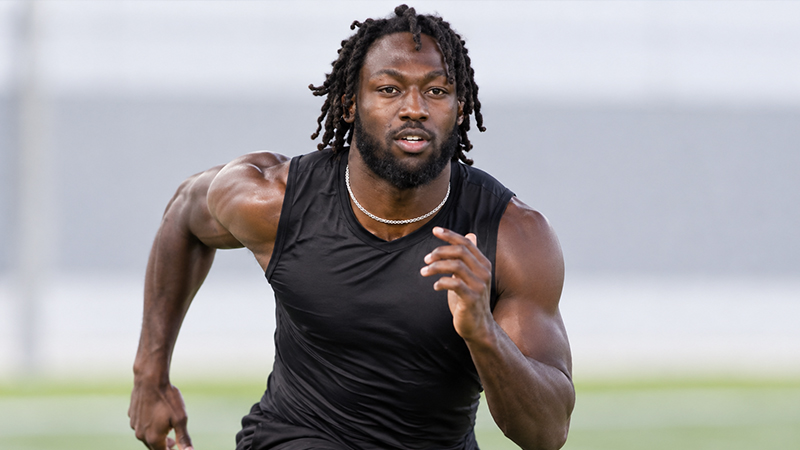
The most anticipated metric for any defensive prospect is the 40-yard dash. This drill serves as a proxy for a player’s “long speed”—the ability to chase down a ball carrier from across the field or drop into deep coverage. During his official testing window, Devin Lloyd recorded a time of 4.66 seconds.
While the final number is what often makes the headlines, professional evaluators look deeper into the “splits” to understand a player’s acceleration and sustained velocity. These intervals describe how a player builds speed from a static start.
| Interval | Time (Seconds) |
|---|---|
| 10-Yard Split | 1.58 s |
| 20-Yard Split | 2.71 s |
| Official 40-Yard Dash | 4.66 s |
A 1.58-second 10-yard split is particularly significant for an off-ball linebacker. It demonstrates the initial “burst” required to shoot through a gap in the offensive line or to react to a sudden change in direction by a quarterback.
For Lloyd, this acceleration profile confirmed that his “football speed” matched the elite instincts he displayed during his collegiate career at Utah.
Physical Dimensions and Developmental Background
To understand the context of these speed metrics, one must look at the physical frame Lloyd carries. Measuring in at approximately 6′ 3″ and weighing 235 to 237 pounds, his speed-to-size ratio is indicative of a modern “prototypical” linebacker.
His length, characterized by an arm length of 33 inches, allows him to engage blockers effectively and disrupt passing lanes—a trait that is amplified by his movement efficiency.
His athletic foundation was built through a high degree of versatility during his formative years. This multi-positional history contributed to a unique sense of field awareness that many traditional linebackers lack.
- High School Versatility: At Otay Ranch High School, Lloyd was a true hybrid player, seeing significant time as a safety, wide receiver, and even a punter.
- Safety Instincts: His background in the secondary is evident in his ball skills. As a high school senior, he recorded eight interceptions, a high number for any defensive player.
- Offensive Contributions: His experience as a wide receiver (catching 29 passes as a senior) provided him with a deep understanding of offensive route concepts, which now aids him in pass coverage at the professional level.
- Special Teams Awareness: Averaging 37.1 yards per punt showcased his coordination and leg strength, further proving his all-around athletic ceiling.
Measuring Explosiveness and Strength
Speed is only one component of the evaluation puzzle. For a player expected to thrive in the “box” (the area of the field closest to the line of scrimmage), explosive power and functional strength are equally vital.
Lloyd’s testing in the jumping and lifting categories placed him among the upper echelon of his draft class.
| Testing Metric | Official Result |
|---|---|
| Vertical Jump | 35.0 inches |
| Broad Jump | 10 feet 6 inches (126.0″) |
| Bench Press | 25 reps |
| Hand Span | 9.5 inches |
The 35-inch vertical jump is a direct indicator of lower-body explosiveness. This metric is critical for a linebacker who must often leap to deflect passes or contest high-pointing catches by tight ends.
Similarly, his broad jump of 10′ 6″ measures horizontal power and balance, two traits necessary for maintaining leverage during a tackle.
The 25 repetitions on the bench press (at 225 lbs) are perhaps the most telling indicator of his readiness for the physical toll of the professional game. This level of strength ensures that he can shed blocks from offensive linemen who often outweigh him by 60 to 80 pounds.
Professional Transition and the Jacksonville Jaguars
The culmination of these metrics led to the Jacksonville Jaguars selecting Lloyd with the 27th overall pick in the first round of the 2022 NFL Draft.
Since entering the league, Lloyd has proven that his testing numbers were not merely gym achievements, but foundational traits that translate to high-volume production.
Over his first 32 professional games, his impact on the field has been quantifiable:
- Total Career Tackles: 242.
- Solo Tackles: 134.
- Assisted Tackles: 108.
- Consistency: He has maintained a high level of activity, averaging over 7.5 tackles per game during this stretch.
These statistics reflect a player who possesses the “sideline-to-sideline” range that scouts predicted based on his 4.66-second 40-yard dash. His ability to rack up nearly 250 tackles in just two seasons highlights his durability and his high motor.
The Strategic Shift: Evolution to Middle Linebacker
In professional football, the only constant is change. As defensive philosophies evolve, players must adapt to new roles. For the 2024 season, under the guidance of defensive coordinator Ryan Nielsen, Lloyd underwent a significant positional transition.
After spending his first two professional seasons primarily as a weak-side linebacker—a role that allowed him to use his speed to chase plays from the backside—he moved to middle linebacker within a 4-2-5 defensive scheme.
This move is a testament to the trust the coaching staff has in his physical tools and mental processing.
As a middle linebacker, Lloyd is now tasked with being the “quarterback” of the defense. His responsibilities include:
- Communication: Calling out offensive formations and adjusting defensive alignments before the snap.
- Gap Integrity: Taking on a more central role in stopping the run, which utilizes his 235-pound frame and 25-rep bench press strength.
- Middle Field Coverage: Patrolling the heart of the defense, where his 4.66 speed and 35-inch vertical jump are essential for neutralizing modern “big-slot” receivers and athletic tight ends.
Conclusion
Devin Lloyd’s profile is a reminder of why physical metrics remain a cornerstone of professional evaluation. While his 40-yard dash time of 4.66 seconds provided the initial excitement, it is the combination of his explosive jumping, veteran-level strength, and versatile background that has made him a fixture in the Jaguars’ defensive unit.
At 25 years of age, Lloyd is entering the prime of his career. His transition to the middle linebacker position marks the next chapter in a journey that began as a three-star recruit at Utah and blossomed into a consensus first-team All-American.
By grounding his instincts in the elite athletic traits measured in Indianapolis, he has established himself as one of the most reliable and dynamic defensive players in the game today.
For those tracking the future of the linebacker position, Lloyd remains the standard-bearer for how to combine size, speed, and intelligence on the professional stage.