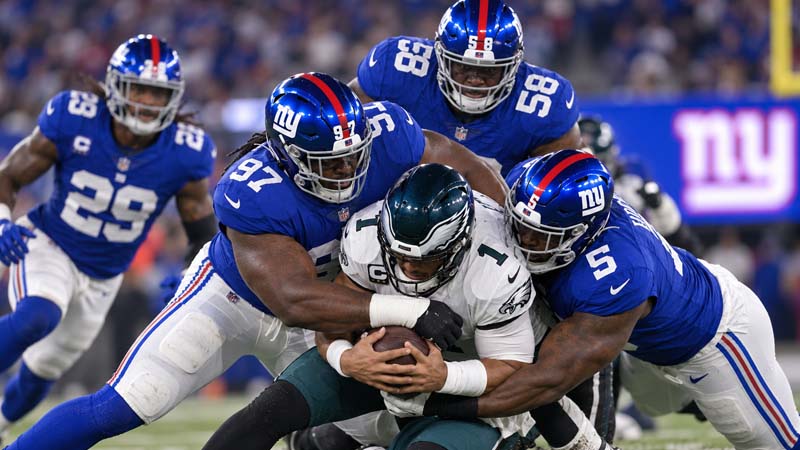
Modern football is defined by a continuous struggle between explosive offensive schemes and the defensive systems designed to neutralize them.
For the New York Giants, the path to defensive stability has undergone a fundamental transformation.
The team’s defensive identity is built on a highly athletic, high-upside pass rush coupled with a strategic overhaul aimed at repairing long-standing run-defense vulnerabilities.
At the center of this transformation is first-year defensive coordinator Dennard Wilson, who has installed an aggressive, highly physical defensive system operating close to the line of scrimmage.
This scheme is engineered around a central concept: the “Human Wall”. Rather than relying on individual defensive linemen to aggressively penetrate deep into the backfield—which historically opened massive running lanes for opponents—the new front focuses on clogging interior gaps.
This tactical positioning allows the team’s linebackers to flow downhill and swarm ball-carriers cleanly.
The Tactical Paradigm Shift: Defining the “Human Wall”
To understand why this schematic shift is necessary, one must look at the structural issues that plagued the defense in prior campaigns. For years, the team’s defensive front struggled to find a balance between rushing the passer and holding the line of scrimmage.
Opposing offenses frequently exploited over-penetration, comfortably running the ball directly through empty gaps and neutralizing the impact of talented perimeter rushers.
The Core Mechanics of Gap Control
In traditional systems that prioritize immediate backfield penetration, defensive linemen are taught to shoot through designated gaps.
While this can lead to spectacular tackles for loss, it carries a high risk: if the ball-carrier evades the initial penetrator, the defense is left out of position.
The “Human Wall” philosophy rejects this high-risk approach in favor of disciplined gap control:
- Clogging the Interior: Defensive tackles and edge defenders maintain leverage on their assigned gaps, physically occupying space at the line of scrimmage rather than immediately vacating it to chase the quarterback.
- Second-Level Freedom: By anchoring the line of scrimmage, the front-line defenders protect the team’s linebackers from being blocked by offensive linemen climbing to the second level.
- Swarming the Ball: Once the running lane is closed, linebackers can trigger downhill to make clean, short-yardage stops.
During summer practices, this newly implemented system showed dominant flashes, routinely overwhelming the offense and establishing a highly physical tone.
The true measure of this system’s viability, however, lies in how effectively the coaching staff can marry this disciplined run-stopping structure with the explosive, vertical talent of their premier edge rushers.
Statistical Breakdown: Key Defensive Personnel
The success of any defensive scheme is ultimately determined by the personnel executing it. The defensive unit features a unique blend of established veteran leaders, highly productive edge rushers, and developing young players.
To evaluate the potential of this unit, we must analyze the performance metrics of the core contributors. The following table provides a comprehensive overview of the key defensive players based on their performance data:
| Player | Position | Age | Primary Performance Metrics & Statistics | Strategic Defensive Role |
|---|---|---|---|---|
| Abdul Carter | EDGE | 22 | 27 Solo Tackles, 20 Stops, 5.0 Sacks, 43 Hurries, 2 Forced Fumbles, 18 QB Hits, 66 QB Pressures, 48 Quick Pressures | High-impact perimeter rusher; primary catalyst for instant backfield disruption. |
| Kayvon Thibodeaux | EDGE | 25 | 20 Solo Tackles, 3 Sacks, 19 Stops, 32 Total Pressures, 23 Hurries, 8 QB Hits | High-upside edge setter; crucial for funneling runs inside and collapsing the pocket. |
| Brian Burns | EDGE | — | Unquestioned defensive leader; elite speed-to-power rusher on the perimeter. | Scheme anchor; commands double-teams and dictates offensive protection schemes. |
| Andru Phillips | CB | 24 | 64 Total Tackles (59 Solo), 2 Interceptions, 12 Pass Deflections, 32 Stops, 95.4 Passer Rating Allowed | Dynamic secondary defender; highly effective in run support and underneath coverage. |
| Tyler Nubin | S | 24 | 57 Solo Tackles, 17 Assist Tackles, 20 Stops, 27 Receptions Allowed, 119.5 Passer Rating Allowed | Deep safety; responsible for secondary communication and limiting explosive plays. |
| Darius Alexander | DT | 25 | 20 Tackles, 3.5 Sacks, 15 Pressures, 9 Hurries, 2 QB Hits | Interior anchor; responsible for holding double-teams and maintaining the “Human Wall”. |
| Arvell Reese | LB | 20 | Developing rookie linebacker; poised to play a central role in the physical front. | Downhill run defender; tasked with clean tackling and gap-filling behind the defensive line. |
Analyzing the Elite Edge Power
The defense’s greatest strength is its perimeter talent. Brian Burns is the unquestioned leader, setting an elite athletic standard and forcing offenses to devote extra protection.
Opposite him, Kayvon Thibodeaux combines physicality with speed-to-power, while contributing against the run with 19 stops and 20 solo tackles last season.
The biggest wild card is Abdul Carter, whose production exploded after moving from off-ball linebacker to natural edge duties.
His alignment change unlocked his athleticism, producing 48 quick pressures, the NFL’s most, and 66 total quarterback pressures, 16th league-wide. With consistent edge usage, Carter could become a premier pass-rushing threat.
The Tactical Challenge: Managing Positional Versatility
Having three premium edge players—Burns, Thibodeaux, and Carter—presents a unique strategic challenge for Dennard Wilson.
Because these players possess exceptional athleticism and versatility, the defensive staff has experimented with moving them into highly unpredictable pre-snap alignments.
This positional versatility allows the Giants to disguise their defensive intent:
- Unpredictable Blitz Paths: By shifting edge rushers into different alignments, the defense can overload specific offensive line protections, creating free-rusher lanes.
- Pre-Snap Disguise: Opposing quarterbacks struggle to identify the primary pass-rushing threats before the snap, often forcing them into rushed decision-making.
- Secondary Blitz Integration: Wilson frequently complements his front-line rushers with unexpected blitzes from the defensive backfield, utilizing safety and cornerback pressure to overwhelm pass protection schemes.
However, some analysts remain skeptical of this approach. When premium edge defenders are consistently asked to drop into coverage or play out of position to get all three on the field simultaneously, it can inadvertently weaken other aspects of the defense, particularly the edge setting required to stop outside zone runs.
The coaching staff must find a delicate balance that utilizes these diverse skill sets without compromising the integrity of the run defense.
The Run-Defense Imperative: Solving a Five-Year Vulnerability
While the pass rush has the talent to be special, the overall success of the defense hinges entirely on its ability to stop the run. Historically, the Giants’ run defense has been a glaring weakness, allowing an average of 145 yards rushing per game in the prior season.
The analytical metrics highlight the severity of this issue: the defense allowed one of the worst Expected Points Added (EPA) per rush in the entire league. This vulnerability severely restricted the team’s ability to rush the passer.
Opposing offenses did not have to drop back and expose their quarterbacks to a stout pass rush; instead, they could comfortably run the ball down the defense’s throat, controlling the clock and systematically moving the chains.
Run Defense Vulnerability (145 Yards/Game)
         │
         ▼
Opponents Run Comfortably / Short-Yardage Success
         │
         ▼
Pass Rush Neutralized (Fewer Third-and-Long Situations)
To resolve this issue, the interior defensive line must take a massive step forward. Players like Darius Alexander must consistently hold the point of attack. Alexander’s prior campaign showed promise, contributing 3.5 sacks and 15 pressures from the interior, but his primary responsibility under Dennard Wilson will be swallowing double-teams to keep the linebackers clean.
Furthermore, the addition of defensive line coach leadership that prioritizes tackling and physical leverage is designed to eliminate the fundamental errors that led to poor run defense in the past.
The Secondary Dilemma: Can the Backfield Hold Up?
A major debate exists among close observers of the team regarding the relationship between the front seven and the secondary.
Some argue that if the front seven plays up to its potential on paper, the sheer volume of pressure will naturally elevate the play of the defensive backfield.
If a quarterback is constantly under duress, they will be forced into quick throws and turnover-worthy decisions, protecting a young secondary from having to cover for extended periods.
Conversely, others fear that a weak secondary will completely negate a stout pass rush. Modern passing games are designed to get the ball out of the quarterback’s hands in under 2.5 seconds.
If the cornerbacks cannot hold up in man coverage or press alignments at the line of scrimmage, opposing offenses can easily bypass the pass rush entirely using quick, short passes.
For the secondary to hold up its end of the bargain, several key developments must occur in the cornerback room:
- Deonte Banks must play at his rookie level or better, establishing himself as a reliable boundary cornerback capable of matching up against top-tier receivers.
- Adebo must recapture the high level of play he demonstrated during his time with the New Orleans Saints, providing much-needed veteran stability on the opposite boundary.
- Hood, a fast-learning young cornerback, must continue to impress and adapt quickly to the physical demands of Dennard Wilson’s secondary blitzes and tight coverages.
Meanwhile, young safety Tyler Nubin must show significant improvement in coverage. While Nubin proved to be a highly physical defender in run support—registering 57 solo tackles and 20 stops—he allowed a passer rating of 119.5 when targeted in coverage.
Under Wilson’s aggressive system, Nubin must serve as the last line of defense, ensuring that aggressive front-seven pressures do not result in explosive plays over the top.
Historical Comparison: Recreating the Championship Formula
The current construction of the defensive front has drawn comparisons to the legendary Giants defensive lines of the past, which featured dominant pass rushers like Michael Strahan, Osi Umenyiora, Justin Tuck, and Mathias Kiwanuka.
That historic group was famous for its “NASCAR” package, which put four elite pass rushers on the field simultaneously to overwhelm opposing passing offenses.
While the modern front possesses comparable athletic upside, there is a major structural difference that highlights the importance of the “Human Wall”:
HISTORIC GIANTS FRONT:
Strahan / Osi / Tuck / Kiwanuka (Pass Rush)
  + Fred Robbins / Barry Cofield / Antonio Pierce (Elite Run Defense)
  = Balanced, Championship-Caliber Defense

MODERN GIANTS FRONT:
Burns / Thibodeaux / Carter (Pass Rush)
  + Dennard Wilson's "Human Wall" Gap-Clogging Scheme (Run Defense Rebuild)
  = High-Upside, Developing Identity
During the championship years, the team’s dominant pass rush was supported by outstanding interior run-stoppers like Fred Robbins, Barry Cofield, and linebacker Antonio Pierce.
Opponents could not run the ball effectively, forcing them into third-and-long situations where the pass rush could safely pin its ears back and hunt the quarterback.
For the modern unit to reach a similar level of dominance, they must replicate this balance. Having multiple high-sack players is highly valuable, but if the interior line cannot prevent opponents from running at will, the overall effectiveness of the defense will remain limited.
Conclusion
The rebuilding of the defensive front represents a bold tactical pivot. By pairing a high-upside, athletic pass rush with a physical, gap-clogging front, Dennard Wilson has laid the foundation for a highly competitive defensive unit.
The talent on the perimeter is undeniable, anchored by the leadership of Brian Burns and the explosive playmaking ability of Abdul Carter and Kayvon Thibodeaux.
However, paper potential must translate to on-field discipline. If the defensive front can successfully execute the “Human Wall” philosophy and shut down opposing run games, they will elevate a young secondary and establish one of the most feared defensive units in the league.
If they fail to stop the run, their elite pass-rushing capabilities will once again be neutralized. The blueprint is set; the execution of this physical identity will define the team’s competitive outlook.