In the high-stakes environment of professional football, a split-second delay or a single misunderstood word can change the outcome of a championship season.
While millions of spectators focus on the spectacular physical feats of the athletes on the turf, an entirely separate, invisible game is played simultaneously: the battle for clean, secure, and rapid on-field communication.
In a stadium filled with eighty thousand roaring spectators, communicating basic instructions becomes an extraordinary challenge.
To solve this, professional football teams rely on a highly coordinated, hybrid system that blends restricted, state-of-the-art radio technology with traditional visual and verbal coordination.
The Technological Foundation: Helmet Radios and the “Green Dot” System
At the center of modern game management is the in-helmet radio system. This technology allows coaches on the sideline or in the press box to transmit play calls directly to key players on the field.
However, this is not an open, multi-way communication network like those used by aviation crews or construction teams. The league enforces strict limits to ensure that technology does not entirely overshadow the traditional physical and mental demands of the sport.
The Mechanics of One-Way Audio
The most critical technical constraint of the helmet communication system is that it operates strictly as a one-way audio channel. The coaches can speak directly into the player’s ear, but the player cannot talk back through the helmet radio.
- Coaches to Players Only: The quarterback or defensive captain receives the voice transmission from the coaching staff but has no microphone to reply.
- Physical Feedback: If a quarterback wants to decline a play suggestion or ask for clarification, they must use physical head nods, hand gestures, or wait until they return to the sideline to speak with the coaching staff face-to-face.
- One-Way Focus: This setup prevents chaotic cross-talk on the radio waves and forces the designated on-field leader to process instructions instantly and make executive decisions.
Identifying the On-Field Captains: The Green Dot
The league dictates that only a highly limited number of players may have access to these radio receivers during active play.
To prevent teams from putting radios in every player’s helmet, the rules mandate that only one offensive player and one defensive player can wear a communication-enabled helmet on the field at any given time.
On offense, this designated player is almost always the starting quarterback. On defense, the helmet is typically worn by the middle linebacker or safety—players who act as the central defensive captains responsible for aligning the entire defensive front.
To ensure compliance, the league requires these specific helmets to be marked with a highly visible, bright green dot on the back.
This simple visual marker allows game officials on the field and league observers in the press box to monitor personnel changes and instantly verify that no team has multiple radio receivers active during a play.
If a backup quarterback or a different defensive player enters the game with a green-dot helmet while another green-dot player is still on the field, the team faces severe administrative penalties.
The Ticking Clock: The 15-Second Cutoff Rule
Perhaps the most dramatic element of the in-helmet radio system is the automatic shutoff mechanism. Coaches do not have a continuous line of communication with their players throughout the entire pre-snap phase.
By league regulation, the radio link cuts off automatically when the play clock reaches 15 seconds, or the instant the ball is snapped—whichever event occurs first.
| Play Clock Time | Radio Status | On-Field Action Required |
|---|---|---|
| 40 Seconds to 16 Seconds | Active Transmission | The coaching staff transmits the primary play call, formation details, and structural adjustments directly to the green-dot player’s helmet. |
| 15 Seconds | Automatic Cutoff | The audio feed goes completely dead. The quarterback and defensive captain are entirely on their own to read the opposing lineup and make adjustments. |
| 0 Seconds (Snap) | System Disabled | No audio transmission can occur during the live play. Communication must happen entirely through physical movements and verbal yells. |
This 15-second cutoff ensures that the intellectual core of the game remains on the field. Once the radio goes silent, the quarterback and defensive captain must rely on their own preparation, instincts, and visual communication to guide their teammates.
Comparative Analysis of On-Field Communication Channels
To manage these tight constraints, teams do not rely on a single method of communication. Instead, they build a multi-layered system that shifts depending on the tempo of the game, the crowd noise, and the time remaining on the play clock.
Below is a structured breakdown of the three primary communication channels utilized during a game:
| Communication Method | Primary Transmitter | Primary Receiver | Key Advantages | Major Constraints |
|---|---|---|---|---|
| In-Helmet Radio | Head Coach / Offensive or Defensive Coordinator | Designated “Green Dot” Player (usually QB or Linebacker) | Instant, highly detailed verbal play calls directly to the field captain. | One-way only; automatically cuts off at 15 seconds on the play clock. |
| Traditional Verbal Huddle | Green Dot Player | Entire Offensive or Defensive Unit | Ensures every player hears the assignment clearly and understands their specific role. | Slow and structured; consumes valuable seconds off the play clock. |
| Sideline Visuals (Poster Boards) | Sideline Assistants / Quality Control Coaches | Entire Offensive Unit | Extremely fast; bypasses the huddle to enable rapid, up-tempo plays. | Vulnerable to opposing observation; requires memorization of complex visual codes. |
| Hand Signals | Quarterback, Linebacker, or Coordinators | Adjacent Position Groups (Linemen, Receivers, Defensive Backs) | Perfect for loud stadium environments; allows last-second adjustments at the line. | Limited in complexity; can only convey simple shifts, protections, or coverage changes. |
The Traditional Verbal Huddle: Translating Strategy Under Pressure
When the quarterback receives the play call through the one-way radio, the process of disseminating that information to the rest of the team begins.
Despite the integration of advanced wireless systems, the traditional verbal huddle remains a cornerstone of offensive execution.
The Mechanics of the Offensive Huddle
Once the green-dot player hears the play call from the sideline, they gather the other ten players into a tight physical circle. Within this circle, the quarterback is the sole authority.
The quarterback must verbally recite a highly complex string of terminology that dictates:
- The Personnel Group: Which running backs and tight ends are on the field.
- The Formation: How the offensive line, receivers, and backfield will align relative to the ball.
- The Pass Protection or Run Blocking Scheme: The specific blocking assignments for the offensive linemen.
- The Route Concepts: The precise pathways the receivers must run.
- The Snap Count: The exact verbal cue or rhythm that will trigger the center to snap the ball.
In a traditional huddle, this entire sequence must be spoken clearly and understood perfectly in a span of five to eight seconds. If even one player misses a single word of the call, it can lead to a broken play, a turnover, or a devastating penalty.
The Defensive Huddle
On the other side of the ball, defensive huddles operate under even tighter time constraints. While the offense knows what play it wants to run, the defense must react to the offensive personnel and alignment.
The defensive green-dot player (typically a linebacker) gathers the defense, receives a foundational coverage or blitz call from the defensive coordinator, and delivers it to the group.
Because defensive players must immediately scatter to match the offensive alignment, the defensive huddle is often shorter and more frantic than the offensive equivalent.
Sideline Visuals: The Mechanics of the Modern “No-Huddle” System
In the modern era of football, many teams prefer to operate at an accelerated tempo. By running a “no-huddle” offense, teams can tire out the opposing defense, prevent them from swapping tired players off the field, and limit their ability to call complex defensive plays.
However, because the helmet radio cuts off at 15 seconds, an up-tempo team cannot rely solely on the quarterback hearing a call and slowly repeating it to the team at the line of scrimmage. To bypass the huddle entirely, teams have turned to highly creative, rapid-fire sideline visual signals.
The Mystery of the Giant Poster Boards
If you watch a professional football game today, you will frequently see sideline assistants holding up large poster boards divided into quadrants, featuring colorful shapes, cartoon characters, numbers, and corporate logos.
- Deceptive Simplicity: These visual boards look lighthearted, but they are actually highly organized, coded transmission systems.
- Instantaneous Translation: Instead of reading a long, verbal play call, players can look at the sideline, spot a specific combination of images, and instantly know the play, the formation, and the tempo. For example, a picture of a cartoon character in a blue square might translate to a specific run play to the left side of the offensive line.
- Cognitive Speed: Visual images are processed by the human brain significantly faster than spoken words. By looking at a board, all eleven players on offense can receive their assignments simultaneously without needing to gather in a huddle.
- Built-In Deception: To prevent the opposing team from deciphering the meaning of the images, teams constantly change the “keys” to the board. On any given play, three of the four pictures on the poster board might be complete decoys designed to confuse opposing scouts, while only one specific quadrant contains the actual play call.
Pre-Snap Adjustments: Hand Signals at the Line of Scrimmage
Even after a play is called—whether via the helmet radio or a sideline poster board—the situation on the field can change in an instant.
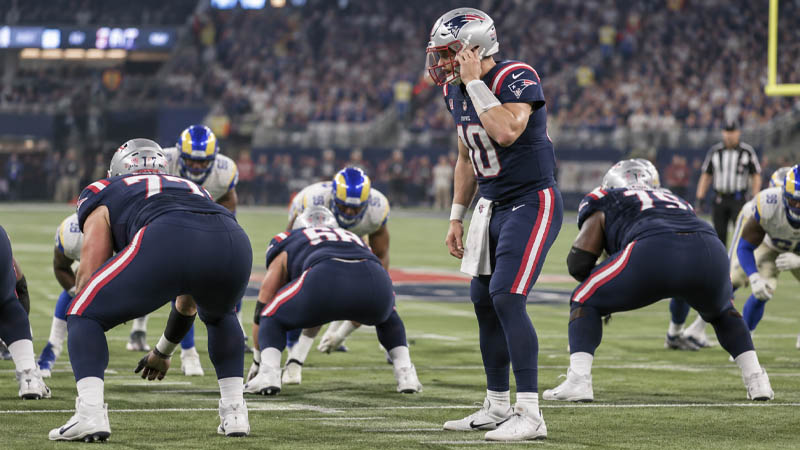
As the players line up, the quarterback might see a defensive alignment that completely neutralizes the planned play. Conversely, a defensive captain might spot an offensive shift that leaves a gap in their coverage.
When the radio system is automatically disabled in the final 15 seconds of the play clock, players must take communication entirely into their own hands. This is where physical hand signals and manual adjustments become vital.
Adjusting Protections and Coverages
At the line of scrimmage, quarterbacks and coordinators utilize highly specific hand gestures to communicate with their teammates.
- Changing Protections: If a quarterback detects an impending blitz from the left side, they will use physical hand signals—such as tapping their helmet, waving a hand across their chest, or pointing to a specific defender—to instruct the offensive line to shift their blocking focus and protect that side of the field.
- Altering Receiver Routes: Quarterbacks will frequently look out at their wide receivers and give subtle hand gestures, such as a quick tug of their jersey, a swipe of their thigh, or a hand wave, to change the receiver’s route based on how close the defender is standing.
- Defensive Shifts: On defense, coordinators on the sideline or linebackers on the field will use rapid hand signals to tell the defensive line to shift their positions, drop into a different zone coverage, or change who they are responsible for covering.
These physical adjustments require immense mental focus. Every player on the field must not only memorize their playbook, but also memorize dozens of hand signals that can completely change their assignment at the very last second.
Tactical Security: The Art of Information Protection
Because on-field communication is so critical to success, opposing teams are constantly searching for ways to intercept or decipher these messages.
In a multi-billion dollar industry, tactical espionage is a constant threat. This has forced teams to implement strict security protocols to keep their strategies confidential.
Why Coaches Cover Their Mouths
One of the most common sights on a professional football sideline is a head coach or offensive coordinator holding a large plastic play-call sheet directly in front of their face while speaking.
Coaches cover their mouths to prevent opponents, television cameras, or high-powered sideline microphones from seeing or overhearing their play calls.
- Preventing Lip-Reading: Many teams employ or consult with professional lip-readers to watch opposing coaches on the sideline. If a lip-reader can decipher what the coach is saying into their headset, they can relay that information to the defensive players, giving them an enormous advantage.
- Blocking Sideline Microphones: Modern television broadcasts utilize highly sensitive directional microphones to capture the authentic sounds of the game. By placing a physical barrier—such as a play-sheet or a gloved hand—directly in front of their mouth, a coach ensures that their voice does not carry across the sideline or get picked up by nearby broadcast equipment.
- Defending Against Technological Interception: While the radio frequencies themselves are heavily encrypted by league technicians, physical visibility remains a vulnerability that coaches must manage manually on every single play.
Conclusion
The sophisticated world of professional football communication is a masterclass in managing constraints.
While the introduction of helmet radios has streamlined how play calls are delivered from the coaching staff to the field, the strict 15-second cutoff and one-way limitations ensure that the human element of the sport remains paramount.
Ultimately, football remains a game of rapid human connection. Whether through a high-tech audio receiver, a physical huddle, an array of colorful sideline posters, or a last-second hand gesture at the line of scrimmage, the teams that communicate the cleanest under immense pressure are almost always the teams that walk off the field victorious.