In the high-stakes environment of professional football, few tactical decisions ignite as much debate among fans, analysts, and coaching staffs as the prevent defense.
It is a strategy defined by its own controversy, a conservative approach used by teams protecting a lead in the closing stages of a game.
While its name implies security, its application often leads to the very disaster it seeks to avoid. As the legendary coach John Madden famously observed, the only thing a prevent defense truly “prevents” is a victory for the team utilizing it.
To understand why this strategy remains a staple of the sport despite its reputation, one must analyze the delicate balance between time, distance, and risk management.
The Tactical Framework: Trading Space for Time
The fundamental philosophy of the prevent defense is a calculated gamble. A winning team, typically ahead by more than a single score late in the fourth quarter, chooses to concede short-yardage gains in exchange for deep-field protection.
The objective is to keep every offensive player in front of the defensive unit, thereby eliminating the possibility of a quick, game-changing touchdown.
1. The Deep Zone Secondary
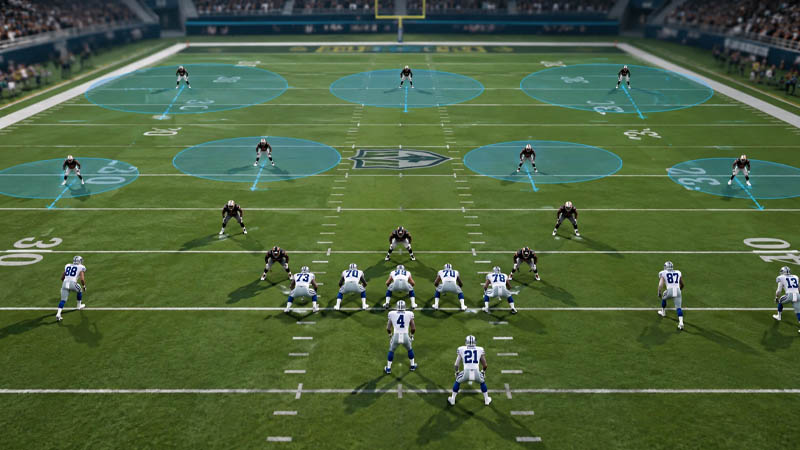
The most visible characteristic of this scheme is the positioning of the secondary. Defensive backs and safeties often line up between 10 and 25 yards off the line of scrimmage.
This “off coverage” ensures that no receiver can get behind the last line of defense. By saturating the deep portions of the field, the defense forces the quarterback to look for shorter, less efficient routes.
2. The Diminished Pass Rush
In a standard defensive set, a team might rush four or five players to pressure the quarterback. In a prevent look, the strategy often shifts to a minimal pass rush, sometimes involving only two or three linemen.
The remaining seven or eight players drop into deep zone coverage. This creates a “wall” in the secondary, making it statistically difficult to complete a long pass through such a crowded field.
3. Boundary Containment and Clock Management
Beyond just stopping the deep ball, a primary goal of the prevent defense is to keep the ball in bounds. By prioritizing the sidelines (the boundaries), defenders force receivers toward the middle of the field.
In the final minutes of a game, a tackle in the field of play keeps the game clock running, which is often more valuable to a leading team than the yards conceded.
The Anatomy of Failure: Why the Strategy Collapses
If the goal is to protect a lead, why does the prevent defense so often result in a “blown” game? The answer lies in the psychological and physical shifts that occur when a defense stops being aggressive.
The “Dink and Doink” Efficiency
By providing a massive cushion to wide receivers, the defense essentially spots the offense “free” yardage. Elite quarterbacks, such as Tom Brady, built legendary careers by exploiting these gaps.
If a quarterback stays calm, they can “chip away” at the defense in 5-to-15-yard chunks. While the defense thinks they are winning by making the offense work down the field, a disciplined offense can move 70 yards in just a few plays if the defenders are too cautious.
The Rhythm Factor
One of the most dangerous side effects of the prevent defense is that it allows the opposing quarterback to find a rhythm. When a defense stops pressuring the pocket and starts playing off the receivers, the quarterback no longer feels the urgency or the threat of a sack.
This comfort allows them to complete easy, high-percentage throws, building confidence that carries them all the way to the end zone.
The Physical Toll on the Front Seven
An overlooked aspect of dropping eight men into coverage is the impact on the defensive line. When only three players are rushing against five offensive linemen, the “front seven” (the linemen and linebackers) can become gassed.
They are forced to work harder to generate pressure with fewer bodies, and because the offense is often moving at a “hurry-up” pace, the defense has no time to substitute players or catch their breath.
When to Hold and When to Fold: Strategic Application
Despite the criticism, the prevent defense is not a failed strategy in every scenario. Its effectiveness is entirely dependent on the context of the game clock and timeouts.
The Ideal Scenario: Low Clock, No Timeouts
The prevent defense is most valuable on the very last play of a half or game. If an offense must travel 80 yards in 30 seconds or less with no timeouts remaining, the prevent defense is statistically the correct choice.
In this situation, the offense does not have enough time to “dink and doink” their way down the field. They are forced to throw deep, which plays directly into the strength of the prevent’s deep-zone saturation.
The Strategic Error: Using It Too Early
The most common mistake coaches make is switching to a prevent look with too much time left on the clock. For example, if a team has over two minutes and all their timeouts, playing prevent is widely considered a tactical blunder.
This was evidenced in a recent matchup where the Rams gained 71 yards in just seven plays against a Panthers defense that shifted to prevent too early.
Critics argue that a team should continue playing the aggressive style that earned them the lead in the first place rather than handing the momentum back to the opponent.
Extreme Down-and-Distance
Beyond end-of-game scenarios, coaches may use a version of this strategy on 3rd-and-very-long (e.g., 3rd and 28).
The logic remains the same: the defense will allow a 15-yard completion because it still results in a fourth down and a punt, effectively ending the drive.
Professional Analysis: The Psychology of the Prevent
From a strategic standpoint, the prevent defense is a manifestation of risk aversion. Coaches are often more afraid of losing a game on one spectacular, deep touchdown than they are of losing it slowly through a series of short completions.
However, this “playing not to lose” mentality can be contagious. When a defense stops attacking, the entire team’s energy can shift from proactive to reactive. This shift often baits the opposing quarterback into taking “chunk” plays.
If the quarterback remains poised, they can exploit the cushion; if they panic and try to get all the yards back in one play, the deep-field coverage can result in a game-ending interception.
Conclusion: A Tool of Necessity, Not Choice
The prevent defense remains one of the most misunderstood and maligned strategies in football.
When executed perfectly in the final seconds of a game, it is an invisible success—a series of inconsequential short passes that expire the clock. When it fails, it does so spectacularly, allowing a trailing team to march down the field with ease.
For coaches, the lesson is clear: the prevent defense is a situational tool, not a blanket solution for a lead. Using it requires a precise understanding of the opponent’s strengths and the remaining time.
As long as there is a scoreboard and a clock, the debate over this conservative gamble will continue to define the closing minutes of every Sunday afternoon.