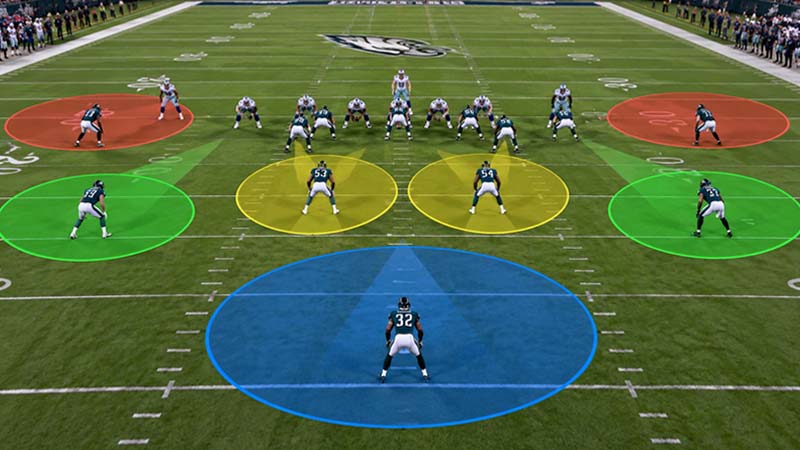
In the high-stakes landscape of modern football, defense is no longer merely a series of individual physical confrontations. It has evolved into a sophisticated game of spatial geometry and collective intelligence.
At the heart of this evolution lies zone coverage, a defensive philosophy that prioritizes the protection of specific territory over the tracking of individual offensive players.
This approach demands a paradigm shift in how defensive backs (DBs) and linebackers view the field, moving from a “man-on-man” mentality to a cohesive, unit-wide strategy of area denial.
Understanding the nuances of zone coverage is essential for any player, coach, or strategist aiming to neutralize high-octane passing attacks.
It is a system built on the premise that while an elite athlete might eventually win a one-on-one matchup, a well-executed collective unit can effectively erase entire sections of the field.
The Fundamental Mechanics of Area Defense
The primary distinction of zone coverage is its focus on field division. Unlike man-to-man schemes, where a defender’s movement is dictated by the route of a specific receiver, zone defenders are assigned “sections” or “buckets” of the field.
Upon the snap, these defenders drop into their designated territory, keeping their eyes focused on the backfield to read the intentions of the quarterback.
This structural framework is generally divided into two main layers:
- Underneath Zones: These are the shorter areas of the field closest to the line of scrimmage, typically categorized as the flats, curls, and hooks. Linebackers and cornerbacks often occupy these spaces to disrupt quick-hitting passes and force the offense to work for every yard.
- Deep Zones: These areas are designed to prevent the catastrophic “big play.” The deep field is often split into halves, thirds, or quarters, depending on the specific coverage shell being utilized.
By dividing the field into these manageable sections, a defense can effectively counter offenses that rely on pick routes and “rub” concepts, which are specifically designed to create natural “rubs” that leave man-to-man defenders trailing behind.
The Four Pillars of Elite Zone Execution
Success in a zone system is not a product of luck; it is a result of mastering four critical technical pillars: Awareness, Communication, Positioning, and Discipline.
1. Strategic Awareness and Anticipation
A great zone defender possesses a form of spatial peripheral vision. They must know exactly where their zone boundaries begin and end to ensure there are no “vacant windows” for the quarterback to exploit.
This awareness extends beyond their own territory; elite players recognize the offensive alignment pre-snap to predict where threats are likely to originate.
By anticipating how route combinations—such as a “smash” or “flood” concept—will develop, a defender can begin their transition before the ball is even thrown.
2. The Art of Seamless Communication
In zone coverage, the defense must function like a single organism. Because receivers are constantly moving between different areas of the field, defenders must master the “pass off” system.
For instance, if a receiver runs a deep crossing route, the outside cornerback must alert the safety or linebacker in the adjacent zone as the player enters their territory.
This prevents “blown coverages” where two defenders follow one player while another offensive threat is left entirely unaccounted for.
3. Precision Positioning and Leverage
Positioning in a zone is a delicate balancing act. A defender must maintain enough depth to ensure they aren’t beaten over the top while remaining close enough to “break” on short or intermediate throws.
Leverage is the tool used to manipulate the receiver’s path. In outside zones, defenders often use the sideline as an extra defender, forcing the receiver into a narrow corridor where the ball is harder to complete.
Conversely, in the middle of the field, defenders maintain inside leverage to protect the “seams”—the vertical gaps between the deep and underneath defenders.
Throughout this, the defender’s vision must remain on the quarterback, allowing them to react to the ball’s trajectory the moment it leaves the hand.
4. The Discipline of the Unit
Perhaps the most difficult aspect of zone defense is trusting the system. It is tempting for a defender to “chase” a receiver who is running out of their zone, but doing so creates a void that the offense can exploit with a secondary route. Discipline involves:
- Reading the Quarterback’s Eyes: Anticipating the throw based on the QB’s body language and throwing arm without biting on pump fakes.
- Holding Ground: Staying patient and not abandoning a zone early, even when the offense attempts to lure defenders out of position.
- Teammate Trust: Having the confidence that the player in the next zone will handle the receiver you just passed off.
Analyzing the Standard Coverage Shells
To implement zone defense effectively, coaches utilize various “shells” that prioritize different areas of the field. Each has its own strategic advantages and inherent vulnerabilities.
Cover 2: The Two-Deep Safety Shell
In a Cover 2 structure, the deep field is split equally between two safeties, while five defenders (usually two cornerbacks and three linebackers) handle the underneath areas.
- Primary Strength: It is exceptionally strong against deep passes to the sidelines and quick “flats” passes, as the cornerbacks are typically “hard” on the edge.
- Strategic Vulnerability: The intermediate middle of the field and the “honey hole” (the space along the sideline between the cornerback and the safety) can be exploited by savvy quarterbacks.
Cover 3: The Deep Thirds Shell
Cover 3 is one of the most common zones at all levels of football. It features three deep defenders (usually two corners and a free safety) dividing the deep field into thirds, with four defenders underneath.
- Primary Strength: It provides a balanced defense that limits “home run” plays while offering strong support against the running game.
- Strategic Vulnerability: Because there are only four underneath defenders, the seams and the flats can become stressed if the offense uses four horizontal receivers.
Cover 4 (Quarters): The Deep Quarters Shell
In Cover 4, the secondary splits the deep field into four vertical quarters.
- Primary Strength: This is the premier “anti-deep ball” coverage. It is designed to keep everything in front of the defense and is highly effective against vertical-passing offenses.
- Strategic Vulnerability: The focus on deep protection often leaves the defense susceptible to short, underneath routes and quick check-downs that can move the chains incrementally.
Cover 6: The Hybrid Approach
Cover 6 is a sophisticated split-field coverage that combines the strengths of multiple systems. Typically, one side of the defense plays Cover 4 (Quarters) while the other side plays Cover 2 (Halves).
- Strategic Advantage: It allows the defense to adjust to the “strong” or “weak” side of an offensive formation, providing maximum flexibility.
- Strategic Challenge: It requires ultra-precise communication and can leave seams open if players lack the discipline to stay within their specific half-field rules.
Technical Excellence: Tips to Dominate in the Zone
Mastering the theory is only the beginning. True excellence in zone coverage comes from the technical execution of individual movements and habits.
- Advanced Film Study: Elite defenders don’t just watch the ball; they study the tendencies of opposing coordinators. They identify which route combinations an offense prefers against specific zone looks and recognize pre-snap tells in offensive formations.
- Optimized Footwork: Reaction time in a zone is dictated by footwork. Defenders must master the smooth transition between a backpedal (to gain depth), a lateral shuffle (to maintain leverage), and the “plant and drive” (to break on the ball).
- Reading the Quarterback’s Drop: A defender can often predict the depth of a route based on the quarterback’s drop-back. A quick three-step drop usually indicates a short pass, while a five- or seven-step drop signals a deeper developing concept.
- Disruptive Physicality: Just because you are playing zone does not mean you have to be passive. Using press techniques at the line of scrimmage can disrupt a receiver’s timing, making it harder for them to reach their designated spot in your zone at the correct moment.
- Leveraging Help: Always know where your “help” is located. If you have a safety over the top, you can play more aggressively on underneath routes. If you are the deep defender, you must stay “top-down” on every threat.
The Power of the Cohesive Unit
Zone coverage is more than a set of rules; it is an art form that requires a rare blend of individual skill and unselfish teamwork.
For a defensive back, mastering these principles is about more than just personal stats; it is about becoming an indispensable asset who can shut down entire passing lanes and frustrate the most efficient offensive schemes.
By prioritizing awareness, perfecting communication, and maintaining ironclad discipline, a defense can transform the field into a series of impenetrable barriers.
Whether you are executing a classic Cover 2 or a complex hybrid scheme, the goal remains the same: defend your space, trust your teammates, and force the offense to earn every inch.