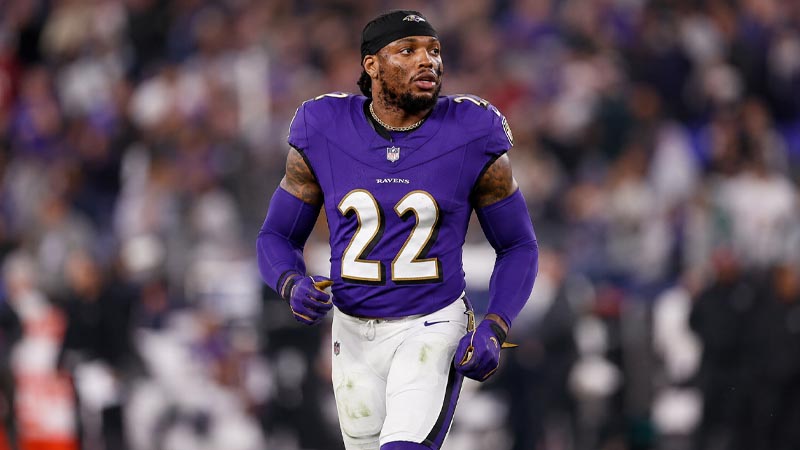
Modern fantasy football is defined by running back scarcity. NFL teams increasingly rely on running back committees, making true three-down bell-cows increasingly rare.
Most backs no longer receive 250-plus carries or consistent workloads, creating a major challenge for fantasy managers seeking dependable production. Derrick Henry stands apart as a powerful exception to this trend.
As a premier fantasy RB1, Henry remains one of the most intriguing and debated players in drafts. Typically selected as a top-10 running back in the late second round, his price creates an important decision:
Is Henry a locked-in elite RB1 who provides a major competitive edge, or does his profile carry enough risk to make him an expensive RB2?
1. The Core Profile: Derrick Henry’s Rushing Baseline
To understand Henry’s value, we must first look at the sheer physical volume that defines his fantasy profile. Fantasy production in the running back tier is driven primarily by opportunity.
While efficiency metrics like yards per carry (YPC) and yards created after contact are important, raw volume remains the strongest predictor of fantasy success.
Henry’s profile is anchored by a workload that is almost entirely unmatched in the modern era. He consistently defies traditional aging curves and workload expectations by delivering elite rushing volume and heavy touchdown production.
The Volume Metric
In recent campaigns, Henry has racked up over 300 carries and amassed more than 1,500 rushing yards. To put this in perspective, very few running backs in today’s NFL even cross the 250-carry threshold, let alone approach 300.
This massive volume ensures a weekly rushing floor that shields fantasy managers from the extreme volatility experienced by players in split backfields.
The Touchdown Floor
Volume alone does not create a high-end RB1; it must be paired with high-value opportunities near the goal line.
Henry excels in this area, boasting an incredibly consistent touchdown floor. He has scored 12 or more rushing touchdowns in four consecutive years, highlighted by a spectacular 16-touchdown performance in his recent campaign.
This consistent ability to find the end zone makes him an elite red-zone weapon. For fantasy purposes, a consistent baseline of double-digit touchdowns provides a massive weekly scoring cushion, frequently turning mediocre rushing days into high-scoring fantasy performances.
Rushing Workload and Scoring Profile
The following table outlines the key statistical pillars that support Henry’s high-end fantasy value:
| Performance Metric | Statistical Baseline | Fantasy Implications |
|---|---|---|
| Annual Carry Volume | Over 300 carries | Ensures an elite weekly rushing floor and high-volume consistency. |
| Rushing Yardage Baseline | 1,500+ rushing yards | Maximizes yardage-based scoring and big-play potential. |
| Touchdown Floor | 12+ rushing touchdowns for 4 consecutive years | Guarantees elite red-zone usage and a high weekly ceiling. |
| Recent Touchdown Peak | 16 rushing touchdowns | Demonstrates elite scoring upside in a high-powered offense. |
| Typical Draft Position | Top-10 RB / Late Second Round | Represents a significant draft capital investment with high-end RB1 expectations. |
2. The Scheme Fit: Baltimore Ravens Offensive Architecture
A running back’s fantasy success depends heavily on the offensive environment around him. Derrick Henry’s situation with the Baltimore Ravens is an ideal schematic fit, pairing his physical running style with one of the NFL’s strongest rushing identities.
- A Run-First Identity: Baltimore consistently emphasizes the ground game, helping maintain Henry’s rushing volume even in neutral or challenging game scripts.
- Defensive Stress and Spatial Efficiency: The Ravens’ mobile quarterback forces defenses to respect the option game on every snap. This creates hesitation from linebackers and opens larger running lanes for Henry to accelerate through.
- High-Value Red Zone Opportunities: Baltimore’s efficient offense creates frequent red-zone chances, giving Henry a strong touchdown floor. As the team’s primary goal-line back, he benefits from valuable scoring opportunities throughout the season.
3. Scoring Format Demarcation: Standard vs. PPR Tiers
One of the most critical aspects of fantasy football valuation is understanding how different league scoring rules affect player rankings.
A player who is a consensus top-5 pick in standard scoring formats might drop significantly in full-point Point-Per-Reception (PPR) leagues. This format dependency is a major factor in the debate surrounding Henry’s ultimate fantasy ceiling.
On public discussion boards such as Reddit, opinions remain mixed regarding Henry’s absolute ceiling. This division is not due to a disagreement over his talent, but rather a direct reflection of how different scoring structures handle his specific skill set.
       [ Derrick Henry's Format Split ]
                      |
        +-------------+-------------+
        |                           |
        ▼                           ▼
[ Standard & Half-PPR ]       [ Full-PPR Leagues ]
  - Elite Value             - Capped Ceiling
  - Massive Rushing Floor       - Low Pass-Catching Volume
  - Goal-Line Dominance         - Touchdown-Dependent Upside
The Standard and Half-PPR Advantage
Henry is universally more valuable in standard and half-PPR formats. In these leagues, the scoring is heavily weighted toward raw rushing yardage and touchdown production—the two areas where Henry is most dominant.
Because receptions are either worth zero points (standard) or half a point (half-PPR), his lack of involvement in the passing game does not put him at a competitive disadvantage against pass-catching specialists.
In these formats, his elite rushing volume and heavy touchdown floor comfortably cement his status as a high-end, top-tier RB1.
The Full-PPR Limitation
In full-PPR leagues, every single reception is worth a full point, which is mathematically equivalent to 10 rushing or receiving yards.
This scoring structure significantly boosts the value of running backs who run routes and catch passes out of the backfield. Because Henry lacks heavy receiving work, his overall upside is slightly capped in full-PPR leagues.
- The Math of PPR Scarcity: A running back who catches 5 passes for 30 yards earns 8.0 fantasy points in full PPR without recording a single carry. To match that production on the ground, Henry must rush for 80 yards.
- The Ceiling Cap: While Henry’s immense rushing volume and touchdown efficiency can offset this deficit, it leaves him with a narrower path to finishing as the overall RB1 in full PPR. If he does not score a touchdown in a given week, his lack of pass-catching volume makes it difficult to salvage a high-end fantasy performance in PPR formats.
4. Overcoming the Age Curve: Historical Anomaly or Risk Factor?
In fantasy football, the running back age curve is taken seriously. Historical trends show declining efficiency and durability around ages 26–28, especially for backs with heavy career workloads.
Selecting an older, high-touch running back in the late second round carries meaningful risk. Henry, however, remains a historic exception:
- Elite Physical Profile: At 6’3″ and nearly 250 pounds, Henry’s rare size helps him absorb contact and handle heavy workloads better than smaller backs.
- Consistent Efficiency: Henry has maintained impressive explosiveness and efficiency despite his age, while his physical style can wear down defenses throughout games.
- Conditioning and Longevity: His exceptional training, recovery, and strength work have helped preserve his speed and power.
Henry still carries age-related risk, but his unique profile and Baltimore’s run-heavy system give him an excellent chance to defy the curve.
5. Strategic Draft Application: Roster Construction Methods
Drafting Henry in the late second round requires a clear understanding of roster construction and draft strategy.
Because he offers a highly unique statistical profile—maximum rushing volume and touchdown upside paired with minimal pass-catching utility—your draft picks around him must be carefully coordinated to build a balanced, high-ceiling roster.
The Hero RB Strategy
The Hero RB approach involves drafting one elite, high-volume running back in the first two rounds, and then focusing entirely on wide receivers, quarterbacks, and tight ends for the next several rounds.
Henry is a perfect fit for this strategy. By securing his elite rushing volume and guaranteed touchdown floor early, you lock in a highly reliable anchor at your RB1 spot.
This allows you to spend your middle-round draft capital accumulating high-target wide receivers, comfortable in the knowledge that your running back position has a rock-solid foundation.
The Double-Down (Robust RB) Strategy
If you select a running back in the first round and pair them with Henry in the late second round, you are building a highly formidable, run-heavy roster. This strategy aims to create a weekly point advantage at the running back position that your opponents cannot match.
When executing this strategy, it is crucial to target high-volume pass-catchers in the subsequent rounds to balance out Henry’s lack of receiving work.
Pairing Henry with high-target, high-reception wide receivers in rounds three through six creates a balanced roster that features both elite rushing floors and high pass-catching ceilings.
Draft Day Decision Framework
The following checklist can help guide your decision on whether to draft Henry based on your draft position and league settings:
- League Scoring Check: Is your league standard, half-PPR, or full-PPR? If it is standard or half-PPR, elevate Henry to a high-priority target.
- Draft Position Check: Are you drafting in the late second round? If so, Henry represents excellent value as a top-10 running back with realistic top-5 upside.
- Roster Balance Check: Have you already drafted a high-volume pass-catcher? Pairing an elite wide receiver from the first round with Henry in the second round creates an incredibly balanced foundation for your team.
- Risk Tolerance Check: Are you comfortable investing early draft capital in an older running back who relies on historic volume and touchdown production to deliver elite value?
The Final Verdict
Derrick Henry remains one of the most bankable forces in fantasy football. While the fantasy community on platforms like Reddit will continue to debate his ceiling due to his lack of pass-catching work, his baseline rushing statistics speak for themselves.
[ Fantasy Format ] ---> [ Standard / Half-PPR ] ---> [ Elite Fantasy RB1 ]
[ Fantasy Format ] ---> [ Full-PPR Leagues ]   ---> [ High-End RB1/RB2 ]
By delivering over 300 carries, 1,500+ rushing yards, and a consistent floor of 12+ touchdowns, Henry provides a level of high-end fantasy production that is incredibly rare in today’s NFL
. When placed in Baltimore’s dominant, run-heavy offense, he is fully equipped to continue defying the age curve.
If you are drafting in standard or half-PPR formats, Henry is a locked-in, high-end RB1 who should be drafted with absolute confidence in the late second round.
In full-PPR formats, he should be viewed as an elite RB1/RB2 borderline option whose lower pass-catching floor can be easily managed through smart, target-heavy roster construction.