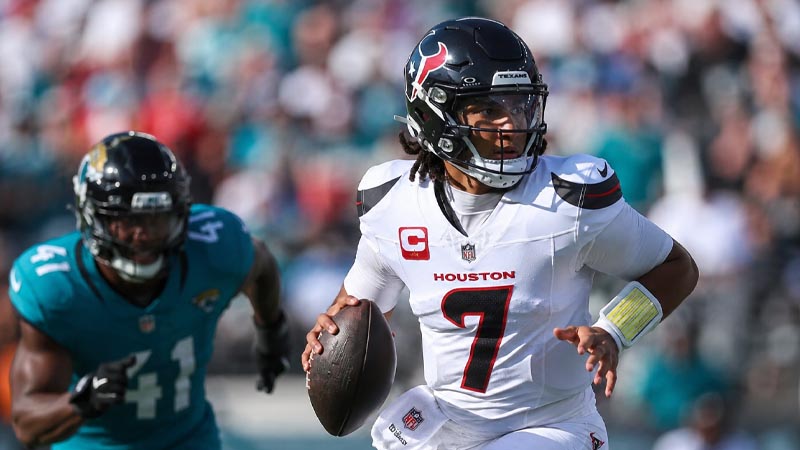
The competitive paradigm of the AFC South has undergone a major shift. Professional analysts and oddsmakers have adjusted their projections, establishing the Houston Texans as the clear favorites to capture the division title over the Jacksonville Jaguars.
This transition is not merely a reaction to recent momentum; rather, it is the result of a rigorous evaluation of defensive metrics, roster construction, and statistical regression modeling.
To understand why the divisional crown is projected to change hands, one must analyze the structural core of both franchises. Houston has constructed a sustainable, high-floor competitive model built around trench dominance and roster continuity.
Conversely, Jacksonville’s previous success was built on highly volatile metrics that are historically difficult to replicate.
1. The Foundation of Dominance: Houston’s Elite Defensive Front
In modern professional football, the most reliable path to consistent success is the ability to disrupt the opposing passing game without relying on blitz schemes.
Houston has achieved this ideal defensive structure by assembling one of the most formidable defensive fronts in the league, anchoring a unit that finished No. 1 in total yards allowed.
The Compounding Effect of Hunter and Anderson
The cornerstone of Houston’s defensive ascendancy is the edge-rushing partnership of veteran Danielle Hunter and Will Anderson Jr.. This pairing generated massive pressure numbers, presenting a multi-faceted threat that opposing offensive coordinators find nearly impossible to neutralize.
When a defensive coordinator has access to two elite edge rushers, it fundamentally alters the protection rules for the opposing offensive line:
- The Double-Team Dilemma: Offensive lines cannot easily slide protection or deploy tight end chips to both sides of the formation simultaneously. If an offense commits extra protection assets to neutralize Hunter’s explosive speed off the edge, they leave Anderson in a one-on-one matchup on the opposite side.
- Collapsing the Pocket: True pass-rushing dominance is not just about individual sack totals; it is about the speed and consistency of pocket compression. The combined pressure from Hunter and Anderson forces quarterbacks to step forward into a collapsing interior pocket or flee into lateral pursuit, leading to rushed throws, intentional grounding penalties, and drive-killing sacks.
- Run Defense Efficiency: Elite edge-setting from Hunter and Anderson prevents outside zone schemes from stretching the defense, forcing ball-carriers back into the teeth of an interior defense that excels at limiting yardage.
Why “Total Yards Allowed” is a Stable Metric
Finishing the season as the league leader in total yards allowed is a strong indicator of a defense’s sustainable quality. While turnover metrics can fluctuate wildly from week to week, yardage prevention is a highly stable metric that reflects a team’s down-to-down consistency.
A defense that consistently limits yards forces opponents into long-yardage situations, limits their play-calling options, and maximizes field position for their own offense.
By suppressing opponent yardage, Houston has built a defensive floor that guarantees competitiveness in every divisional matchup.
2. The Fallacy of Takeaway Sustainability: Jacksonville’s Imminent Regression
The primary catalyst for Jacksonville’s slide in divisional projections is the statistical reality of defensive regression. In their previous division-winning campaign, Jacksonville’s defense relied heavily on generating 31 takeaways to mask structural defensive weaknesses. Analytical models strongly indicate that this defensive strategy is unsustainable.
The Mathematics of Turnover Volatility
Turnovers are among the most volatile and non-persistent statistics in professional sports. A deep dive into historical defensive data reveals that high takeaway numbers are rarely a repeatable skill from one season to the next. Several factors contribute to this volatility:
- The Randomness of Fumble Recoveries: While forcing a fumble requires skill and physical execution, recovering a loose football is largely a matter of random bounces and player positioning. Teams that recover an unusually high percentage of fumbles in one season almost always regress toward a 50% recovery rate the following year.
- Opponent Errors vs. Defensive Skill: A significant portion of interceptions are the result of unforced quarterback errors, tipped passes, or receiver route mistakes rather than superior defensive coverage. A schedule featuring backup quarterbacks or highly mistake-prone offenses can artificially inflate a team’s takeaway numbers over a 17-game season.
- The Regression to the Mean: When a team relies on an outlier statistic like 31 takeaways to win close games, professional projection models automatically apply a heavy regression penalty for the upcoming season. If Jacksonville’s takeaway total normalizes to the league average, their defense must find other ways to stop opponents—a difficult task given their underlying yardage metrics.
When a defense can no longer rely on turnovers to end opponent drives, they are forced to play long, grinding defensive series.
If that defense struggles to stop the run or limit passing yardage, their time of possession skyrockets, leading to defensive fatigue and late-game collapses. This is the precise regression trap that analysts project for Jacksonville.
3. Trench Warfare: Where Houston’s Strength Meets Jacksonville’s Weakness
Football remains a game won and lost in the trenches. The divisional shift in the AFC South is highly evident when contrasting Houston’s defensive line with Jacksonville’s offensive line concerns.
+------------------------------------+       +------------------------------------+
|       HOUSTON DEFENSIVE FRONT      |       |     JACKSONVILLE OFFENSIVE LINE    |
|                                    |       |                                    |
|  • Danielle Hunter (Elite Edge)    |  vs.  |  • Structural protection concerns  |
|  • Will Anderson Jr. (Elite Edge)  |       |  • Vulnerable to lateral speed     |
|  • No. 1 defense in yards allowed  |       |  • High risk of pocket collapse    |
+------------------------------------+       +------------------------------------+
The Tactical Mismatch
An offensive line with protection weaknesses is a catastrophic vulnerability when facing a pass rush of Houston’s caliber. If a tackle cannot handle speed rushes without help, the offense must keep a running back or tight end in block protection, effectively removing a pass-catcher from the pattern.
This simplifies the coverage rules for Houston’s secondary, allowing them to play tighter, more aggressive coverage.
Furthermore, offensive line instability disrupts the timing of the entire offense. Quarterbacks facing constant interior and exterior pressure are forced to shorten their dropbacks and abandon downfield passing concepts.
The playbook becomes restricted to quick-game passes, screens, and low-yield running plays, making the offense predictable and easy to defend.
4. Strategic Continuity: The Texans’ Roster Construction Advantage
While Jacksonville faces questions about defensive sustainability and offensive line integrity, Houston has fortified its roster through a combination of continuity and targeted, high-impact veteran acquisitions.
Preserving the Championship Core
Roster turnover is one of the most common disrupters of team chemistry and execution. Houston’s decision to return the core of their dominant roster gives them an immediate competitive advantage over teams undergoing major personnel transitions.
Roster stability allows players to operate within a familiar system, reducing communication errors on the field and allowing the coaching staff to install advanced tactical adjustments rather than retreading foundational concepts.
Strategic Offseason Additions
To complement their returning core, Houston targeted specific weaknesses with veteran additions designed to bring physical, mistake-free execution to key positions:
- David Montgomery (Running Back): The addition of Montgomery gives Houston a physical, downhill running style that is vital for controlling the game clock and finishing games in the fourth quarter. Montgomery’s ability to gain tough yards after contact keeps the offense ahead of the chains, reduces third-down distance, and shields the defense from excessive snap counts. A productive running game also forces opposing linebackers to play closer to the line of scrimmage, opening up passing lanes.
- Wyatt Teller (Interior Offensive Line): To build a championship-caliber team, a front office must match its defensive line dominance with interior offensive line strength. The acquisition of Teller provides Houston with an elite run-blocker and a highly anchored pass-protector. Teller’s presence stabilizes the interior pocket, preventing interior defensive tackles from pushing the pocket back into the quarterback’s face and creating clean lanes for Montgomery.
By pairing a returning, high-chemistry core with proven veterans like Montgomery and Teller, Houston has designed a balanced roster capable of winning in multiple ways.
They do not need to rely on high-margin plays or unsustainable turnover luck; they can control the line of scrimmage, run the ball effectively, and rely on their premier defense to close out games.
Conclusion
The division projection shift in the AFC South is a clear illustration of how modern professional football franchises are evaluated.
Championship windows are built on stable foundations—trench dominance, yardage prevention, roster continuity, and physical offensive execution.
Houston has systematically checked every box:
- They have built a premier defensive front featuring Danielle Hunter and Will Anderson Jr. that limits opponents’ yardage better than any other unit in the league.
- They have maintained high roster stability while adding impact veterans like David Montgomery and Wyatt Teller to establish a physical identity on offense.
- They are positioned to benefit from the statistical regression of their primary rival, Jacksonville, whose previous division title was built on unsustainable defensive metrics.
As the season approaches, the Texans stand as a testament to intelligent team-building and tactical clarity.
By focusing on repeatable strengths and addressing positional vulnerabilities, Houston has earned its place as the rightful favorite to claim the AFC South crown.