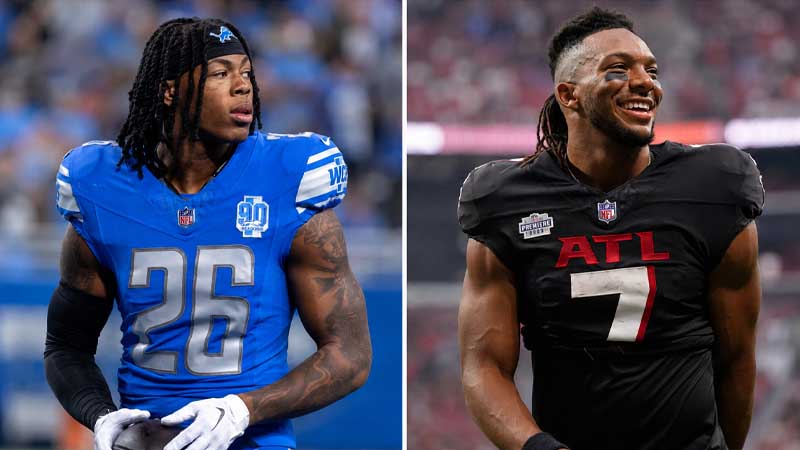
The landscape of fantasy football in 2026 has reached a definitive peak where traditional “workhorse” volume is being challenged by elite, high-efficiency production within superior scoring environments.
For managers holding the first overall pick, the choice between Jahmyr Gibbs and Bijan Robinson represents more than just a player preference; it is a strategic decision between a high-ceiling offensive engine and a high-floor volume anchor.
While both athletes are entering their physical primes and are projected for “Legendary RB” seasons, the shift in backfield dynamics—specifically the departure of key veteran competitors—has altered the math of the 1.01.
This analysis deconstructs the efficiency metrics, vacated workloads, and environmental factors to determine who truly deserves the top spot in 2026 drafts.
The Infrastructure of Success: Detroit vs. Atlanta
The primary differentiator in the 2026 debate is the offensive environment. In professional football, individual talent is often capped by the quality of the surrounding cast and the coaching philosophy.
| Factor | Jahmyr Gibbs (Detroit Lions) | Bijan Robinson (Atlanta Falcons) |
|---|---|---|
| Offensive Line | Elite, top-tier unit providing high-scoring floors | Developing unit with moderate consistency |
| Coaching Intent | Designated “Bell Cow” by Dan Campbell | Lead weapon in a reception-heavy system |
| Quarterback Impact | High-powered offense with frequent red-zone trips | High checkdown rate favoring short-area targets |
| Primary Backup | David Montgomery (Vacated) | Tyler Allgeier (Vacated) |
| Weekly Upside | Highest single-week boom potential in the league | Consistent, high-volume production |
The Lions’ offense is widely considered a superior unit that will generate more touchdown opportunities. For Gibbs, this environment acts as a force multiplier, allowing his natural explosiveness to translate into massive fantasy totals.
The Strategic Case for Jahmyr Gibbs
The argument for selecting Gibbs at the 1.01 is rooted in his “other-worldly” efficiency and the sudden lack of backfield competition.
Traditionally, Gibbs shared the workload in a way that capped his short-yardage scoring, but 2026 marks a new era for the Detroit backfield.
1. Elite Efficiency Metrics
- Yards Per Carry: Gibbs has consistently maintained an average of over 5 yards per carry, placing him in an elite tier of historical producers.
- Receiving Dominance: Last season, he recorded 77 catches, ensuring he remains productive even when the team is playing from behind.
- Explosive Play Rate: He accounts for a significant portion of the league’s 20+ yard runs, providing “nuclear” upside that can win a weekly matchup single-handedly.
2. The Impact of Vacated Touches
With David Montgomery no longer in Detroit, the “touchdown vulture” effect has been eliminated. This opens the door for Gibbs to absorb high-value red-zone and goal-line carries that were previously unavailable to him.
While there are hypothetical concerns about a “Diet Montgomery” replacement, the internal expectation is that Gibbs will see his highest workload to date.
3. High Scoring Ceiling
Data from the previous season highlights that while other backs may be steadier, Gibbs possesses the highest single-week ceiling in the game.
He has demonstrated the ability to record multiple games with 35+ fantasy points, a feat that is difficult for volume-dependent backs in lower-scoring offenses to replicate.
The Argument for Bijan Robinson: The Ultimate Safety Net
Managers who lean toward Robinson often cite his durability and the sheer volume of his role. He is frequently viewed as the “safer” pick because his production is less reliant on long touchdowns and more on consistent usage.
Why Robinson Remains a Tier-1 Asset:
- Reception Floor: Playing with a quarterback who has the highest checkdown rate in the league guarantees Robinson a massive share of high-probability targets.
- Physical Durability: Robinson is often perceived as sturdier and more capable of handling a “workhorse” load of 20+ touches per game over a full season without injury regression.
- Career Scrimmage Totals: Through his first three years, Robinson has logged slightly higher total yardage than Gibbs, showcasing a reliable path to RB1 status.
- Red-Zone Consolidation: With Tyler Allgeier gone, Robinson is expected to handle nearly all of the Falcons’ goal-line work, addressing one of the few historical weaknesses in his fantasy profile.
Analytical Comparison: Upside vs. Stability
The 2026 draft dilemma can be summarized as a choice between the explosiveness of Gibbs and the stability of Robinson.
- Gibbs’ Advantage: He plays in a much better offense that will score more touchdowns. His ability to “boom” more regularly with an increased workload makes him the preferred choice for those chasing a league-winning trophy.
- Robinson’s Advantage: He is likely to be steadier week-to-week, especially in PPR formats where target volume is king. He is the player you take if you want to ensure your first-round pick provides a guaranteed floor regardless of game script.
Some analysts have compared this to the 2019 debate between Alvin Kamara and Christian McCaffrey. In that instance, one player benefited from a clearly superior offense and higher touchdown probability, while the other relied on a massive, all-encompassing workload.
Gibbs currently occupies the high-efficiency, high-scoring role in Detroit that mimics the elite Saints offenses of the past.
Mitigating Risks at the 1.01
Regardless of the choice, certain risks inherent to the first overall pick must be managed.
- Injury and Depth: History suggests that a consensus 1.01 is often at higher risk of being sidelined or limited by a poor surrounding cast. To counter this, managers should prioritize drafting significant running back depth in the early-to-middle rounds.
- The “1.02 Luxury”: Some managers prefer the second overall pick, as it removes the burden of choice and allows the draft to dictate which elite back they receive.
- Positional Scarcity: While some suggest elite wide receivers like Ja’Marr Chase, the 2026 landscape remains dominated by the value of “Legendary RBs” who can contribute in both the run and pass games.
Final Verdict
While Bijan Robinson is an exceptional talent who will succeed despite his circumstances, Jahmyr Gibbs is the superior selection for the 1.01 in 2026.
The combination of an elite offensive line, a vacated goal-line role, and the highest single-week upside in the league creates a profile that is impossible to ignore.
Gibbs is not just a player; he is a strategic asset positioned in the league’s most favorable environment for a running back.
For managers aiming to maximize their championship probability, the explosive potential of the Detroit backfield is the definitive tiebreaker.