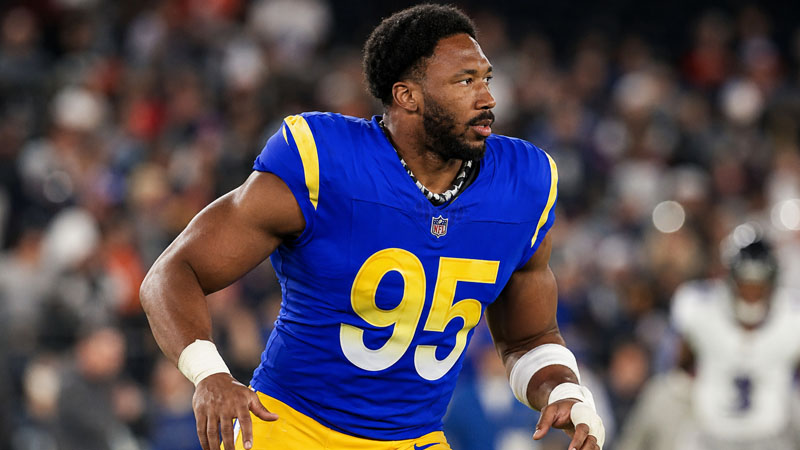
The June 1, 2026, trade sending reigning Defensive Player of the Year Myles Garrett from the Cleveland Browns to the Los Angeles Rams represents a watershed moment in professional sports management.
This transaction is not merely a player swap; it is a high-stakes masterclass in divergent franchise philosophies.
While the Rams are doubling down on an “all-in” championship window centered around their home stadium, the Browns are executing a calculated strategic retooling designed to maximize financial flexibility and long-term draft capital.
The Macro-Economic Impact of the Blockbuster Deal
In the landscape of the modern NFL, few assets are as valuable as a generational pass rusher. Myles Garrett, who holds the league’s record for sacks in a single season, is widely regarded as the premier defensive talent in football.
His acquisition by the Rams immediately shifted the betting markets, with Super Bowl LXI odds for Los Angeles moving from 8-1 to 13-2.
For the Browns, the decision to move a franchise icon was rooted in a rigorous evaluation of “capital allocation.”
By trading Garrett, Cleveland secured a younger, high-performing asset in Jared Verse while simultaneously clearing significant future liabilities from their balance sheet.
Transaction Summary: Asset Exchange
| Asset Category | Los Angeles Rams Receive | Cleveland Browns Receive |
|---|---|---|
| Primary Player | Myles Garrett (DE) | Jared Verse (LB/Edge) |
| Draft Capital | N/A | 2027 1st Round Pick |
| Future Capital | N/A | 2028 2nd Round Pick |
| Contingent Assets | N/A | 2029 3rd Round Pick |
| Contractual Status | $160M Extension (Through 2030) | Rookie-scale contract (Eligible for 2027 ext.) |
The Rams’ Strategic Mandate: Championship or Bust
The Los Angeles Rams front office has long abandoned the traditional “build through the draft” model in favor of acquiring “blue-chip” veteran talent.
This “persistent pursuit” of Garrett was not an isolated incident but a continuation of a strategy that proved successful in 2021 with the acquisition of Matthew Stafford.
Why the Rams Pushed for Garrett
- The SoFi Factor: Super Bowl LXI is scheduled to be played at SoFi Stadium in February 2027. The organization is highly motivated to repeat their 2021 feat of winning a championship on their home turf.
- Asset Concentration: The Rams were facing a looming financial crisis with three young defensive stars—Jared Verse, Byron Young, and Kobie Turner—all nearing massive contract extensions. Management determined it was more efficient to consolidate that spending into one “crown jewel” like Garrett.
- Defensive Dominance: Adding Garrett to a defense that already features newly acquired stars like Trent McDuffie and Jaylen Watson creates a historically formidable unit.
Garrett’s statistical profile justifies the Rams’ aggressive posture. Since entering the league in 2017, he has been the gold standard for defensive production:
- Ranked 1st in total sacks (125.5).
- Ranked 1st in total pressures (413).
- Ranked 1st in tackles for loss (149).
The Browns’ Strategic Retooling: Financial and Draft Optimization
From Cleveland’s perspective, the trade is an exercise in “asset diversification.” General Manager Andrew Berry noted that while the trade was “unexpected,” it provides the franchise with the resources needed to bolster their “budding core”.
The Jared Verse “Homecoming”
The centerpiece of the return for Cleveland is 25-year-old Jared Verse. Verse, a Dayton, Ohio native, represents the ideal “bridge” asset—a player with proven Pro Bowl production who remains on a cost-controlled contract.
- Production: Verse recorded 12 sacks and 22 tackles for loss over his first two seasons in Los Angeles.
- Cost-Efficiency: The Browns estimate the trade will save them approximately $30 million in cash over the short term.
- Future Planning: Verse will not be eligible for a significant contract extension until after the 2026 season, giving Cleveland time to evaluate their internal cap structure.
The 2027 Draft War Chest
The draft picks acquired in this deal have positioned the Browns as one of the most flexible teams in the league for the upcoming cycles.
- The Browns now possess 11 total picks for the 2027 NFL Draft.
- This includes two first-round selections, giving them the “liquidity” to move up the draft board for a franchise quarterback or another elite prospect.
Contractual Engineering: The Loophole That Made It Possible
The mechanics of this trade were facilitated by a specific contractual modification made in March 2026. Originally, Garrett’s option bonuses were due on the 15th day of the league year.
By pushing those deadlines back to seven days before the regular season, the Browns significantly lowered the “dead money” hurdle, making a trade feasible for both parties.
Furthermore, Garrett possessed a rare defensive no-trade clause. His willingness to waive this clause was the final green light required to finalize the deal.
while Garrett was in regular contact with the front office during the offseason, he had no face-to-face interactions with new head coach Todd Monken, suggesting a level of professional detachment that may have contributed to the trade’s timing.
Historical Context: The Rare Departure of a DPOY
It is exceptionally rare for a player to be traded immediately following a Defensive Player of the Year campaign. In the history of the NFL, this has only occurred twice before:
- Dana Stubblefield (1998): Left the 49ers for Washington after winning the 1997 DPOY.
- Deion Sanders (1995): Left the 49ers for the Cowboys after winning the 1994 DPOY.
Myles Garrett now joins this exclusive list, marking the first time in the modern era that such a move was facilitated via trade rather than free agency.
This follows a broader league trend of aggressive front-office behavior, mirroring recent blockbuster trades involving Micah Parsons (Cowboys to Packers) and Sauce Gardner (Jets to Colts).
Critical Analysis: Competitive Differentiation
The Rams have chosen a path of immediate high-impact results. By sacrificing their 2027-2029 draft capital, they have eliminated the uncertainty of the draft in exchange for the certainty of Garrett’s elite production. This strategy assumes that the “window” for Matthew Stafford and the current veteran core is limited.
The Browns have chosen a path of sustainable competitiveness. By trading their most visible star, they have mitigated the risk of an aging player on a massive contract while replenishing their roster with youth and optionality.
Summary of Strategic Outlook
The Garrett-to-Rams trade is a defining moment for the 2026 NFL season. It pits the “win now” urgency of Los Angeles against the “long-term value” approach of Cleveland.
- For Los Angeles: The focus is on February 2027 at SoFi Stadium. Anything less than a Super Bowl appearance will likely be viewed as a failure given the assets surrendered.
- For Cleveland: The focus is on the 2027 Draft and financial sustainability. The success of this trade will be measured by how they utilize their 11 draft picks and whether Jared Verse can maintain his double-digit sack production.
This transaction serves as a reminder that in the modern NFL, no player—regardless of their accolades or “untouchable” status—is immune to the shift in franchise strategy if the right package of assets is presented.