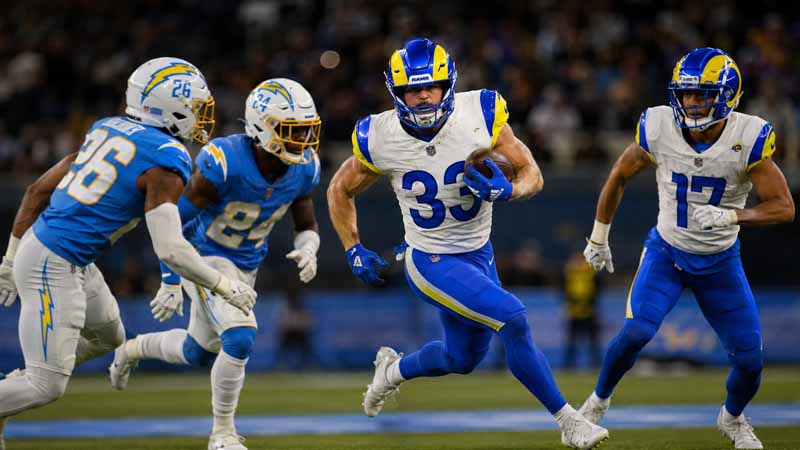
In the modern landscape of professional football, the months of May and June are defined by a singular, intoxicating atmosphere: optimism.
Rosters are healthy, salary caps are managed, and every franchise is a contender in the minds of its fan base.
However, seasoned observers of the sport understand that the team presented on paper during the spring rarely resembles the unit fighting for a playoff spot in the deep winter.
Joe Buck, one of the most prominent voices in sports broadcasting, has recently emerged as a significant skeptic regarding the overwhelming hype surrounding the Los Angeles Rams.
His concerns do not stem from a lack of talent or a poor coaching scheme; rather, they are rooted in the fundamental physics of the game—health, durability, and the inevitable attrition of a long season.
While the broader national conversation has centered on the Rams’ explosive offensive potential and their high-tier leadership, Buck’s analysis serves as a necessary grounded perspective.
He posits that the “hype” often fails to account for the fragility of a veteran-heavy roster. Specifically, the Rams’ reliance on an aging quarterback with a documented history of physical setbacks creates a precarious foundation that could crumble well before the postseason begins.
The Dichotomy of the NFL Season: May Projections vs. November Realities
The NFL season is an endurance test masquerading as a sprint. One of the primary reasons Joe Buck remains hesitant to join the chorus of Rams supporters is the stark difference between preseason potential and mid-season sustainability.
Buck has emphasized that a team’s outlook in the early months of the year is often a mirage because it assumes a level of physical consistency that the league rarely provides.
The “grueling NFL season,” as Buck describes it, is a 17-game gauntlet that tests the limits of the human body. For a team like the Rams, who have historically prioritized top-tier veteran talent over deep, young developmental benches, the margin for error is razor-thin.
Buck notes that while a team may look like a powerhouse in May, the cumulative effect of injuries by November can fundamentally alter their competitive trajectory.
This “November Reality” is the lens through which we must view the current Rams roster. If the “injuries pile up,” the sophisticated schemes and elite play-calling that define the team’s identity become irrelevant.
The Quarterback Conundrum: Age, Impact, and Availability
At the heart of Buck’s skepticism is the Rams’ “MVP-caliber leader.” In the contemporary NFL, the quarterback is more than just a player; they are the central nervous system of the entire organization.
When that leader is performing at an elite level, the team can mask deficiencies in other areas. However, Buck points out a critical vulnerability: the Rams’ quarterback is no longer a young athlete in his physical prime.
Age in the NFL brings with it a shifting set of variables. While veteran quarterbacks often possess superior cognitive processing and defensive recognition, their bodies lose the ability to recover rapidly from the “weekly car crashes” that occur on the field.
Buck’s focus on the quarterback being an “older player” is not a slight against his skill, but an acknowledgment of biological reality.
In a league where pass-rushers are becoming faster and more specialized, an older signal-caller faces an increased risk of sustaining injuries that linger rather than heal.
The Chronic Back Condition: A Structural Red Flag
Perhaps the most specific and damning evidence Buck provides for his cautionary stance is the mention of a “chronic back condition” affecting the Rams’ star quarterback.
In professional athletics, few injuries are as debilitating or as unpredictable as those involving the back. Unlike a clean break of a bone or a standard ligament tear—which often have clear recovery timelines—chronic back issues are managed rather than cured.
A quarterback’s power and accuracy are derived from the kinetic chain that starts in the feet and moves through the hips and spine.
Any instability or pain in the back disrupts this entire process. Buck’s pointed mention of this history suggests that the “hype” is ignoring a structural red flag that could reappear at any moment.
If the Rams’ leader cannot maintain his physical integrity, the team’s entire offensive architecture—which relies on precise timing and deep-field shots—is compromised.
The term “chronic” implies a recurring threat. For Joe Buck, the fact that this condition is already a known factor makes the preseason optimism feel premature.
He argues that it is difficult to maintain health over a full season when a player is already starting from a position of physical compromise.
The Ripple Effect: How Injury Attrition Dismantles Elite Schemes
The Rams’ success has traditionally been built on a “stars and scrubs” roster construction philosophy. By investing heavily in a few elite, high-salary veterans, the team accepts a lack of depth in their middle-tier roster.
Buck’s analysis highlights why this strategy is so high-risk. If the “MVP-caliber leader” or other key veterans are sidelined, the drop-off in talent is often more severe for the Rams than it would be for a more balanced roster.
When injuries begin to “pile up” by November, the tactical advantage of having a brilliant coaching staff is neutralized. A coach can design the perfect play, but if the personnel on the field lack the experience or physical traits to execute it, the team stagnates.
Buck’s skepticism is a reminder that in the NFL, availability is the ultimate currency. Without it, the most talented roster in the league is nothing more than a “what-if” story in the history books.
Assessing the Durability of the Rams’ Strategy
To understand why Buck is questioning the narrative, one must look at the historical context of veteran-led teams in the 17-game era.
The transition from 16 to 17 games may seem minor, but for an older player with a back condition, that extra week of physical toll is significant. It represents one more opportunity for a season-ending hit and one less week of recovery before the playoffs.
Buck’s stance is a critique of the “May mindset,” where analysts focus on the ceiling of a team rather than its floor. The Rams have a very high ceiling—they can compete with any team in the league when healthy.
However, Buck is looking at the floor. If the back issues resurface, how low does that floor go?
For a broadcaster who has seen countless “super-teams” fall apart due to the attrition of the late autumn, the Rams represent a classic case of high-risk, high-reward management that may be leaning too far into the “risk” category.
Critical Questions for the Los Angeles Rams
Given Joe Buck’s insights, several critical questions must be addressed by those who are bullish on the Rams’ prospects this year:
- The Contingency Plan: Does the organization have a viable backup strategy if their veteran leader’s back condition flares up in Week 8?
- Roster Balancing: Has the team done enough to bolster their depth to prevent the “pile up” of injuries that Buck warns about?
- The Age Curve: At what point does the quarterback’s experience no longer outweigh his physical decline?
Buck’s commentary suggests that the answers to these questions are not as positive as the current hype would suggest. He is essentially asking the football world to wait and see if the team can actually survive the “grueling NFL season” before crowning them as a lock for deep postseason success.
Conclusion: Why Caution is the Correct Analytical Framework
In conclusion, Joe Buck’s skepticism regarding the Los Angeles Rams is a masterclass in realistic sports analysis. While it is easy to get swept up in the highlight reels and the potential of an MVP-caliber quarterback, the underlying physical realities cannot be ignored.
The combination of an “older player,” a “chronic back condition,” and the inevitable “pile up” of injuries over a 17-game schedule creates a high probability of disappointment.
Buck is not suggesting the Rams lack talent; he is suggesting they lack the durability required to turn that talent into a championship.
As the season progresses from the optimism of May to the cold reality of November, his warnings will likely serve as the benchmark for evaluating the Rams’ success.
In the NFL, the most important stat isn’t passing yards or touchdowns—it’s the number of games your star players are able to finish.
Until the Rams prove they can keep their leader upright and healthy, Joe Buck’s caution remains the most logical perspective on the team’s true outlook.