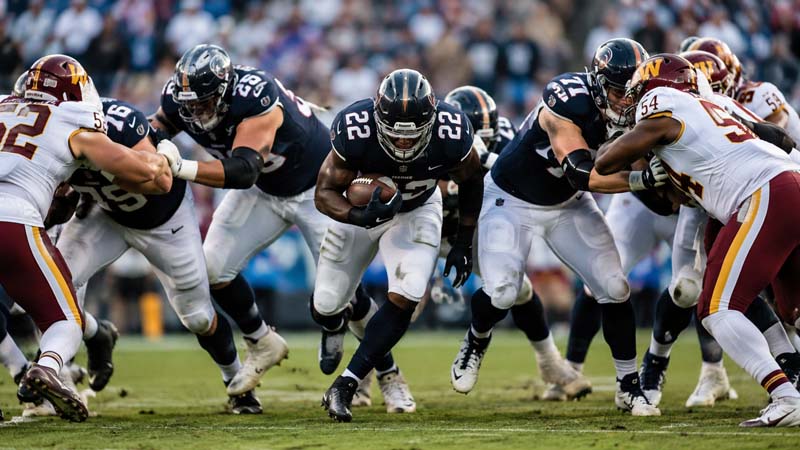
The Power run, frequently identified in technical circles as “Power” or “Power O,” stands as a cornerstone gap-scheme running play in modern football.
At its core, the play is designed to create a high-leverage downhill running lane by utilizing down blocks on the play side and a pulling guard from the backside.
This creates a physical confrontation that favors the offense through superior numbers and favorable blocking angles.
The Strategic Foundation: Beyond Brute Force
A common misunderstanding of the Power scheme is the belief that its success rests solely on the physical strength of the offensive line. While physicality is a prerequisite, the true engine of the play is geometry and numerical superiority.
The Advantage of Geometry
The scheme relies on down blocks, where offensive linemen block defenders aligned inside of them.
This technique provides a significant mechanical advantage, as it allows the blocker to use the defender’s own momentum and positioning against them, essentially building a firm wall that defines the interior edge of the running lane.
By attacking at an angle rather than head-on, the offense can move defenders more effectively than in a standard man-to-man drive block.
The Numbers Advantage
The defining characteristic of Power is the backside guard pulling across the formation.
By moving a lineman from the non-play side to the point of attack, the offense creates a temporary surplus of blockers at the specific gap being targeted.
This tactical relocation forces the defense to account for an extra heavy blocker appearing in a space they may not have the personnel to fill.
The Anatomy of the Power Block: A Positional Breakdown
Executing a successful Power O requires synchronized performance across the entire offensive unit. Each player operates under specific “gap rules” that dictate their path based on the defensive front presented.
1. The Playside Tackle (PST) and Guard (PSG)
The primary objective for these two players is to collapse the interior of the defensive front. In a standard Kick-Out Power, the PST will down-block the first defensive lineman to their backside, often working with the PSG to create a double team.
This double team is designed to drive the defender vertically before one of the blockers climbs to the second level to engage a backside linebacker.
2. The Center (C)
The center’s role is critical for the integrity of the play’s timing. The center must execute a backside gap block, preventing any interior defensive penetration that could disrupt the pulling guard’s path. If a defender “splits the wall” in the middle, the entire timing of the pull and the runner’s path is compromised.
3. The Backside Guard (BSG): The “Puller”
The BSG is the most recognizable element of the Power scheme. Immediately following the snap, the guard pulls, clearing the adjacent linemen and staying tight to the line of scrimmage.
A tight path is essential; a wide or looping pull takes too long and allows the defense to close the gap before the runner arrives.
Depending on the specific call, the guard will either kick out the edge defender or wrap through the hole to lead-block an oncoming linebacker.
4. The Backside Tackle (BST)
While often overlooked, the BST must “pinch down” and hinge to seal the backside edge. This maneuver prevents backside defenders from chasing the play from behind and ensures that the “backdoor” of the play remains closed.
Functional Variations: Adaptations for Modern Personnel
The versatility of the Power scheme allows it to be run from various personnel groupings, from heavy “I-formations” to modern shotgun and spread sets.
Kick-Out Power vs. Lock Power
These two variations change the responsibility of the edge block:
- Kick-Out Power: The backside guard pulls with the intention of kicking the end man on the line of scrimmage (EMLOS) up and out, widening the hole. In this scenario, the playside tackle remains focused on down-blocking the interior.
- Lock Power: The playside tackle “locks” onto the EMLOS, sealing them to the outside. This allows the pulling backside guard to wrap through the gap and focus exclusively on the second-level linebacker. This is often used when the offense has a dominant tackle who can handle the edge defender solo.
Personnel Groupings
- Heavy Personnel: Teams like the Buccaneers or Rams frequently utilize H-backs, tight ends, or extra linemen to create favorable alignments. These additional players can deliver the kick-out block, freeing the pulling guard to act as a lead blocker through the hole.
- One-Back/Shotgun Power: Modern offenses often run Power from the shotgun, sometimes involving jet motion or RPOs (Run-Pass Options) to freeze defenders. Even in these “light” looks, the core mechanics—down blocks, an edge kick-out, and a pulling guard—remain consistent.
The Ball Carrier’s Directive: Vision and Discipline
The running back is not a passive participant; the success of the Power run depends on the back’s ability to read the leverage of the blocks in front of them.
The Read Progression
The runner generally follows a specific path, often described as taking a track off the inside hip of the pulling guard. The back must be patient, allowing the pulling guard to clear the line and engage the target.
- Read 1: The Kick-Out Block. If the edge defender is successfully widened, the back stays inside.
- Read 2: The Pulling Guard. The back follows the guard into the seam, using the guard as a shield against second-level pursuit.
If the defense “squeezes” the hole or “spills” the block, a disciplined runner can adjust their path to bounce the play wider or bend it behind the down blocks.
Strategic Differentiation: Power vs. Alternative Schemes
It is vital to distinguish Power from other run concepts that may look similar but operate on different mechanical principles.
| Scheme | Key Identifier | Distinguishing Mechanic |
|---|---|---|
| Power | One puller (Backside Guard) | Focuses on a specific gap with a kick-out and a wrap. |
| Counter | Often two pullers (Guard/Tackle) | Incorporates backfield misdirection to pull defenders out of position. |
| Duo | No pullers | Relies on vertical double teams and linebacker reads; looks like Power without the pull. |
| Inside Zone | Lateral movement | Linemen step in unison, sorting defenders through zone rules rather than assigned gaps. |
| Trap | Interior puller | Intentionally invites a defender upfield before blocking them from the side. |
Defensive Counter-Measures: Neutralizing the Power
Defensive coordinators have developed specific techniques to disrupt the geometric advantages of the Power scheme.
The “Spill” Technique
The most effective way to defend Power is to “spill” the ball carrier. The edge defender will squeeze the kick-out block, intentionally collapsing the hole and forcing the running back to bounce the play toward the sideline, where waiting linebackers and safeties can pursue more easily.
Interior Disruption and Stunts
Defensive linemen can defeat the scheme by penetrating the down blocks. If an interior defender gets across the face of a playside lineman, they can tackle the runner in the backfield or disrupt the pulling guard’s path.
Defensive stunts—where linemen switch gaps post-snap—are particularly effective because they change the defensive alignment after the offensive linemen have already committed to their blocking angles.
Legal Integrity: Ensuring Compliance at the Point of Attack
The physical nature of Power O requires strict adherence to technical legality to avoid drive-stalling penalties.
Legal Blocking Frame
Pulling guards and lead blockers must engage defenders within the frame of the body. Grabbing the outside of a defender’s shoulders or jersey is a common holding infraction during the “wrap” phase of the play.
Prohibition of Chop Blocks
The 2026 NFL rulebook explicitly prohibits chop blocks, which occur when one offensive player engages a defender high while another blocks them low.
In the Power scheme, where double teams and down blocks are frequent, linemen must be disciplined to ensure they are not creating illegal high-low combinations that could result in penalties or injuries.
Conclusion: The Enduring Legacy of the Power O
The Power run remains a staple of competitive football because it is a numbers-and-leverage concept disguised as a simple strength play.
By creating favorable angles through down blocks and a numerical advantage with the pulling guard, offenses can reliably move the ball against a variety of defensive fronts.
Whether executed from a heavy I-formation or a modern shotgun spread, the Power O provides a physical identity that forces the defense to defend every gap with discipline.
To identify this play during a broadcast, spectators should ignore the ball for the first second and watch the backside guard; if that guard crosses the formation, the offense is likely attempting to exert its will through the Power scheme.