In the modern landscape of competitive football, the battle for field leverage is increasingly fought on the edges. Among the most effective tools for manipulating defensive alignment and testing lateral discipline is the Jet Sweep.
While often viewed as a simple speed play, the Jet Sweep is a sophisticated tactical concept that combines high-speed pre-snap motion with complex blocking schemes to create an immediate advantage for the offense.
This analysis explores the mechanical foundation, philosophical underpinnings, and multi-level execution of the Jet Sweep, providing a comprehensive look at why it remains a staple from high school stadiums to NFL Sundays.
Understanding the Foundation: What is a Jet Sweep?
At its core, a Jet Sweep is an outside running play where a wide receiver or slot receiver crosses the formation at full speed via pre-snap motion.
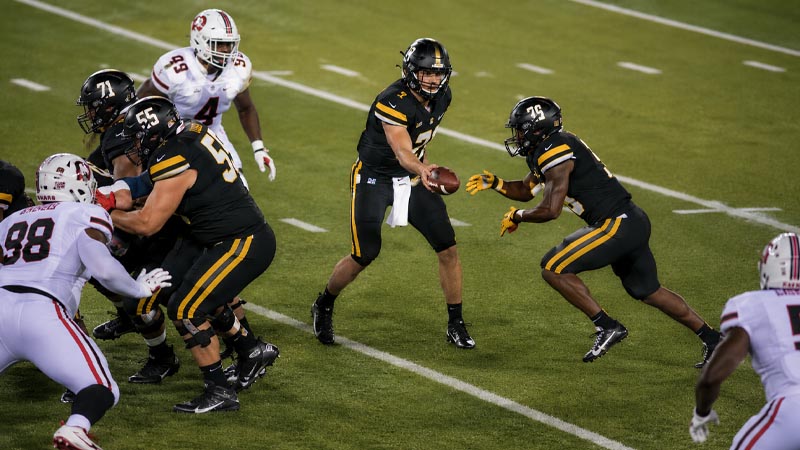
Unlike a traditional handoff to a stationary running back, the receiver receives a quick handoff from the quarterback right at the snap while already maintaining maximum horizontal velocity.
The primary objective is to beat the defense to the perimeter. By the time the ball is snapped, the runner is already at top speed, forcing every defender on the field to react instantly to a threat moving toward the sideline.
This immediate horizontal pressure creates what coaches refer to as “horizontal stress,” stretching the defense and exposing players who are out of position or slow to communicate.
The Core Features of Execution
- High-Speed Motion: The runner begins their horizontal sprint before the snap, ensuring they are not starting from a standstill when they take the ball.
- Timing and Precision: The quarterback must time the snap perfectly to place the ball into the runner’s hands in stride.
- Perimeter Sealing: The success of the play relies on perimeter blockers—typically other receivers and tight ends—sealing off cornerbacks and safeties to create an open lane down the sideline.
The Philosophy of Horizontal Stress and Misdirection
The Jet Sweep is more than a rushing attempt; it is a philosophical tool used to dictate defensive behavior. It is frequently described as the “ultimate horizontal stressor” for an offense.
Stretching the Defense
By threatening the edge with a player moving at full speed, the offense forces the defense to “flow hard” toward the motion.
If defenders fail to respect this pre-snap movement or take even a single false step, the Jet Sweep can “get the corner,” leading to massive gains.
Window Dressing and Decoy Value
At the elite levels of the sport, such as the NFL and high-level college programs, the Jet Sweep is often used as “window dressing”.
Even when the ball is not handed to the receiver, the threat of the sweep forces linebackers and defensive backs to shift their alignment and focus.
- Eye Discipline: Teams like the San Francisco 49ers, Baltimore Ravens, and Los Angeles Rams utilize the motion to draw defensive eyes away from the actual intended play.
- Communication Breakdown: The high-speed movement forces the defense to communicate adjustments in real-time, often leading to coverage lapses or vacated gaps in the interior run game.
The Mechanics of the Play-Side Attack
The success of a Jet Sweep is determined by the synchronized actions of the ball carrier, the receivers, and the offensive line.
Each unit has specific landmarks and assignments that must be hit with precision.
The Ball Carrier’s Path
Once the receiver takes the handoff, they do not simply run in a straight line. The ball carrier is taught to “bubble”—a slight outward path—after receiving the ball. They aim for three specific landmarks in sequence:
- The Hash
- The Numbers
- The Sideline
If any of these landmarks are successfully “walled off” by a defender, the runner is coached to immediately cut upfield to salvage positive yardage rather than being forced out of bounds for a loss.
The Quarterback’s Responsibility
The timing of the handoff is the most critical element for the quarterback. Because the receiver is moving at maximum velocity, the window for the exchange is narrow.
The quarterback must ensure the receiver does not have to slow down to take the ball, as the entire advantage of the play is predicated on maintained speed.
Advanced Blocking Schemes: Perimeter and Interior
While the runner’s speed is the highlight, the blocking dictates the play’s ceiling. Teams generally employ two distinct philosophies for their receivers and specific assignments for the offensive line.
Wide Receiver Blocking Assignments
Receivers are the most critical blockers on the field for this concept; without them, the play cannot function. They typically use one of two techniques:
- The Crack Block: The receiver blocks down on the first defender inside of them that is outside the box (such as a linebacker or a safety). This “cracks” the edge of the defense, creating a natural alley for the runner.
- The Head-Up (Stalk) Block: The receiver engages the defender directly in front of them (usually a cornerback). The goal is to shade slightly to the outside of the defender to seal the edge and keep the runner clean as they round the corner.
The Role of the Running Back
The running back serves a dual purpose: they are either the primary lead blocker or the primary tool for misdirection.
- The Fake: To pull defenders away from the sweep, the running back will often fake an outside zone or stretch play in the opposite direction. They must sell this fake with the same intensity and track as a real run to manipulate the linebackers’ keys.
- The Lead Block: In “crack” schemes, the running back will lead the way and “kick out” the cornerback who is left unblocked on the outside. This creates a defined lane between the receiver’s inside block and the running back’s outside block.
Offensive Line: Stability vs. Misdirection
The offensive line’s role varies depending on the level of competition and the specific offensive system being run.
Mirroring Outside Zone
Particularly at the high school level, many teams keep their offensive line’s burden low by running the same blocking scheme as their outside zone. This allows the linemen to play fast without learning a new set of rules for a specialty play.
Higher-Level Variations
At the college and NFL levels, schemes become more tailored:
- Reaching the Edge: Linemen may be tasked with “reaching” the defensive end to the play-side.
- The Unblocked End: Some teams rely so heavily on speed and misdirection that they leave the play-side defensive end unblocked, trusting that the runner will outrace them to the corner before they can react.
Specific Lineman Roles:
- Play-side Tackle (PST): Must secure the edge and prevent any immediate penetration into the backfield.
- Play-side Guard (PSG): Prevents penetration and fights to reach the defender in their play-side gap or climbs to the linebacker.
- Center (C): Attacks the play-side shoulder of the interior defender to drive them away from the runner’s path.
- Backside Guard (BSG): Cuts off and “walls” defenders to prevent pursuit from behind.
- Backside Tackle (BST): Often leaves the backside end unblocked to navigate up to the second level and block a linebacker.
Level-Specific Application and Tactical Examples
The Jet Sweep adapts to the environment in which it is played, exploiting different defensive weaknesses at different levels of the game.
The High School Advantage
In high school football, the wider placement of the field hashes allows offenses to exploit the “wide side” of the field. Coaches use their best athletes to outrun defenders who may not have the lateral speed to close the gap created by the pre-snap head start.
The NFL and Collegiate Chess Match
In the professional ranks, the play is a weapon against man-to-man coverage. A defender assigned to the motioning receiver must navigate through heavy traffic and across the entire formation to stay with the play, which is often an impossible task against elite speed.
- The Green Bay Packers Example: The Packers have demonstrated elite perimeter blocking where receivers can “two-for-one” defenders by recognizing man coverage and moving their assigned man into the path of a safety.
- The Purdue Loop: Some collegiate schemes, like Purdue’s, involve the play-side tackle looping out to act as the lead blocker for the sweep. This puts a larger body on a smaller defensive back, creating a physical mismatch on the perimeter.
Challenging the Defense: Why the Jet Sweep Works?
The primary reason the Jet Sweep remains effective is its ability to exploit defensive eye discipline. When a player flashes across the formation at 20 miles per hour, every defender is forced to make a decision:
- Respect the Motion: Shift toward the sweep, potentially opening gaps for an inside run.
- Ignore the Motion: Stay in place and risk the receiver rounding the corner for a touchdown.
By pairing the sweep with “outside zone” fakes in the opposite direction, offenses create a “split-flow” action that pulls the defense in two directions at once. This conflict is what makes the Jet Sweep a foundational element of modern, high-efficiency offensive systems.
Conclusion: The Perimeter Powerhouse
The Jet Sweep is a testament to the importance of geometry and timing in football.
By utilizing pre-snap motion to create a speed advantage and employing strategic blocking to secure the edge, offenses can consistently stress even the most disciplined defenses.
Whether used as a primary scoring threat or as “window dressing” to set up other concepts, the Jet Sweep’s ability to force horizontal movement makes it an indispensable part of the modern playbook.