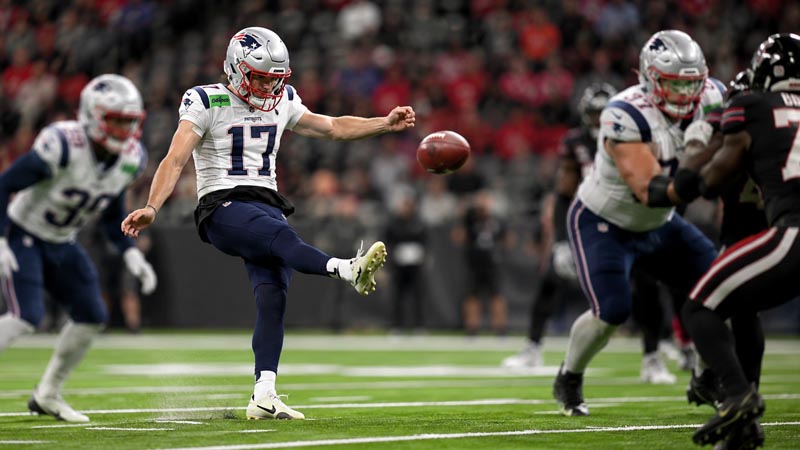
In the game of football, every yard represents a battle of leverage, territory, and probability.
While the high-octane passes of offenses and the bone-crushing tackles of defenses capture the majority of spectator attention, many games are quietly decided by the battle for field position.
At the very center of this strategic tug-of-war is a highly specialized position: the special teams player tasked with executing the fourth-down kick.
When an offensive drive stalls and a team is forced to surrender possession, this player steps onto the field to prevent the opponent from starting their drive with a short path to the end zone.
The main goal of this player is to flip field position. By catching a long snap and kicking the ball deep downfield, they systematically force the opposing team to start their next offensive drive deep within their own territory.
This transition of possession is not merely a defensive surrender; it is a calculated tactical maneuver designed to make the opponent’s journey as long and difficult as possible.
Every yard added to the opponent’s drive decreases their statistical likelihood of scoring, making this role one of the most critical defensive assets on the team.
The Mechanics of the Fourth-Down Kick: Alignment and Execution
To understand the complexity of this role, one must first examine the physical alignment and immediate pressure under which these players operate.
The sequence begins when the offense fails to secure a first down on its third attempt, necessitating a strategic decision to kick the ball on fourth down.
At this critical juncture, the kicker does not line up directly behind the offensive line. Instead, they must step back approximately 15 yards from the line of scrimmage. This deep alignment is critical for several tactical reasons:
- Creation of Space: The 15-yard cushion provides the necessary physical distance to protect against rushing defenders who are attempting to block the kick. Because the opposing team will often rush multiple players to disrupt the kick, this distance is the primary line of defense for the kicker.
- Trajectory Management: Stepping back allows the kicker to receive the ball and have the physical clearance required to launch the kick at an optimal upward angle. If they were too close to the line of scrimmage, the defensive line could easily leap and swat the ball down.
- Clean Handling: This distance gives the kicker a clear view of the field as they prepare to catch the long snap. They can monitor the rush, assess the wind, and prepare their footing.
Receiving a long snap from 15 yards away requires exceptional hand-eye coordination. The kicker must catch the ball cleanly, instantly transition it to their preferred kicking grip, and execute a precise drop and kick, all within a fraction of a second before the oncoming rush arrives.
The physical mechanics must be repeated with absolute consistency under intense physical threat, as any bobble or delay can result in a blocked kick, turning a potential field-flipping play into a catastrophic turnover deep in their own territory.
Maximizing Distance and Hang Time: The Physics of Territory
Once the snap is secured, the player must execute a kick that balances two competing physical variables: distance and hang time. These two elements must be maximized in tandem to ensure a successful play.
The Dual Goals of the Kick
- Maximizing Distance: The primary mechanism of flipping field position is kicking the ball as far downfield as possible. A long kick forces the receiving team to retreat, moving their starting point further away from the goal line.
- Maximizing Hang Time: Distance alone, however, is insufficient. If a ball is kicked far but with a flat, low trajectory, the opposing returner will have ample time and open space to catch the ball and advance it back upfield before any defenders can arrive. Therefore, the player must kick the ball exceptionally high into the air.
The Strategic Value of Hang Time
The duration of time the ball remains in the air—known as hang time—is the safety net of the kicking unit. A high trajectory serves a vital tactical purpose: it provides the kicking team’s coverage players with the necessary time to sprint downfield.
As the ball hangs in the air, coverage defenders cover the 40, 50, or 60 yards of distance separating them from the returner.
By the time the returner catches the high kick, the coverage players should ideally be in position to instantly tackle them.
This immediate tackle prevents any return yards, securing the maximum possible net distance for the kick and sealing the transition of field position.
A perfect kick is therefore a delicate balance of physical strength and launch angle, ensuring the ball travels deep while remaining airborne long enough to neutralize the opposing return specialist.
The Art of the Pin: Tactical Accuracy inside the 20-Yard Line
While raw power and distance are useful when kicking from deep within one’s own territory, punting transitions into an art of extreme precision when the team approaches midfield.
In these scenarios, kicking the ball as far as possible is counterproductive, as a ball kicked into the opponent’s end zone results in a touchback, bringing the ball out to the 20-yard line and negating much of the field-position advantage.
Instead, the player must focus on pinning the opponent. The objective shifts from maximum power to exceptional accuracy, aiming to trap the opposing offense near their own end zone, specifically inside their 20-yard line.
The Strategic Impact of the Under-20 Pin
- Playbook Limitation: When an offensive unit is trapped inside its own 20-yard line, their play-calling is severely restricted. The threat of a safety or a turnover close to their own goal line forces them to play conservatively. They are less likely to attempt risky, deep passes and will often rely on predictable running plays to gain breathing room.
- Defensive Advantage: Forcing the opponent to start deep in their own territory means they must gain at least 80 to 90 yards to score. This significantly increases the number of plays they must run, raising the mathematical probability that the defense can force a stop, a turnover, or another kick.
- Psychological Pressure: Operating on the edge of one’s own end zone places intense pressure on the opposing quarterback and offensive line, shifting the psychological momentum of the game in favor of the defensive unit.
Achieving this precision requires the kicker to carefully adjust the power, spin, and angle of their kick.
They must calculate how the ball will bounce upon hitting the turf, aiming to have it bounce out of bounds or be downed by a teammate before it crosses the goal line.
This requires a completely different physical technique than a deep distance kick, emphasizing touch and ball rotation over sheer force.
The Holder Role: The Unsung Partner of the Placekicker
Beyond the primary responsibility of executing fourth-down kicks, these athletes must possess a secondary skill set that is equally vital to the team’s scoring capability.
Frequently, they must act as the holder for the placekicker during field goal and extra point attempts.
The interaction between the long snapper, the holder, and the placekicker is one of the most finely tuned operations in professional sports.
When a team attempts a field goal or an extra point, the holder must perform a sequence of precise actions in under two seconds:
- Receive the Snap: Catch a high-velocity snap while kneeling approximately seven to eight yards behind the line of scrimmage.
- Position the Ball: Instantly place the ball vertically on the designated spot on the turf.
- Adjust the Laces: Spin the laces of the football so they face away from the placekicker, ensuring a clean and predictable contact point for the kick.
- Maintain Stability: Hold the ball perfectly still at the correct tilt angle while the placekicker strikes it.
Because of their daily practice with the long snapper, these players are uniquely suited for this role.
Their exceptional hand-eye coordination and familiarity with high-pressure snaps make them the ideal partners to ensure the kicking game operates with flawless precision.
A missed hold can cost a team critical points, meaning the punter’s role as a holder carries immense responsibility for the team’s overall scoring efficiency.
The Threat of the Fake: Forcing Defensive Hesitation
The modern game demands that every player on the field be an athletic threat, and special teams are no exception.
To prevent the opposing team from committing all of their players to an aggressive rush or an early retreat, the kicking unit must occasionally introduce the element of surprise.
This is executed through the fake punt. On these surprise plays, instead of performing the traditional kick, the player will suddenly run or pass the ball in an attempt to secure a first down.
Strategic Implications of the Fake
- Defensive Caution: Even if a team rarely executes a fake, the mere threat of a run or pass forces the opposing defense to remain disciplined. They cannot completely abandon their defensive assignments to rush the kicker or set up a return block, because doing so leaves them vulnerable to a surprise play.
- Momentum Shifts: A successfully executed fake on fourth down can completely re-energize an offense, keeping a drive alive and demoralizing an opponent who believed they were about to regain possession.
- Athletic Demands: This tactical option requires the player to be more than just a kicker; they must possess the athletic ability to throw an accurate pass or run the ball effectively under sudden pressure.
By threatening a fake, the special teams unit keeps the opponent guessing, forcing them to play “safe” defensive coverages that ultimately make the standard kick safer and more effective to execute.
Summary: The Strategic Value of the Kicking Game
Ultimately, the role of this special teams player is defined by strategic discipline, mechanical precision, and multi-functional utility.
From flipping the field with deep, high-trajectory kicks to pinning opponents inside their own 20-yard line, they dictate where the game is played.
When combined with their critical holding duties and the strategic threat of surprise runs or passes, these players prove to be indispensable components of a championship-caliber team.