In the modern era of gridiron football, passing offenses have reached unprecedented heights of sophistication and productivity.
Quarterbacks routinely throw for hundreds of yards per game, wide receivers display spectacular athleticism, and offensive playbooks are filled with complex route combinations designed to stress even the most disciplined defenses.
However, this offensive explosion is not unchecked. To maintain a fair and competitive balance between the offense and the defense, football governing bodies enforce strict rules regarding physical contact downfield.
While defensive pass interference (DPI) frequently makes headlines and draws the ire of fans, its offensive counterpart—Offensive Pass Interference (OPI)—is an equally critical and highly scrutinized infraction.
OPI is a rule that governs how offensive eligible receivers, such as wide receivers and tight ends, interact physically with defenders while a pass play is developing.
This guide provides a comprehensive, highly detailed analysis of the mechanics, spatial and temporal boundaries, and strategic implications of Offensive Pass Interference in football.
Defining Offensive Pass Interference (OPI)
To understand how football matches are officiated, one must first understand the fundamental definition of Offensive Pass Interference.
Under standard football regulations, OPI is a penalty called when an offensive player—most commonly a wide receiver or a tight end—uses illegal physical contact more than one yard downfield to significantly hinder a defender’s chance to catch or make a play on a forward pass.
The philosophy behind this rule is rooted in competitive fairness. In any passing play, the receiver has a natural advantage: they know the exact route they are running, the timing of their breaks, and the target area of the pass, whereas the defender must react purely to the receiver’s movements.
If receivers were permitted to physically shove, block, or hold defenders downfield before a catch, defensive play would become impossible.
The OPI rule acts as a necessary counterweight, establishing that once a play moves downfield, both players have an equal right to the football and must compete without illegal physical contact.
While wide receivers and tight ends are the most frequent recipients of this penalty due to their roles in downfield route running, any eligible offensive player can be flagged for OPI if they engage in prohibited physical contact that compromises a defender’s ability to defend a pass.
Spatial and Temporal Boundaries of the OPI Rule
The application of the OPI rule is not uniform across the entire field or throughout the duration of a play. Instead, officials rely on precise spatial and temporal markers to determine whether an action constitutes a penalty.
The Spatial Boundary: The One-Yard Zone
The physical restrictions governing offensive contact do not begin the instant a player crosses the line of scrimmage. Rather, the rules establish a specific geographic buffer zone near the line of scrimmage:
- The Boundary: Illegal contact restrictions for offensive players generally begin more than one yard beyond the line of scrimmage.
- The Exemption: Within this shallow one-yard zone immediately past the line of scrimmage, players are permitted to engage physically in ways that would be deemed illegal further downfield. This allows receivers to engage with defenders at the line of scrimmage during the initial release of their routes without fear of triggering a pass interference flag.
- The Threshold: Once an offensive player travels more than one yard past the line of scrimmage, the OPI rule becomes fully active, and any physical contact that significantly hinders a defender’s play on the ball is subject to a penalty.
The Temporal Boundary: Snap to Touch
One of the most vital distinctions between offensive and defensive pass interference lies in the timeline of their enforcement.
While many fans believe pass interference can only occur when the ball is in the air, this is only true for the defense. For the offense, the timeline is significantly wider:
- Defensive Pass Interference Timing: DPI restrictions only apply once the forward pass has been thrown and the ball is actively in the air.
- Offensive Pass Interference Timing: OPI rules apply from the exact moment the ball is snapped.
- The Termination Point: The OPI restriction remains active from the snap until the ball is touched by any player on the field.
This means a receiver can be flagged for OPI long before the quarterback releases the football.
If a receiver initiates prohibited contact downfield immediately after the snap, the play is immediately subject to a penalty, regardless of when—or if—the ball is thrown in their direction.
This comprehensive timeline ensures that the offense cannot execute premature blocks or physical pick plays to clear out defenders while the quarterback is still scanning the field.
The Three Most Common Examples of Offensive Pass Interference
Under official football regulations, three primary categories of physical contact trigger an OPI call. Each of these represents a distinct tactical infraction that gives the offense an unfair advantage during a pass play.
Pushing Off to Create Separation
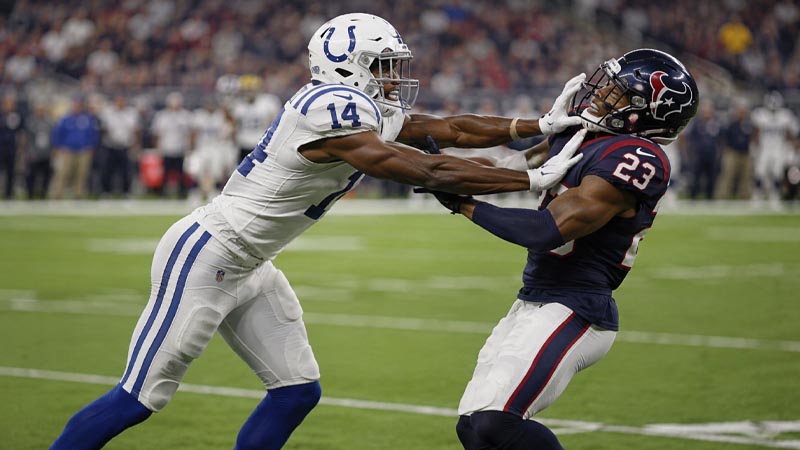
The most common on-field manifestation of OPI is the act of “pushing off”. As receivers run their routes and attempt to break away from tight man-to-man coverage, they are tempted to use physical force to create the separation necessary to make a clean catch.
- The Action: A receiver shoves or extends their arms against a defensive player.
- The Impact: This extension of the arms pushes the defender’s body away, creating a sudden pocket of space for the receiver to catch the ball.
- Official Evaluation: Officials watch for the visible extension of the receiver’s arms. If a receiver places their hands on a defender’s chest or shoulder and pushes outward to gain separation more than one yard downfield, it is a textbook OPI infraction. The rule requires receivers to rely on their speed, agility, and route running to shake a defender, rather than physical displacement.
Illegal Pick Plays
In modern offensive schemes, teams frequently employ crossing routes, mesh concepts, and rub routes to confuse defenses. However, when these concepts involve intentional physical contact, they cross the line into illegal pick plays.
- The Action: An offensive player intentionally blocks or runs into a defender who is covering another receiver downfield.
- The Timing: This physical interference takes place before the ball is thrown or while the ball is actively in the air.
- Official Evaluation: While offensive players are legally allowed to run routes that cross paths, they are strictly prohibited from acting as physical blockers downfield during a pass play. If an official determines that a receiver ran a route with the primary intent of physically colliding with or blocking a defender to set their teammate free, an OPI penalty is assessed.
Premature Downfield Blocking
During a pass play, especially on plays like screen passes, run-pass options (RPOs), or slow-developing play-action passes, offensive players must be highly disciplined about when they begin blocking downfield.
- The Action: An offensive player blocks a defender past the one-yard restriction area.
- The Timing: This blocking occurs while a forward pass is still in the air or before the ball has been touched by any player.
- Official Evaluation: Offensive players are prohibited from engaging in downfield blocks while a pass is traveling through the air. If a receiver or tight end initiates a block on a defender more than one yard downfield before the pass has crossed the line of scrimmage or before the ball has been touched, they have committed OPI. This prevents the offense from blocking defenders out of the play while the ball is still in transit.
Penalty Enforcement and Gameplay Consequences
When an official observes an OPI infraction and throws a yellow flag, the resulting penalty carries specific mechanical enforcement steps that can severely hamper an offensive drive.
Yardage Assessment
The primary consequence of an OPI penalty is the loss of field position:
- The Distance: Committing OPI results in a 10-yard penalty.
- The Enforcement Spot: Unlike some defensive penalties that are enforced from the spot of the foul, OPI is assessed from the previous line of scrimmage. This means that regardless of where the illegal contact occurred downfield, the offense is marched back exactly 10 yards from where the play originally began.
Replaying the Down
In football, some severe offensive penalties carry a secondary consequence known as a “loss of down.” However, OPI is handled with standard down preservation:
- No Loss of Down: A loss of down is not part of the standard OPI penalty in either professional or collegiate football.
- The Outcome: The down is simply replayed.
For example, if an offense commits OPI on a 1st-and-10 play, the 10-yard penalty is assessed, and the team will replay the down as 1st-and-20 from their new, receded line of scrimmage.
If the infraction occurs on 3rd-and-5, the penalty moves them back 10 yards, and they replay the down as 3rd-and-15.
While replaying the down prevents the offense from losing a valuable turn, a 10-yard penalty is a significant strategic blow.
It puts the offensive team in “long-yardage” situations, which are statistically much harder to convert, limits their play-calling options, and plays directly into the hands of the defensive coordinator.
OPI vs. DPI
To fully grasp the mechanics of downfield pass interference, it is helpful to compare the differences between Offensive Pass Interference (OPI) and Defensive Pass Interference (DPI) side-by-side:
| Structural Feature | Offensive Pass Interference (OPI) | Defensive Pass Interference (DPI) |
|---|---|---|
| Primary Target of Penalty | Wide receivers, tight ends, and other eligible offensive players. | Cornerbacks, safeties, linebackers, and other defenders. |
| Timing of Restrictions | Active from the exact moment the ball is snapped until the ball is touched by any player. | Only active once the forward pass is thrown and the ball is in the air. |
| Spatial Boundaries | Restrictions begin more than one yard beyond the line of scrimmage. | Applies downfield once the ball is in flight. |
| Penalty Severity | 10 yards assessed from the previous line of scrimmage. | Varies by league (can be a spot foul in the NFL or 15 yards in college). |
| Impact on Downs | The down is replayed; no loss of down is assessed. | Usually results in an automatic first down for the offense. |
How Officials Evaluate OPI in Real Time
Evaluating Offensive Pass Interference in real time is one of the most challenging duties of a football officiating crew. Because football is an inherently physical sport, officials must distinguish between incidental contact and illegal interference. To do this, they look for specific criteria:
- The One-Yard Zone Check: Officials must track where the contact occurs. If the physical contact takes place within one yard of the line of scrimmage, it is generally legal. Once the contact moves past that one-yard threshold, the strict OPI rules apply.
- Arm Extension: On suspected push-offs, officials look for the telling sign of a receiver’s arms fully extending. A receiver running side-by-side with a defender is normal, but a sudden shove that displaces the defender is an immediate trigger for a flag.
- Intent and Path on Pick Plays: On crossing routes, officials must determine if a receiver was running a legitimate route or if they intentionally altered their path to collide with a defender covering another receiver. If the receiver makes immediate, intentional contact with a defender who is trailing a teammate, the official will throw the flag for an illegal pick.
- Timing of the Block: On downfield blocking plays, officials monitor the timing of the block relative to the pass. If an offensive player engages a defender downfield before the pass has been touched or while it is still traveling in the air, the official must call a penalty.
Strategic Implications for Offenses and Defenses
The OPI rule strongly influences football play-calling and player execution. Offenses must rely on speed, footwork, timing, and precise route running instead of pushing defenders to gain separation.
Receivers and blocking players must also remain aware of their position, especially on play-action and RPO plays, where illegal downfield movement can result in a penalty.
For defenses, understanding OPI allows players to defend confidently while protecting their space downfield.
If a receiver illegally pushes or blocks a defender before the pass arrives, officials can penalize the offense. Ultimately, OPI preserves fairness by ensuring passing plays depend on skill, timing, discipline, and strategy.