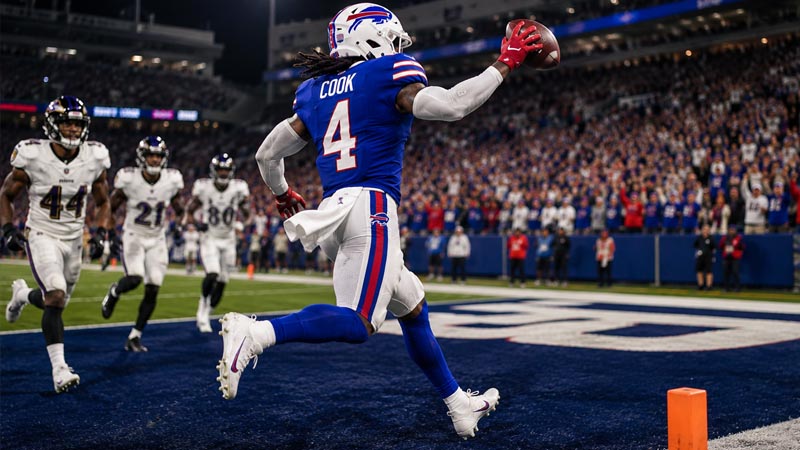
The momentum of a football game can hinge on a single second. While long touchdown passes and bruising goal-line stands often dominate the highlight reels, no single event captures the sudden, visceral shift of a game’s destiny quite like the pick six.
It is the ultimate reversal of fortune—a moment where the hunter becomes the prey, and the scoreboard is altered without the offensive unit even stepping onto the field.
Defining the Pick Six: The Mechanics of a Game-Changer
At its most fundamental level, a pick six occurs when a defensive player catches a pass thrown by the opposing team’s quarterback before it touches the ground—an act known as an interception or a “pick”—and proceeds to return that ball across the opponent’s goal line for a touchdown.
The term itself is a piece of gridiron shorthand: the “pick” refers to the interception, and the “six” represents the six points awarded for the resulting touchdown.
While an interception alone is a significant victory for a defense, the “six” element elevates the play into a different stratosphere of impact. A standard interception merely stops the opponent’s momentum and grants possession to the defense’s own offense.
A pick six, however, bypasses the need for an offensive drive entirely, placing points directly onto the scoreboard via the defensive unit.
The Anatomy of the Play
To understand why this play is so rare and celebrated, one must look at the technical requirements of the defensive players involved.
- The Anticipation (The Pick): A pick six usually begins long before the ball is in the air. Elite defensive backs and linebackers spend hours studying “film”—video recordings of their opponents—to recognize the subtle “tells” of a quarterback. This might be the way a quarterback plants his feet, the direction of his gaze, or the specific formation the offense uses on a third-down play. When the defender successfully anticipates the route, they “jump” the pass, catching it in stride.
- The Transition: The moment the ball is intercepted, the roles on the field instantly flip. The offensive players, who were prepared to block or catch, must suddenly become tacklers. Conversely, the defensive players must immediately transition into blockers. This transition is chaotic and requires immense situational awareness.
- The Return: Navigating the distance to the end zone is the final, and often most difficult, stage. The intercepting player must possess the speed to outrun the quarterback and the vision to follow the blocks provided by their teammates.
The Strategic Significance: Why the Play Matters
In the modern era of high-scoring, pass-heavy offenses, the pick-six has become a primary tool for defensive coordinators to combat aggressive passing attacks. The play matters for several critical reasons:
1. Instant Scoring and Scoreboard Pressure
In a standard game flow, a team must grind through a series of plays to move the ball down the field. A pick-six provides an instant score, allowing the defense to contribute directly to the team’s total.
This is particularly devastating in close games where offensive yards are difficult to come by. It essentially serves as a “bonus” score that the opposing team’s strategy did not account for.
2. Rapid Momentum and Energy Shifts
Football is as much a game of psychology as it is of physical talent. A pick-six creates a massive change in the energy of the stadium and the sidelines. For the team that scores, it is a surge of adrenaline. For the team that threw the interception, it is a staggering blow.
The suddenness of the event—going from a potential scoring drive to being down by another touchdown in a matter of seconds—can dismantle a team’s composure.
3. The “No Rest” Factor
One of the most overlooked aspects of the pick six is the physical and mental toll it takes on the opposing offense.
Because the defense scores directly, the opposing offense—which may have just spent several minutes on the field during a long drive—is forced to watch from the sidelines as the other team celebrates.
They do not get a turn to respond or “make it right” on that possession. This lack of immediate redemption can lead to “pressing,” where a quarterback tries too hard to compensate for the mistake, often leading to further errors.
The Psychology of the Quarterback Following a Pick Six
The impact on a quarterback’s psyche after throwing a pick-six cannot be overstated. In the world of professional football, the quarterback is the “CEO” of the field.
When they commit a mistake that leads directly to opponent points, it challenges their confidence and the trust of their teammates.
Analysts often look for a quarterback’s “short-term memory.” Can they forget the disaster of the previous drive and focus on the next play? A pick six tests this more than any other event.
The “no rest” factor mentioned previously means the quarterback has to sit on the bench and stew over the mistake while the kickoff occurs and the other team’s offense potentially takes the field. This downtime can be a breeding ground for doubt.
Historical Context and the Evolution of the Defense
Historically, the interception was a way to “flip the field.” In the early days of the sport, the forward pass was a risky, secondary option. As the game evolved and rules were changed to favor the passing game, defenses had to adapt.
The modern “ball-hawk” defender is a product of this evolution. Players like Deion Sanders or Ed Reed became legends not just for their ability to stop catches, but for their ability to turn those catches into points.
They treated every interception as a potential touchdown, a mindset that has now become standard for elite defensive units across the globe.
Technical Breakdown: Common Scenarios for a Pick Six
While a pick six can happen on any passing play, certain scenarios are more common:
- The “Screen” Pass: If a defender reads a screen pass correctly, they are often in a direct line to the end zone with no one between them and the goal.
- The “Out” Route: When a quarterback throws toward the sideline, a fast cornerback can “undercut” the route. Because the quarterback’s momentum is often moving toward the middle of the field, they are out of position to make a tackle once the ball is intercepted.
- Tipped Balls: Many pick sixes are the result of a ball hitting an offensive player’s hands or helmet and popping into the air. These “unscripted” plays create the most chaos, as the defense is often better positioned to react to the bouncing ball than the offense.
The Value of Defensive Scoring in Elite Competition
In high-stakes environments—such as championship games or playoff runs—the margin for error is razor-thin. When analyzing the success of championship teams, a recurring theme is the ability of the defense to generate “non-offensive touchdowns.”
A defense that can consistently threaten a pick six forces the opposing offensive coordinator to be more conservative.
If a quarterback knows that a small mistake could result in six points for the other side, they may hesitate to throw into “tight windows” or take the risks necessary to move the ball downfield. In this way, the threat of a pick six is almost as valuable as the play itself.
Expert Insights: The Tactical Nuance
From a coaching perspective, the pick six is the result of perfect “alignment and assignment.”
- Pressure: A pick six is often caused by the defensive line. If a quarterback is under heavy pressure and “feeling the heat,” they are more likely to throw a hurried, inaccurate pass.
- Coverage Shells: Defensive coordinators use “disguised coverages” to trick the quarterback into thinking a receiver is open when, in reality, a defender is waiting in the “weeds” to pounce on the ball.
Conclusion: The Ultimate Reversal
The pick six remains the most electric play in American football. It encapsulates the inherent drama of the sport—the reality that at any moment, the entire landscape of a game can be transformed.
It is a testament to defensive skill, opportunistic running, and the unforgiving nature of a game played at the highest level.
For the fans, it is a moment of pure, unbridled excitement or total despair. For the players, it is a career-defining highlight. And for the strategists, it is the ultimate proof that the best defense is often a high-scoring offense.