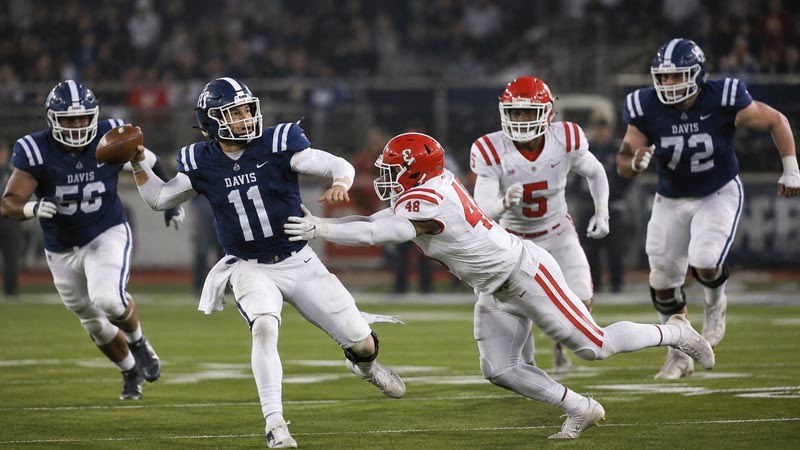
Few moments in gridiron football spark as much immediate confusion, heated sideline debate, and stadium-wide booing as the sight of a referee throwing a yellow penalty flag for intentional grounding.
To the casual observer, the act seems simple: a quarterback is about to be tackled for a massive loss of yardage, so they throw the ball into the turf or out of bounds to save their team.
One week, you see a quarterback make this throw and get cheered for a smart play; the next week, a different player does almost the same thing and receives a devastating penalty that ruins the entire offensive drive.
Why is there such a massive discrepancy? How do officials decide when a throw is a brilliant tactical escape versus an illegal rule violation?
This comprehensive guide breaks down the complex mechanics of the intentional grounding rule.
By examining the precise technical requirements, the physical boundaries of the field, the differences across various levels of play, and the historical evolution of the rule, you will learn how to read this play like an official.
The Core Purpose – Why the Rule Exists
At its heart, the game of football is a battle for territory. When a defense successfully breaks through the offensive line, defeats their blockers, and puts the quarterback in immediate danger, they have earned the right to a “sack”—a tackle behind the line of scrimmage that results in a loss of yardage and a down for the offense.
Before the rule against intentional grounding was established, quarterbacks who realized they were about to be sacked would simply drop the ball or toss it aimlessly into the dirt.
This stopped the game clock and returned the ball to the previous line of scrimmage, completely erasing the defensive team’s hard work.
To restore competitive balance, rulemakers established the intentional grounding infraction. The penalty is designed to ensure that if a defender successfully collapses the pocket and creates an imminent sack, the offense is penalized with the equivalent loss of yardage and down that they would have suffered from the physical tackle.
It forces the quarterback to accept the consequences of a dominant defensive pass rush.
The Three-Part Grounding Formula
To understand how officials make this call in real-time, you must understand that intentional grounding is not a single, subjective guess.
Instead, it is a strict, three-part criteria checklist. An official will only throw the yellow flag if all three of the following elements are simultaneously present during a single play:
   [Imminent Defensive Pressure]
                +
   [Quarterback Inside the Pocket]   ===>  INTENTIONAL GROUNDING FLAG
                +
 [No Realistic Chance of Completion]
1. Imminent Defensive Pressure
The rule does not apply to every incomplete pass. A quarterback is legally allowed to throw a terrible, uncatchable pass if they are standing comfortably in a clean pocket with no defenders nearby.
This frequently happens when there is a miscommunication between the passer and a wide receiver who ran the wrong route.
For grounding to occur, the passer must be facing an “imminent loss of yardage” due to pressure from the defensive rush. NFL officials define this pressure as a defender being within a step and a half or two steps of the quarterback.
If a sack is truly imminent, the quarterback is officially deemed under duress and cannot legally dump the ball to escape.
2. Position Relative to the “Tackle Box” (The Pocket)
The physical location of the quarterback when they release the football is the most critical factor in determining whether a throw is legal.
- Inside the Tackle Box: The “tackle box” (commonly called the pocket) is defined as the lateral area between where the left offensive tackle and the right offensive tackle lined up at the start of the play, before the ball was snapped. As long as the quarterback remains inside these physical boundaries, they are highly restricted in where they can throw the ball.
- Outside the Tackle Box: If the quarterback scrambles to either the left or the right, crossing the imaginary line where the offensive tackles lined up, they have successfully escaped the pocket. Once outside the tackle box, their legal options expand dramatically.
3. No “Realistic Chance of Completion”
While inside the pocket, a pressured quarterback cannot simply throw the ball into empty space. The pass must be thrown in the direction of and land in the vicinity of an eligible offensive receiver.
Fortunately for quarterbacks, the definition of “receiver in the area” is highly generous. Referees do not expect perfect accuracy under pressure.
If an eligible receiver—such as a wide receiver, tight end, or running back—is within approximately 5 yards of where the ball lands, the penalty will be waived.
It does not matter if the quarterback throws the ball directly into the dirt at a running back’s feet, or if the ball sails 20 feet over a receiver’s head; as long as an eligible player was in the general zone of the pass, the official will rule that there was a realistic attempt at a completion.
Visualizing the Field: The Pocket and the Line of Scrimmage
To help visualize how these rules work on the field, consider the diagram below. It illustrates the critical boundaries that determine whether a quarterback’s throw-away is legal:
========================= SIDELINE =========================

                         (Pass Must Cross Line)
                                   |
                                   v
------------------------ LINE OF SCRIMMAGE -----------------

      [Eligible WR]                |
                                   |
                                   |
          LT      LG      C      RG      RT     <-- Offense Lines Up
          |______________________________|
                  |  TACKLE BOX  |
                  |   (POCKET)   |
                  |              |
                  |    [QB]      |  <-- Inside the pocket:
                  |              |      Must throw to a receiver
                  |______________|
                         |
                         v
                  Scrambling Out
                         |
                         +-------------> [QB]   <-- Outside the pocket:
                                                    Can throw to sideline,
                                                    but pass must cross
                                                    Line of Scrimmage

========================= SIDELINE =========================
The Legal Exceptions – Get-Out-of-Jail-Free Cards
Because football is an incredibly dynamic sport, rulebooks outline several clear exceptions where a quarterback can throw the ball away without receiving a penalty card.
Escaping the Pocket and Reaching the Line of Scrimmage
If a quarterback scrambles outside of the tackle box, they are legally permitted to throw the ball away into an empty area where no receivers are present.
However, there is a catch: the thrown ball must reach or cross the line of scrimmage, even if it goes completely out of bounds over the sideline.
If the quarterback scrambles outside the pocket but gets desperate and throws the ball directly into the turf behind the line of scrimmage, or fails to throw it far enough to reach the line of scrimmage, they will still be flagged for intentional grounding.
Physical Contact by a Defender
Quarterbacks are frequently hit at the exact microsecond they attempt to throw. If a defender makes physical contact with the quarterback’s body or arm during their forward throwing motion, altering the trajectory of the ball, the referee will usually waive any potential intentional grounding penalty.
For instance, if a quarterback attempts to throw a legal pass to a receiver in the flat, but a defender hits their arm mid-throw, causing the ball to flutter helplessly into an empty patch of grass, grounding will not be called. The physical contact of the defense is ruled as the primary cause for the uncatchable pass.
The Clock-Stopping Spike
In late-game scenarios, teams must manage the game clock with extreme precision. A team with no timeouts remaining cannot afford to let the clock run after a completed play. To combat this, the rules provide a specific, written exception for spiking the ball.
A quarterback standing directly under center is legally allowed to take the snap and immediately throw the ball straight into the ground to stop the game clock. To be ruled legal, this motion must be:
- Immediate: The quarterback cannot drop back, hesitate, look around, or simulate a play before throwing the ball down.
- Continuous: The throw must be a single, fluid motion from the snap to the ground.
- Under a Running Clock: The clock must actually be running.
A famous example of this exception failing occurred on November 4, 2018, when star quarterback Patrick Mahomes mistakenly spiked the ball when the game clock was already stopped. Because the clock was not running, the exception did not apply, and Mahomes was correctly penalized for intentional grounding.
The Devastating Costs – Penalty Structures Explained
Committing an intentional grounding penalty is one of the most damaging mistakes an offensive unit can make. The penalty is structured specifically so that the offense receives absolutely no benefit from committing the foul.
Loss of Down
Unlike common offensive penalties like holding or false starts, which simply repeat the down with more yards to gain, intentional grounding carries an automatic loss of down.
This means if a team commits grounding on a 2nd-and-6 play, they do not get to play second down again. The play immediately becomes 3rd down, forcing the offense into a highly difficult conversion situation.
Yardage Penalties by League
The exact yardage penalty assessed depends entirely on the level of football being played:
- The National Football League (NFL): The penalty is a loss of 10 yards from the previous line of scrimmage, unless the spot of the pass was further back than 10 yards, in which case the ball is placed at the exact spot of the pass.
- NCAA (College) & NFHS (High School): The penalty is assessed exactly at the spot of the foul where the quarterback threw the illegal pass, along with the loss of down.
Example Comparison: Imagine a play that begins at the opponent’s 40-yard line on 2nd-and-6. The quarterback runs backward and throws an illegal grounding pass from the 48-yard line (8 yards behind the line of scrimmage).
- In the NFL, the team would be penalized 10 yards from the line of scrimmage, making it 3rd-and-16 from the 50-yard line.
- In College, the penalty is placed at the spot of the foul, making it 3rd-and-14 from the 48-yard line.
Special End Zone Safety Rule
If a quarterback is standing inside their own end zone when they throw an illegal grounding pass, the penalty results in an automatic safety.
This awards the defending team 2 points and forces the offense to kick the ball back to the defense, representing a massive shift in game momentum.
The Ten-Second Runoff
To prevent trailing teams from intentionally committing grounding late in a half to stop the clock, the rules allow the defending team to elect a 10-second clock runoff.
This ensures that teams cannot abuse a penalty to gain a tactical clock management advantage.
Rule Variations Across Different Leagues
While the core concept of intentional grounding remains consistent, different leagues have tailored the rule to fit their unique athletic and tactical philosophies.
| Rule Component | National Football League (NFL) | College Football (NCAA) | Canadian Football League (CFL) | High School (NFHS) |
|---|---|---|---|---|
| Yardage Penalty | 10 Yards from Line of Scrimmage (or spot of foul if worse) | Spot of the Pass | Spot of the Pass | Spot of the Pass |
| Tackle Box Exception | Yes (Since 1993) | Yes | No (Exempt from pocket rules) | Yes (Since 2022) |
| Line of Scrimmage Rule | Pass must cross the line of scrimmage when outside the pocket | Pass must cross line of scrimmage when outside pocket | Pass must cross line of scrimmage from anywhere | Pass must cross line of scrimmage when outside pocket |
| End Zone Grounding | Automatic Safety | Automatic Safety | Automatic Safety | Automatic Safety |
The Canadian Football League (CFL) Rule
In the CFL, the quarterback is given much more freedom. There is no “tackle box” or pocket restriction.
A CFL quarterback can throw the ball away from anywhere on the field—even directly from the pocket—without needing a receiver nearby, as long as the pass reaches or crosses the line of scrimmage.
The NFL Pro Bowl Rule Exception
To maximize player safety and protect high-value star quarterbacks during an exhibition game, the NFL explicitly makes intentional grounding legal in the Pro Bowl. This allows players to throw the ball away freely to avoid physical hits.
The History and Evolution of the Rule
To fully appreciate the complexity of the intentional grounding rule, it helps to look back at how the game of football evolved over the past century.
- 1906: The forward pass is legally introduced to American football in an effort to open up the game and reduce brutal, close-quarters collisions. Initially, incomplete forward passes resulted in an automatic turnover, meaning teams rarely used them.
- 1912: Rulemakers change the rules so that incomplete passes no longer result in a turnover, instead returning the ball to the previous line of scrimmage.
- 1914: Recognizing that quarterbacks are abusing this change by throwing the ball away to avoid sacks, the first official rules against intentional grounding are put into place.
- 1993: To protect modern, highly paid franchise quarterbacks from taking devastating physical hits in the pocket, the NFL introduces the “Tackle Box Exception”. For the first time, quarterbacks who scramble outside the tackles are legally allowed to throw the ball away.
- 2022: Recognizing the safety benefits of the tackle box exception at the professional and collegiate levels, the National Federation of State High School Associations (NFHS) officially adopts the rule for high school football players nationwide.
Strategic Implications: Sacks vs. Grounding
For modern coaching staffs and quarterbacks, deciding when to accept a defender’s tackle versus when to risk throwing the ball away is a high-stakes tactical calculation.
Here is the comparison table detailing how the two outcomes compare under the rules:
| Tactical Element | Taking a Sack | Committing a Grounding Penalty |
|---|---|---|
| Yardage Consequences | Loss of yardage is determined solely by where the quarterback is physically tackled. | Severe yardage penalty: An automatic 10-yard penalty from the line of scrimmage in the NFL (or half the distance if inside the 20-yard line), or placed at the spot of the pass in college and high school. |
| Down Assessment | Loss of down: The play naturally ends, and the offense moves to the next down. | Automatic loss of down: Unlike standard penalties, grounding carries an automatic loss of down with no opportunity to replay the down. |
| Turnover & Health Risks | Physical & ball security risks: High exposure to physical hits, as well as a severe risk of fumbling the ball or throwing a desperate interception under pressure. | Low physical risk: Protects the quarterback from a direct physical hit, but carries a severe turnover-equivalent penalty if committed. |
| Extreme Game Scenarios | Normal down-and-distance progression from the spot of the tackle. | Safety & Runoff Risks: Results in an automatic 2-point safety for the defense if thrown from the offense’s own end zone, and can trigger a 10-second game clock runoff if committed near the end of either half. |
The Final Whistle
Intentional grounding is a complex, fast-moving rule that balances player safety, defensive reward, and offensive strategy.
By mastering the three-part formula—Pressure, Pocket, and Completion Vicinity—you can easily anticipate when the referees will throw their flags on game day.
The next time you watch a game, pay close attention to where the quarterback is standing and where the defenders are when the ball is released; you will find yourself calling the penalty before the officials even blow their whistles.