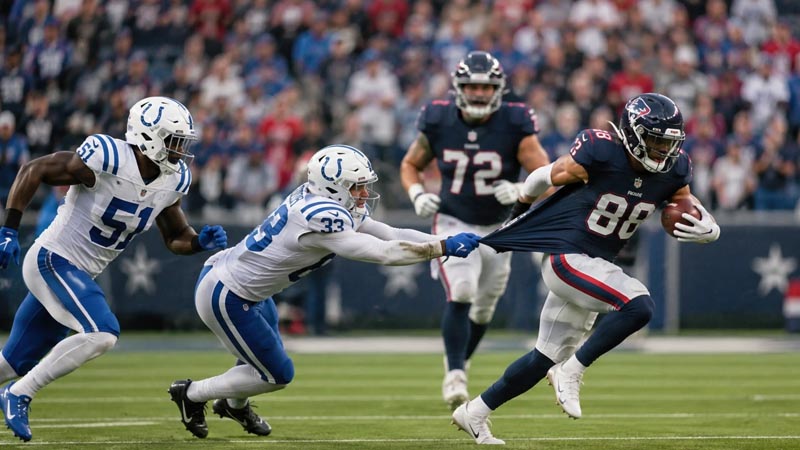
In the game of American football, maintaining the integrity of physical matchups is essential to fair play. Among the various infractions designed to regulate player contact, few are as influential or as frequently discussed as the holding penalty.
At its core, holding is called when a player illegally restricts the movement of an opponent who does not have possession of the ball.
By defining the boundaries of legal physical engagement, this penalty shapes how offensive and defensive units execute their strategies.
To fully understand its role on the field, we must examine the specific mechanics of the infraction, its distinct manifestations on offense and defense, and the mathematical impact of its associated penalties.
The Core Mechanics: What Constitutes an Illegal Hold?
The fundamental definition of holding revolves around restriction. Football is a game of leverage, positioning, and momentum. When a player cannot legally maintain their position, they may resort to illegal physical actions to compensate.
According to the rules, holding is flagged when a player illegally performs any of the following actions against an opponent who does not have the ball:
- Grabbing: Clenching or holding onto a player’s equipment or body.
- Hooking: Using an arm or hand to curve around an opponent, trapping them.
- Twisting: Applying rotational force to alter an opponent’s body alignment.
- Tackling: Bringing a non-ball-carrier to the ground.
The physical consequence of these actions is twofold: they restrict the opponent’s movement and alter their natural path on the field. Because football relies heavily on precise timing and route-running, even a fraction of a second of illegal restriction can entirely disrupt a play. This foul is highly versatile and can be committed by either the offensive side or the defensive side of the ball.
Offensive Holding: Protecting the Play
Offensive holding is primarily committed by players who are tasked with blocking to create running lanes or protect the passer.
Who Commits Offensive Holding?
This infraction is typically committed by:
- Offensive Linemen: The players who form the front line of protection and must block oncoming pass rushers.
- Wide Receivers: Outlined on the perimeter, receivers often block defensive backs during running plays or screens.
Visual Indicators of the Infraction
On the field, officials monitor specific physical cues to identify offensive holding. These include:
- Outside Grabbing: Securely grasping a defender’s jersey or shoulder pads from the outside, rather than maintaining a legal block with hands positioned inside the frame of the defender’s chest.
- Arm Hooking: Wrapping or hooking an arm around a defender to impede their rush or run-defense path.
- Pulling to the Ground: Dragging or pulling a defender down to the turf to prevent them from reaching the quarterback or stopping the ball carrier.
The Penalization Structure
Offensive holding carries a severe tactical penalty:
- Distance Penalty: The offensive unit is pushed back 10 yards.
- Enforcement Spot: The yardage is assessed from the previous spot (the line of scrimmage where the play began).
- Down Status: The offense must replay the down.
A 10-yard penalty significantly lowers the statistical probability of an offense converting a first down, making offensive holding one of the most drive-stalling penalties in the game.
Defensive Holding: Regulating Coverage
While offensive holding focuses on block execution, defensive holding regulates how defenders cover eligible receivers.
Who Commits Defensive Holding?
This foul is typically committed by members of the secondary who are responsible for pass coverage:
- Cornerbacks: Defenders matched up on outer wide receivers.
- Safeties: Deep-field defenders who help in zone or man coverage.
The Mechanics of the Five-Yard Threshold
Defensive holding is defined by a specific physical and spatial boundary on the field. It occurs when a defender illegally grabs or holds a receiver to slow them down past the first 5 yards from the line of scrimmage.
Within the first 5 yards, physical contact is regulated differently, but once a receiver crosses this threshold, any grabbing that impedes their route constitutes defensive holding.
The Penalization Structure
The penalty for defensive holding is highly punitive, prioritizing offensive progression:
- Distance Penalty: The defense is penalized 5 yards.
- Down Status: The offense is awarded an automatic first down.
Even though the yardage penalty (5 yards) is shorter than the offensive holding penalty (10 yards), the automatic first down makes defensive holding incredibly costly. It immediately terminates the defense’s opportunity to force a punt, regardless of how many yards the offense needed prior to the penalty.
Comparing Offensive vs. Defensive Holding
The table below outlines the core differences in how holding is defined, executed, and penalized on both sides of the ball:
| Metric | Offensive Holding | Defensive Holding |
|---|---|---|
| Primary Actors | Linemen, Wide Receivers | Cornerbacks, Safeties |
| Physical Action | Grabbing jersey/pads from outside, wrapping arms, or pulling to the ground | Grabbing or holding a receiver past the 5-yard threshold |
| Tactical Goal | Protecting the quarterback or sealing a running lane | Restricting a receiver’s route timing or speed |
| Yardage Penalty | 10 Yards | 5 Yards |
| Down Penalty | Replay the down | Automatic First Down for the offense |
Conclusion
Ultimately, holding remains one of the most critical infractions in American football, heavily influencing the flow of the game on both sides of the ball.
Whether committed by offensive linemen struggling to protect the quarterback or defensive backs attempting to disrupt a receiver’s route past the five-yard mark, the illegal acts of grabbing, hooking, twisting, or tackling restrict natural player movement and alter critical paths on the field.
With offensive infractions resulting in a ten-yard penalty and defensive holding yielding a five-yard penalty plus an automatic first down, mastering legal physical positioning is vital for avoiding costly field setbacks.