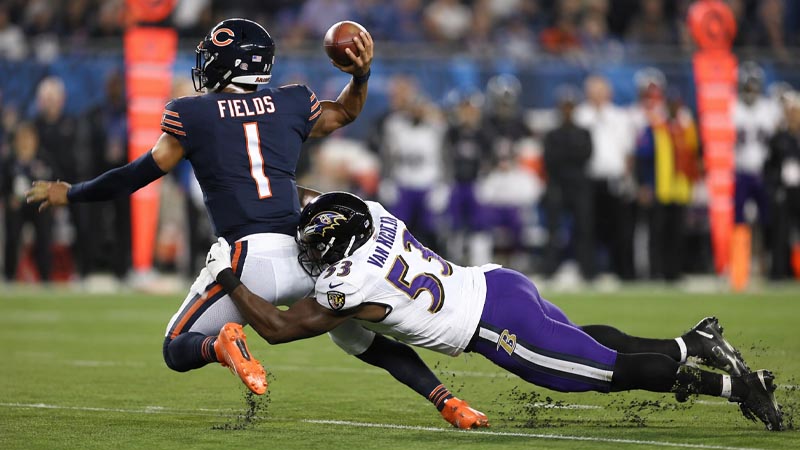
In the high-stakes theater of American football, few moments ignite a stadium—or devastate an offensive strategy—as rapidly as the quarterback sack.
It is the ultimate expression of defensive dominance, a collision of timing, athleticism, and raw power that fundamentally alters the trajectory of a game.
While fans see a spectacular hit, the technical reality of a sack is governed by a specific set of criteria that distinguish it from a standard tackle.
Understanding these nuances is essential for anyone seeking a professional-grade comprehension of the sport’s most influential defensive metric.
The Foundational Definition: More Than a Tackle
At its core, a sack occurs when the defensive unit successfully tackles the quarterback behind the line of scrimmage before he can release a forward pass.
This distinction is critical. If a quarterback is tackled one yard beyond the line of scrimmage, it is statistically recorded as a “rushing attempt” for positive or neutral yardage.
However, once that tackle occurs behind the starting point of the play, it transforms into a sack—a play recognized globally as a powerhouse defensive achievement.
The sack represents a dual failure for the offense and a dual victory for the defense. It is not merely about the physical takedown; it is about the systematic dismantling of the offensive play-call.
By preventing the pass from ever occurring, the defense essentially erases the intended strategy of the opposing coaching staff.
The Technical Criteria: The “What” and “How” of the Play
To be officially recorded in the annals of football history, a sack must meet specific regulatory requirements. These rules ensure consistency across different levels of play and provide a clear framework for officials and statisticians.
The Line of Scrimmage Boundary
The most basic requirement for a sack is the location of the tackle. The quarterback must be brought down behind the starting line of the play.
This line of scrimmage acts as a binary threshold: behind it, the play is a sack; beyond it, the play is a run. Even a fraction of an inch can determine whether a defensive player receives credit for this prestigious statistic.
The Requirement of Pass Intent
Perhaps the most nuanced aspect of the rule involves the quarterback’s intent. For a sack to be credited, the quarterback must be actively attempting to pass the ball or, at the very least, maintaining a “passing posture”.
This posture is typically defined by the quarterback looking downfield, holding the ball with both hands in a ready position, or being within the “pocket” created by his offensive linemen.
If a quarterback tucks the ball and clearly becomes a runner (such as on a designed “quarterback draw”), a tackle behind the line is often categorized as a “tackle for loss” rather than a sack, depending on the judgment of the official scorekeeper.
The “Pressure” Factor: Running Out of Bounds
A sack does not always require a thunderous collision in the middle of the field. In many instances, the sheer pressure exerted by the defensive line forces the quarterback to flee.
If this defensive pressure compels the quarterback to run out of bounds behind the line of scrimmage, it is officially recorded as a sack.
This highlights the psychological impact of the defense; the threat of a hit can be just as effective as the hit itself in forcing a loss of yardage.
The Evolution of the “Strip Sack”
While every sack is beneficial for the defense, the “strip sack” represents the pinnacle of defensive efficiency. This occurs when a defender knocks the ball loose from the quarterback’s grasp during the tackle.
The strip sack is a “special type” of play because it introduces the element of the turnover. In a standard sack, the offense retains the ball but loses yardage and a down. In a strip sack, the ball becomes live, offering the defense a chance to recover it and immediately transition to offense. This play often results in a massive shift in win probability, particularly when it occurs deep in offensive territory.
Measuring the Consequences: Why Sacks Kill Momentum
To understand the strategic value of the sack, one must look at the mathematical disadvantages it imposes on the offense. It is a compounding penalty that affects both spatial and temporal aspects of the game.
The Loss of Yards
Modern football is a game of inches, but sacks are a game of yards. When a quarterback is sacked, the offense loses valuable ground, making their ultimate goal—reaching the end zone or the next first-down marker—significantly harder to achieve.
A 10-yard sack on first down creates a “2nd and 20” scenario, a statistical nightmare that drastically reduces the likelihood of a successful drive.
The Loss of Down
Unlike a penalty, which might occasionally allow for a replay of the down, a sack consumes one of the offense’s limited opportunities.
In American football, an offense typically has four downs to gain 10 yards, though in practical strategy, they usually only have three tries before being forced to punt.
A sack burns one of these precious attempts while simultaneously increasing the distance required for the next one. This “double-whammy” effect is why defensive coordinators prioritize the “pass rush” above almost all other defensive elements.
The Historical Context: The Legend of Deacon Jones
The term “sack” is so ingrained in the sports lexicon that it is easy to forget it was not always part of the game. The term was famously coined by Hall of Fame defensive end Deacon Jones during the 1960s.
Jones, a legendary figure for the Los Angeles Rams, sought a word that captured the devastation of the play.
He compared it to “sacking a city”—a total devastation where you “devastate the whole city and then you’ve got it.” Before Jones popularized the term, the play was often simply referred to as a “tackle of the passer.”
By giving the play a name, Jones elevated its status, turning a simple defensive statistic into a cultural phenomenon that changed how the game was marketed and analyzed.
Personnel and Strategy: The Architecture of a Sack
Achieving a sack is rarely the result of a single player’s effort. It is a collaborative triumph of the defensive ecosystem.
- The Edge Rusher: Usually defensive ends or outside linebackers, these players use speed and bend to get around the offensive tackles. Their goal is the “blind side” sack, hitting the quarterback from a direction he cannot see.
- Interior Pressure: Defensive tackles provide the “push” up the middle. Even if they don’t get the sack themselves, they prevent the quarterback from “stepping up” into the pocket to avoid the edge rushers.
- The Coverage Sack: This occurs when the defensive secondary (cornerbacks and safeties) covers the receivers so effectively that the quarterback has nowhere to throw the ball. He is forced to hold onto it until the pass rush eventually reaches him.
Strategic Ripples: The Long-Term Impact
The effects of a sack linger long after the whistle blows. For a quarterback, being sacked multiple times leads to “happy feet”—a state of nervousness where he begins to look at the rushers instead of his receivers. This degradation of focus leads to hurried throws, poor decisions, and interceptions.
For the offensive line, a sack is a public indictment of their protection scheme. It often forces coaches to keep additional players (like tight ends or running backs) in the backfield to help block, which in turn reduces the number of available receivers, making the offense more predictable and easier to defend.
Conclusion: The Ultimate Defensive Statement
The quarterback sack is more than just a highlight reel moment; it is a fundamental pillar of football strategy. From the early innovations of Deacon Jones to the high-tech, data-driven pass rushes of today, the objective remains the same: disrupt, displace, and devastate.
By forcing a loss of yards and a loss of down, the defense exerts its will over the game, turning the tide of momentum and setting the stage for victory.
Whether it’s a clean tackle or a chaotic strip sack, the result is a testament to the skill and tenacity required to compete at the highest levels of the sport. For the offense, it is a problem to be solved; for the defense, it is the ultimate reward for a job well done.