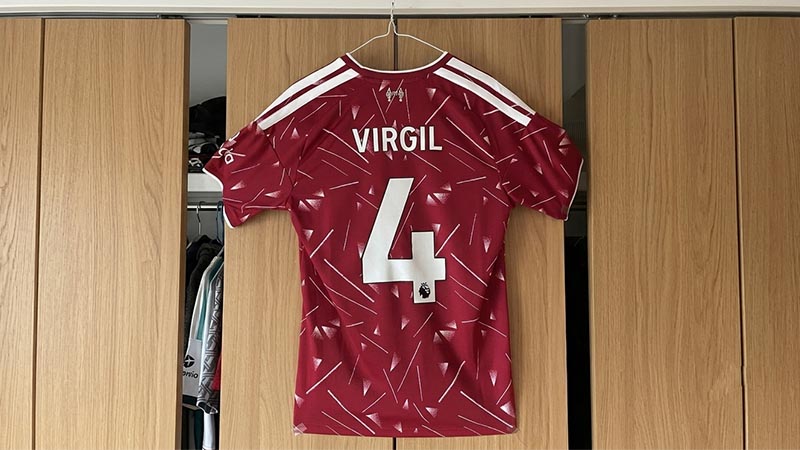
In the world of elite professional sports, the jersey is a player’s primary identifier. It is the bridge between the athlete and the fans, a billboard for sponsors, and a permanent record of a legacy.
For most players in the English Premier League or on the international stage, the surname on the back of the kit is a point of pride, representing generations of family history.
However, if you look at the back of the number 4 jersey for Liverpool FC or the captain’s kit for the Netherlands national team, you will notice a conspicuous absence. There is no “van Dijk.” Instead, there is simply “Virgil.”
This choice is not a marketing gimmick or an attempt at single-name stardom like the legends of Brazilian football. It is a deeply personal, deliberate, and public act of reclamation.
The story of why Virgil van Dijk wears “Virgil” is a narrative of resilience, maternal sacrifice, and the courage to define one’s own identity in the face of abandonment.
The Childhood Turning Point
To understand the athlete, one must understand the environment that forged him. The decision to drop the “van Dijk” name from his professional attire is rooted in a pivotal moment from his childhood.
When Virgil was just 12 years old—a formative age where many young athletes begin to dream of their professional futures—his father, Ron, walked out on the family.
This was not merely a physical departure; it was a fracture in the foundation of his home life. For Virgil, the surname “van Dijk” became inextricably linked to the man who left, rather than the family that remained.
In the high-stakes world of professional football, where every detail is analyzed, Virgil’s decision to disown the surname on his kit serves as a permanent boundary between his professional success and a father he feels did not contribute to his journey.
The Matriarch’s Mark: A Tribute to Strength
While the removal of the surname represents a distancing from his father, the choice of “Virgil” is a profound tribute to his mother. In the wake of his father’s departure, Virgil’s mother was left to navigate the challenges of raising him and his siblings alone.
The life of a single mother in any context is defined by sacrifice, but for the mother of a budding football star, the demands are often doubled. From logistical hurdles to emotional support, she became the sole architect of his early development.
Virgil has made it clear that his professional kit is a recognition of the immense struggles she overcame to provide him with a stable childhood and the opportunity to pursue his athletic dreams.
By wearing “Virgil,” he ensures that when he lifts trophies, signs contracts, or leads his team onto the pitch, the glory is shared with the person who stayed.
It is an acknowledgment that his success is a direct result of her perseverance. In his eyes, the name “van Dijk” belongs to a man who wasn’t there; “Virgil” belongs to the son his mother raised.
Redefining the Professional Identity
In professional sports, the “brand” of an athlete is often managed by agencies and PR firms. Yet, Virgil’s choice transcends typical branding strategies.
It is an authentic expression of personal truth that resonates with millions of fans worldwide who have faced similar family dynamics.
Typically, footballing tradition dictates that European players use their surnames unless there is a specific cultural reason (such as the Iberian tradition of using nicknames).
Virgil’s departure from this norm was a bold move early in his career. Whether playing for Groningen, Celtic, Southampton, or his current home at Liverpool, he has remained steadfast in this choice.
It serves as a reminder that athletes are not just commodities; they are individuals with histories that shape their professional personas.
The Psychology of the Name
Psychologically, a name is a powerful symbol of belonging. For Virgil, the “van Dijk” name represented a legacy he no longer wished to carry. By opting for his first name, he asserted his independence and his right to curate his own history.
This level of agency is rare. Many young athletes feel pressured to conform to family expectations or traditional naming conventions to maintain a sense of “continuity.”
Virgil’s refusal to do so demonstrates a level of emotional maturity that matches his tactical brilliance on the pitch. He chose to build a legacy that was entirely his own, anchored by the support of his mother rather than the shadow of his father.
The Global Impact: Why the Story Matters
The resonance of Virgil’s story extends far beyond the borders of the Netherlands or the stands of Anfield. It touches on universal themes of family, abandonment, and the power of the matriarch.
In many cultures, the father’s name is the default carrier of legacy, but Virgil’s kit challenges this patriarchy. It suggests that legacy is not something you are born into, but something you earn through presence, support, and love.
Fans who wear his jersey aren’t just wearing the name of a world-class defender; they are wearing a symbol of a man who stood by the person who stood by him. It transforms a simple piece of sports apparel into a statement of loyalty and gratitude.
Navigating Modern Football Legacies
As we look at the trajectory of Virgil’s career, his identity is now firmly established. He is “Virgil” to the fans, “Virgil” to his teammates, and “Virgil” to the history books.
He has successfully detached himself from a surname that carried painful memories, replacing it with a first name that represents triumph over adversity.
This narrative is essential for understanding the modern athlete. The depth of their performance is often fueled by the depths of their personal experiences.
When Virgil makes a goal-saving tackle or leads a defensive line, he does so with the weight of his mother’s sacrifice and the strength of his own chosen identity.
Enhanced FAQ: Understanding Virgil’s Choice
Q: Did Virgil van Dijk legally change his name?
A: While he uses “Virgil” on his professional kit to recognize his mother’s struggles, he is still widely known as Virgil van Dijk in official records. The choice is primarily a symbolic one for his professional identity and jersey.
Q: Does his father have any involvement in his career now?
A: According to available information, Virgil has disowned his father, Ron, due to his abandonment of the family when Virgil was 12. The lack of the surname on his jersey is a public manifestation of this estrangement.
Q: Why don’t more players use their first names?
A: Most European football leagues follow the tradition of using surnames. Using a first name usually requires a specific reason—either cultural (common in Brazil and Portugal) or, as in Virgil’s case, a significant personal reason.
Q: How does his mother feel about this tribute?
A: While she maintains a private life, the tribute is widely understood as a public thank-you for her role in raising Virgil and his siblings after their father left.
Q: Is “Virgil” considered a brand name?
A: While it has become a powerful personal brand, the origins of the choice are rooted in family history and personal loyalty rather than a commercial strategy.
The Power of Choosing Your Own Path
The story of Virgil’s name is a reminder that we are not defined by those who leave us, but by our response to that absence.
By honoring the matriarch who raised him, Virgil van Dijk has created a legacy that is both unique and deeply meaningful.
He has proven that on the world’s biggest stage, you don’t need a traditional surname to be remembered—you only need the courage to be yourself.
As you watch the next match and see that simple name—”Virgil”—across the shoulders of one of the world’s greatest defenders, remember that it is more than just a name.
It is a badge of honor, a tribute to a mother’s love, and a testament to the strength of a son who chose his own path.