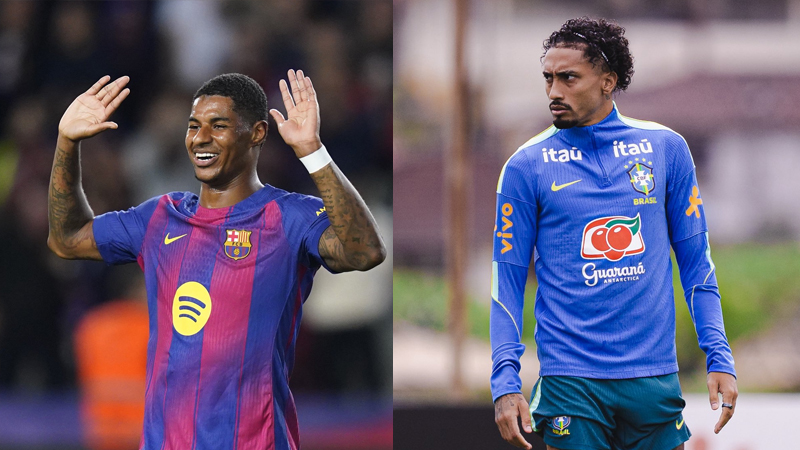
The 2025–26 season has witnessed a tactical masterclass at FC Barcelona, driven by the unprecedented coexistence of Marcus Rashford and Raphinha.
Following Rashford’s high-profile arrival in Catalonia, fans and analysts alike have debated which forward truly defines Hansi Flick’s offensive engine.
While Raphinha has cemented his status as an elite, high-volume finisher, Rashford has reinvented himself as a physical playmaker and a primary source of vertical threat.
This comprehensive analysis delves into their current form, advanced metrics, and historical trajectories to determine who holds the statistical edge in this world-class attacking duo.
Marcus Rashford vs Raphinha: The 2025–26 Statistical Edge
To understand the current hierarchy at Barcelona, one must look at the raw output of both players across all major club competitions, including LaLiga, the Champions League, and the Copa del Rey.
The 2025–26 season presents a fascinating contrast where Raphinha dominates the scoresheet while Rashford orchestrates the play. While individual brilliance is evident in both, their roles have become specialized under the current management.
| Statistic (2025–26) | Raphinha (Barcelona) | Marcus Rashford (Barcelona) |
|---|---|---|
| Total Goals | 21 | 14 |
| Total Assists | 7 | 11 |
| LaLiga Goals | 13 | 8 |
| LaLiga Assists | 3 | 7 |
| UCL Goals | 3 | 5 |
| UCL Assists | 2 | 3 |
| Chances Created (LaLiga) | 31 | 35 |
| 1vs1 Performance Index | 93.1 (#1 in LaLiga) | 76.12 (#9 in LaLiga) |
| FotMob Average Rating | 7.77 | 7.18 |
Decoding the Clinical Output vs. Playmaking Shift
While Raphinha holds the upper hand in clinical output with 21 goals, his assist tally of 7 suggests a more narrow focus on finishing compared to previous years. In contrast, Marcus Rashford has experienced a significant “creative shift,” leading the team with 11 total assists.
This evolution is reflected in their chances created, where Rashford’s 35 key passes edge out Raphinha’s 31, proving that Rashford is now the primary creative engine in the final third.
Tactical DNA: Vertical Power vs. Defensive Intensity
The tactical integration of these two stars depends on their distinct physical and technical profiles. Hansi Flick’s system requires a blend of rapid transitions and high-intensity pressing, areas where both players excel but in vastly different ways.
Understanding these nuances is key to understanding how they have shared the pitch for 17 matches this season, securing 15 wins.
Marcus Rashford: The Physical Vertical Driver
Marcus Rashford remains one of the most physically dominant forwards in world football. He currently leads Barcelona in raw athletic output, ranking near the top of LaLiga for total sprints, top speed, and distance covered.
His primary role is that of a “Vertical Driver,” utilizing a high success rate for direct, line-breaking progressive passes to orchestrate rapid counterattacks.
Rashford has completed 76 progressive dribbles this season, significantly higher than Raphinha’s 57, highlighting his ability to carry the ball deep into enemy territory.
Additionally, Rashford offers an aerial presence that Raphinha lacks, winning 46.15% of his aerial duels compared to Raphinha’s 25%.
Raphinha: The Elite Finisher and Pressing Leader
Raphinha has transformed into a volcanic scoring threat, following up a 32-goal 2024–25 season with another high-volume campaign. Beyond his 21 goals, his greatest asset to the team is his “Out-of-Possession” work.
Raphinha is considered a master of the counter-press, averaging significantly more high-intensity pressures and defensive contributions than Rashford.
This is backed by defensive data showing Raphinha has 42 interceptions and 21 blocks, compared to Rashford’s 27 interceptions and 15 blocks.
His versatility allows him to cut inside from either wing or operate centrally, making him a fluid weapon in the modern Barcelona setup.
Advanced Analytics: Expected Threat and Game Involvement
Beyond traditional goals and assists, advanced metrics provide a clearer picture of which player exerts more influence over the 90 minutes.
Metrics such as Expected Threat (xT) and game involvement reveal that while one player might score the goal, the other is often the architect of the danger.
Measuring Impact via Expected Threat (xT)
In the realm of chance creation, Marcus Rashford is statistically more dangerous when he receives the ball. He generates an Expected Threat (xT) of 583.69, ranking 19th in LaLiga, whereas Raphinha generates 427.09, ranking 57th.
This indicates that Rashford is far more likely to start moves that lead to scoring opportunities and put opposing defenses under serious pressure.
Furthermore, Rashford ranks higher in general activity levels, with an involvement ranking of 15.95 compared to Raphinha’s 13.16. This suggests Rashford is touching the ball more often and influencing the game’s flow through constant participation and movement.
The 1vs1 Dominance of Raphinha
While Rashford dominates the build-up threat, Raphinha is the king of the 1vs1 encounter. Raphinha holds the #1 spot in LaLiga for the “1vs1 Index” with a score of 93.1, while Rashford ranks 9th with a score of 76.
This index measures a sophisticated set of values including successful passes, ball regains, and initiating dangerous attacks.
Raphinha’s superior passing accuracy in the opponent’s box (45.83% vs. Rashford’s 32%) further cements his status as the more efficient operator in congested high-risk areas.
Historical Context: Career Trajectories and Silverware
Evaluating these players also requires a look at their long-term consistency and the trophies they have helped secure for their respective clubs.
Marcus Rashford’s decade-long tenure at Manchester United provides a larger sample size of raw volume, while Raphinha’s journey through Portugal, France, and England shows a player who has consistently improved with every move.
| Career Statistic | Marcus Rashford | Raphinha |
|---|---|---|
| Total Senior Appearances | 585 | 465 |
| Total Career Goals | 172 | 134 |
| Total Career Assists | 97 | 102 |
| Goals per Match Ratio | 0.29 | 0.28 |
| Assists per Match Ratio | 0.16 | 0.22 |
| Highest Market Value | €85.00m | €90.00m |
The Tale of Two Peak Seasons
Both players have enjoyed “volcanic” individual seasons that elevated them to the world-class tier. Rashford’s peak occurred in 2022/23, where he scored 30 goals following an impressive World Cup performance.
Raphinha responded with a historic 2024/25 campaign, netting 32 goals and providing 17 assists under Hansi Flick.
While Rashford holds the advantage in career goal volume due to his early breakthrough at age 18, Raphinha maintains a superior career assist-per-match ratio (0.22 vs. 0.16), reflecting his broader utility as a playmaker throughout his career.
Market Value and Financial Efficiency
The economic aspect of these two players is equally compelling. As of late 2025, Raphinha commands a higher market value of €80m, having recently peaked at €90m. Marcus Rashford’s market value sits at €40m, a decrease from his career high of €85m.
This disparity is partly due to Raphinha’s age-prime status and his consistent performance since joining Barcelona in 2022.
In terms of financial efficiency, Raphinha currently offers a better “goals per million salary” ratio than Rashford, though both players are central to the club’s commercial and sporting strategy.
Frequently Asked Questions
Who is faster, Marcus Rashford or Raphinha?
Marcus Rashford holds the edge in raw speed and vertical driving. He ranks near the top of LaLiga for total sprints and top speed, whereas Raphinha focuses more on high-intensity defensive pressing and quick 1vs1 shifts.
Who has more career goals?
Marcus Rashford has more career goals, with 172 total senior goals compared to Raphinha’s 134. This is largely due to Rashford’s long tenure at Manchester United, where he scored 138 goals.
Which player is more creative for Barcelona?
Statistically, Marcus Rashford is currently the more creative player. In the 2025–26 season, he leads Raphinha in assists (11 to 7) and Expected Threat (583.69 to 427.09), indicating he is the one initiating dangerous scoring moves.
How do they perform when playing together?
They have proven to be highly compatible. In the 17 matches they played together this season, Barcelona won 15 times, lost only once, and drew once. In those joint appearances, Raphinha scored 9 goals while Rashford contributed 4 assists.
Who is better defensively?
Raphinha is the superior defensive asset. He is a master of the counter-press and records significantly higher numbers for interceptions (42 vs. 27) and blocks (21 vs. 15) than Rashford.
Conclusion: A Partnership of Necessity
The debate between Marcus Rashford and Raphinha is not a matter of who is “better,” but rather how their contrasting styles create a balanced attack.
Raphinha provides the clinical finishing and defensive grit that every elite side requires, while Rashford offers the physical dominance and creative vision to break down the most stubborn defenses.
As Barcelona continues its pursuit of silverware in 2026, the synergy between Raphinha’s 21 goals and Rashford’s 11 assists will be the deciding factor in their success.
Are you ready to see how this duo evolves in the next Champions League knockout stage? Stay tuned for our deep-dive analysis into Barcelona’s tactical shifts as the season reaches its climax. Follow our blog for more data-driven football insights and expert player comparisons.