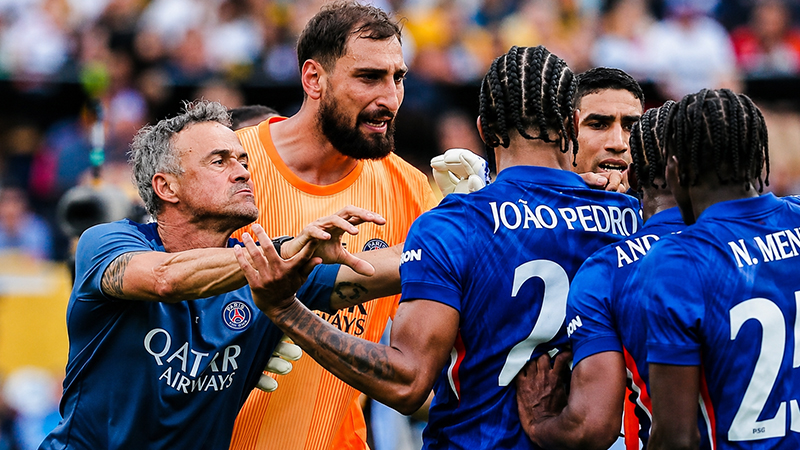
The FIFA Club World Cup final in New Jersey was supposed to be a celebration of elite football, yet it ended in a shocking physical altercation that dominated global headlines.
As Chelsea secured a dominant 3-0 victory, the focus shifted from the trophy presentation to PSG manager Luis Enrique’s uncharacteristic outburst.
The sight of a world-class manager grabbing striker João Pedro by the neck stunned spectators and ignited a firestorm of debate.
Understanding why this happened requires looking beyond the moment of impact to analyze the match-day frustrations, tactical failures, and the psychological weight of managing under extreme pressure.
The Breaking Point in New Jersey
The atmosphere at the full-time whistle was heavy with the weight of Paris Saint-Germain’s 3-0 loss to a Chelsea side that Luis Enrique himself described as “wonderful”.
This was not merely a defeat; it was a comprehensive tactical outclassing that compounded the existing frustrations of a long, high-tension season. For a manager of Enrique’s stature, watching a final slip away in such a decisive manner created a volatile emotional landscape.
A Final Defined by Extreme Tension
Enrique noted that the tournament was born from a need to identify the best team in the world, creating a high-stakes environment where every action is amplified.
The “extreme tension” and immense pressure associated with such a high-level competition made a physical reaction almost logical in his view, given the stress all participants were under. This was the final hurdle of a marathon season, and the psychological fatigue was evident.
The Statistical Context of a 3-0 Defeat
PSG had significant opportunities to score early in the game, but their failure to capitalize allowed Chelsea to seize momentum. Enrique admitted that Chelsea started the game with intense pressure and played exceptionally well.
When Chelsea scored at the end of the first half, the mountain PSG had to climb became significantly steeper, leading to an undercurrent of desperation that persisted throughout the second half.
The Catalyst: From On-Field Friction to Full-Time Brawl
The brawl did not occur in a vacuum; it was the result of a slow burn of incidents that ignited in the closing minutes of the match.
The 86th-Minute Red Card
The hostile tone was set well before the final whistle. In the 86th minute, PSG’s João Neves was sent off for pulling the hair of Chelsea defender Marc Cucurella.
This moment of indiscipline signaled that PSG’s players were losing their composure, a sentiment that quickly spread to the coaching staff. The red card effectively ended any hope of a late comeback and replaced tactical focus with raw aggression.
Defending Teammates: The Spark
When the final whistle blew, the “powder keg” finally exploded. A confrontation broke out between Chelsea’s Andrey Santos and PSG’s Achraf Hakimi.
As emotions flared, João Pedro stepped in to intervene, later stating that “like a good Brazilian,” he went to protect his friend. This act of loyalty placed Pedro in the middle of a swirling mass of PSG players, including goalkeeper Gianluigi Donnarumma.
Analyzing the Physical Altercation: Why Did It Happen?
As João Pedro became entangled in a heated argument with Donnarumma, Luis Enrique stormed the pitch. Rather than acting as a traditional peacemaker, the PSG manager’s intervention was strikingly physical.
| Incident Element | Description of Events |
|---|---|
| The Trigger | Pedro’s argument with Donnarumma following the Santos-Hakimi clash. |
| The Physical Act | Enrique grabbed João Pedro by the neck and face, forcing him to the floor. |
| The Crowd | A “whole bunch of pushing” was occurring simultaneously involving many people. |
| Managerial Peer Involvement | Chelsea’s Enzo Maresca was also caught in the fray, with Enrique claiming Maresca was pushing others. |
The sheer speed at which Enrique moved from the technical area to the center of the pitch suggested a loss of control, though he would later frame this very differently.
The sight of a manager physically subduing an opposing player is rare in modern football, leading to immediate questions about disciplinary consequences and the underlying causes of such an outburst.
Luis Enrique’s Defense: De-escalation or Losing Control?
In the aftermath of the chaos, Luis Enrique was adamant that his actions were misunderstood by the media and the public. He sought to reframe the narrative from one of aggression to one of necessary intervention.
The Goal to “Separate the Footballers”
Enrique reiterated multiple times that his primary objective was to pull the squads apart to prevent his players from incurring further disciplinary trouble.
He claimed that his intention was “crystal clear” and that he wanted to ensure the situation did not become worse than it already was. From his perspective, the pitch was a scene of chaos that required a forceful hand to manage.
The Pressure of the Paris Saint-Germain Environment
Managing a club like PSG brings a unique set of challenges. Enrique highlighted that the club is surrounded by people who “always take advantage” of moments of weakness to criticize.
He acknowledged that he is a polarizing figure—one who “awakens a lot of passion”—and that the intense scrutiny makes every loss feel like a catastrophe.
This defensive posture suggests that his actions on the pitch were partly a reaction to the external pressures that define the PSG project.
The “Bad Loser” Narrative vs. Professional Reality
A significant portion of the post-match discourse centered on whether Enrique exhibited the traits of a “bad loser.” This is a label he flatly rejected during his press conferences.
“We Are the Runners-Up”
Enrique provided a philosophical defense of his team’s performance, stating, “We are not losers… we are the runners-up”. In his view, a loser is only someone who gives up and does not get back up.
By emphasizing that PSG had won four trophies throughout the season, he attempted to contextualize the Club World Cup final as a single disappointing moment in an otherwise successful campaign.
High-Level Sport and Human Emotion
He argued that at the highest level of sport, the line between success and failure is thin, and the emotions involved are naturally extreme.
He admitted to being “a little bit egocentric” but insisted that he generally gets along well with those who truly know him, suggesting that the public image of the brawl did not reflect his true character.
He viewed the stress of the match as “rather logical” and felt he had no problem expressing his feelings at the end of such a taxing game.
Broader Implications for the FIFA Club World Cup
The incident has raised questions about the format and the scheduling of the new FIFA Club World Cup. As the tournament seeks to establish itself as the pinnacle of club football, the intensity of the competition is undeniable.
A High-Stakes Global Format
Enrique found the tournament format “interesting” and “noteworthy,” acknowledging that it was born out of a desire to find the definitive best team in the world.
However, the combination of a long European season followed by a high-stakes summer tournament in New Jersey created a pressure cooker environment.
The fatigue—both mental and physical—of the players and staff was a contributing factor to the lack of discipline shown at the final whistle.
Lessons in Discipline and Management
While Enrique focused on his role as a protector of his team, the global football community viewed the event as a lapse in professional standards.
The confrontation serves as a case study in how the pressures of modern, high-stakes football can bridge the gap between tactical management and physical conflict.
Frequently Asked Questions (FAQ)
Why did Luis Enrique specifically target João Pedro?
Enrique intervened when João Pedro became involved in an argument with PSG’s goalkeeper, Gianluigi Donnarumma. Pedro had entered the fray to protect his teammate Andrey Santos, and Enrique claimed he was trying to separate the groups to avoid further trouble.
Was João Pedro injured in the altercation?
Reports indicate that while Enrique grabbed Pedro by the neck and face, forcing him to the floor, the primary impact was the shock of the physical contact rather than a lasting injury.
What did Luis Enrique say about his actions after the match?
Enrique stated that his intention was to “avoid any type of situation to get even worse” and that he was trying to separate the footballers in a moment of “extreme tension”.
How did Chelsea react to the incident?
While the Chelsea players were involved in the initial pushing, the team largely focused on celebrating their 3-0 victory and their crowning as world champions.
What was the score of the match?
Chelsea defeated PSG 3-0, with João Pedro scoring the final goal that secured the trophy.
A Season of Four Trophies and One Final Flashpoint
Ultimately, the clash between Luis Enrique and João Pedro will be remembered as the defining image of the New Jersey final.
While Enrique’s season with PSG was highly successful—yielding four trophies—this moment of chaos serves as a reminder of the volatility inherent in elite sports.
Whether one views Enrique as a protective leader or a manager who lost his composure, the incident underscores the incredible stress of competing for the title of the “best team in the world.”
As the players head into a well-deserved three-week vacation, the footballing world is left to reflect on a final that was as explosive as it was decisive.