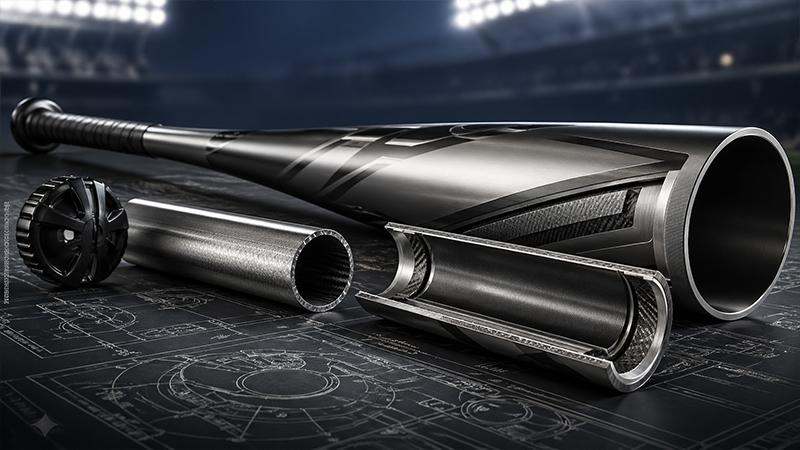
In the high-stakes world of competitive baseball, the crack of a bat is being replaced by a sophisticated “ping.”
But that sound comes with a price tag that often leaves parents and amateur players in a state of sticker shock. As retail prices for top-tier aluminum bats climb toward the $500 mark, a critical question emerges: What are you actually paying for?
To the untrained eye, a bat is a simple metal tube. To a world-class engineer, it is a complex precision instrument designed at the intersection of aerospace material science and kinetic physics.
This report breaks down the multi-faceted reasons—from trampoline effect optimization to aerospace-grade alloy sourcing—that justify the premium pricing of modern aluminum bats.
The R&D Engine: Engineering the “Trampoline Effect”
At the heart of every premium bat’s price tag is a massive investment in Research and Development (R&D). Manufacturers are not just shaping metal; they are fine-tuning the physics of energy transfer.
The Physics of the Barrel
The primary goal of high-end engineering is to maximize what is known as the “trampoline effect”. When a ball strikes a wood bat, the ball compresses and loses significant energy.
However, a high-end aluminum bat is designed so that the barrel wall itself compresses slightly upon impact, then springs back, returning energy to the ball.
Optimizing this effect requires millions of dollars in simulation software and physical testing. Engineers must calculate the exact wall thickness—often varied across the length of the barrel—to ensure the maximum possible exit velocity.
Navigating the Regulatory Tightrope
The engineering challenge is compounded by strict regulatory standards like BBCOR (Batted Ball Coefficient of Restitution) and BESR (Ball Exit Speed Ratio).
Manufacturers must invest heavily to ensure their bats hit the absolute legal limit of performance without crossing it.
This “limit-testing” requires precise calibration; a bat that is too “hot” will be banned, while a bat that is too “dead” will fail in the marketplace.
Material Science: Aerospace Pedigree on the Diamond
The “aluminum” in a $400 bat is a far cry from the aluminum found in a soda can. Modern bats utilize aerospace-grade alloys and complex composite layers that are inherently expensive and difficult to manipulate.
High-Performance Alloys
Premium bats often use proprietary zinc-aluminum alloys or scandium-infused metals. These materials are chosen because they offer an elite strength-to-weight ratio, allowing for a thinner barrel wall (enhancing the trampoline effect) without sacrificing structural integrity.
The Composite Revolution
In many top-tier models, engineers incorporate complex composite layers. These carbon-fiber-based materials allow for “tuned” stiffness.
By layering fibers in specific orientations, manufacturers can create a handle that flexes to whip the head through the zone while keeping the barrel stiff enough for maximum power. The manufacturing tolerances required for these layers are incredibly tight, driving up the cost of production.
The Manufacturing Paradox: Precision at Scale
While mass production usually lowers costs, the sophisticated engineering of aluminum bats requires a level of manufacturing precision that keeps prices high.
Tight Tolerances and Quality Control
Unlike cheaper alternatives, premium bats are built to precise manufacturing tolerances. If a barrel wall is off by even a fraction of a millimeter, it can change the bat’s vibration frequency or its performance against BBCOR standards.
Maintaining this level of consistency across thousands of units requires expensive machinery and rigorous quality control protocols.
Western Labor and Specialized Craftsmanship
A significant portion of the cost is attributed to the complex labor process. The shaping, heat-treating, and multi-stage engineering of these bats—particularly when performed in Western countries to ensure higher quality standards—involves high labor costs.
The transition from a raw tube of alloy to a finished, high-performance bat is a labor-intensive journey involving specialized technicians rather than just automated assembly lines.
The Value Proposition: Aluminum vs. Wood
To understand the price, one must look at the Cost-Per-Swing. While the upfront cost is higher, aluminum bats are often a more economical “one-time” investment for youth and college players.
| Feature | Wood Bats | Premium Aluminum Bats |
|---|---|---|
| Upfront Cost | Low ($100 – $200) | High ($300 – $500) |
| Durability | Prone to breaking/splintering | Extremely durable; no splintering |
| Consistency | Varies by grain and wood quality | High-level performance “out of the wrapper” |
| Distance | Standard | Potential for 50-100 ft further hits |
The Durability Factor
Wood bats are fragile. A single “mishit” on the handle or the end of the bat can result in a snapped barrel, necessitating an immediate replacement.
In contrast, an aluminum bat does not break or splinter, offering a longer life and consistent performance over multiple seasons.
This longevity makes them the gold standard for college and youth leagues, where the budget for replacing equipment is a primary concern.
Performance ROI: The 100-Foot Advantage
In competitive sports, even a 1% advantage is worth a premium. In baseball, the engineering of a premium aluminum bat can translate to hits that travel 50 to 100 feet further than those from a standard bat.
For a high school player looking to get noticed by recruiters, or a college player aiming for the draft, that extra 50 feet is the difference between a routine flyout and a home run.
The market price is driven by this intense consumer demand for a competitive advantage. Players and parents are not just buying a piece of equipment; they are investing in the statistical probability of better performance.
Brand Equity and the Price of Trust
Finally, the retail price reflects the brand and marketing investments of industry leaders. Major brands invest millions in:
- On-field testing with elite athletes.
- Reputation management to ensure players feel confident in their gear.
- Marketing that highlights their technological breakthroughs.
Players are often willing to pay a premium for a brand they trust, knowing that the manufacturer has a proven track record of maximizing performance within legal limits.
Conclusion: Engineering the Future of the Game
The $500 aluminum bat is a byproduct of a competitive arms race in sports technology. Between the R&D costs required to master the trampoline effect, the use of aerospace-grade materials, and the complex labor required for precision manufacturing, the price is a reflection of the bat’s status as a high-performance tool.
For the serious athlete, the “Price of Power” is justified by the bat’s durability and its ability to deliver consistent, elite-level results right out of the wrapper. It is not just a bat; it is the pinnacle of modern sports engineering.
Frequently Asked Questions (FAQ)
Q: Is a $400 bat really better than a $100 bat?
A: Yes, in terms of technical specifications. Higher-end bats use better alloys that allow for thinner walls and a more pronounced trampoline effect, which can increase hit distance by 50-100 feet.
Q: Why do college players use aluminum if pros use wood?
A: Cost and durability. Aluminum bats are a “one-time” investment because they don’t break or splinter like wood. Additionally, the performance boost of aluminum makes the college game more high-scoring and exciting for fans.
Q: Does an aluminum bat lose its “pop” over time?
A: While aluminum is durable, the “trampoline effect” can eventually diminish after thousands of hits as the metal fatigues. However, they still remain significantly more cost-effective than wood over a long season.