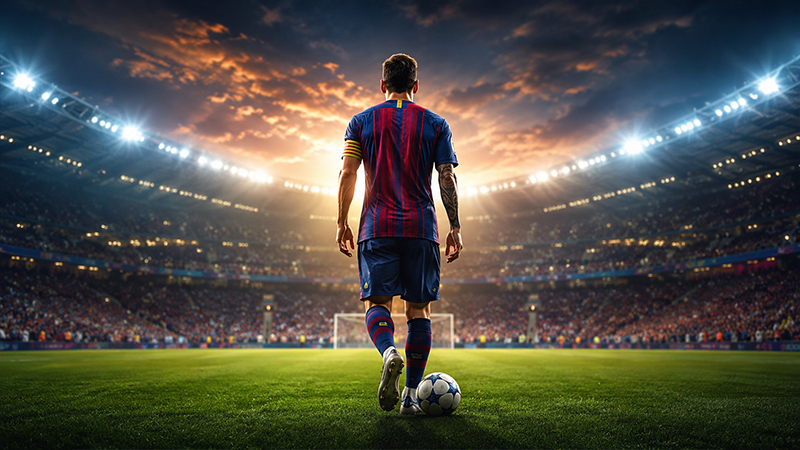
In the landscape of modern digital discourse, few questions are as circular, provocative, or unintentionally profound as “Who is the Lionel Messi of soccer?” At first glance, the query appears to be a linguistic redundancy—a glitch in the matrix of sports commentary.
This question represents a fascinating intersection of user intent, cultural satire, and the evolving globalization of the world’s most popular sport.
This deep-dive analysis explores the “Messi of Soccer” phenomenon, examining the cultural “Messi Effect” in North America, the statistical realities of a 36-year-old “machine,” and the satirical internet communities that have turned a simple name into a multifaceted meme.
The Linguistic Divide: Soccer vs. Football
To understand why the question “Who is the Lionel Messi of soccer?” exists, one must first navigate the historical and cultural divide between American “soccer” and global “football”.
For many international fans, the phrasing itself is a point of contention, often met with the corrective retort: “It’s football, not soccer”.
This tension serves as the foundation for the satirical discourse found in communities which characterizes itself as a space for “classy sophisticated satire”.
In these digital arenas, users intentionally use Americanized terminology to poke fun at the growing, yet sometimes clunky, integration of European football culture into the United States’ sporting consciousness.
The “Messi Effect”: Redefining the Sport in the United States
The search intent behind “Messi of Soccer” often leads directly to his transformative impact on Major League Soccer (MLS). Following his tenure at Paris Saint-Germain (PSG), Messi’s move to Inter Miami was not merely a transfer; it was a cultural shift.
The Viral Impact of the Leagues Cup
Messi’s arrival “absolutely blew up” the sport in the USA. His debut and subsequent performances in the Leagues Cup became a viral sensation, capturing the attention of a nation that has historically been slow to embrace the sport.
By delivering “ridiculous free kicks and golazos,” Messi did more than win matches; he fundamentally changed how Americans view the quality and entertainment value of the game.
A Machine at 36
A critical component of his current authority is his longevity. At 36 years old, Messi continues to “shock people with his quality every match”.
While younger athletes may possess more raw speed, Messi’s status as a “machine” remains unchallenged, evidenced by his pivotal roles in both the Leagues Cup and the 2026 World Cup qualifiers.
For the American audience, he isn’t just a player; he is the definitive proof of concept for soccer’s elite tier.
The GOAT Debate: Statistical Prowess vs. Cultural Gravity
In any SEO-driven analysis of sporting excellence, the comparison between traditional metrics and cultural impact is vital.
Messi vs. Haaland: The Quality Gap
When users search for the “Messi of soccer,” they are often looking for a comparison with modern rivals like Erling Haaland.
It is a matter of record that Haaland scored more goals and secured more prestigious trophies in the English Premier League (EPL) during recent seasons. However, traditional insights suggest that goals alone do not define the “Messi” archetype.
Despite Haaland’s clinical efficiency, many observers classified the recent period as “The Year of Messi” because of his ability to “show up big” in high-pressure international and domestic moments.
The consensus among many fans is that while others might match his output, none match his “joy to watch” factor—the “Prime Messi” standard that remains the benchmark for all playmakers.
The “Saka” Comparison
Emerging search trends have also begun to link younger stars like Bukayo Saka to Messi’s legacy.
Some analysts argue that Saka’s current form is “genuinely close to as good as Messi was in 2021”. While these comparisons are often debated, they highlight a specific user intent: the search for the next Messi.
Cross-Sport Icons: Messi as a Global Benchmark
The name “Messi” has transcended the pitch to become a unit of measurement for greatness across all disciplines. This is a key area that is established by placing the athlete in a global context.
- The Michael Jordan of Soccer: Many fans simplify his dominance by referring to him as “Messi’s Jordan,” a title that resonates with American audiences familiar with basketball’s “Greatest of All Time”.
- The “Asada Curry” (Steph Curry) Parallel: In some circles, his technical precision is compared to Steph Curry’s impact on the NBA, emphasizing his role as a game-changer who relies on skill over brute force.
- The Payton Pritchard Meme: In more niche, satirical corners of the internet, unexpected names like Payton Pritchard are jokingly elevated to the “Messi” status, reflecting how the term is used to describe any player currently overperforming their expected role.
Satire and Subversion: The “Antony” Phenomenon
A world-class content strategy must acknowledge the “gaps” in traditional reporting—specifically the role of irony. In online communities, the question “Who is the Messi of soccer?” is often met with the name Antony.
Within the context of “sophisticated satire,” users ironically claim that “Messi is the Antony of soccer” or that Antony is the “true GOAT”. This subversion of the GOAT debate serves as a critique of how fans obsess over rankings and statistics.
It suggests that in the digital age, being “viral” or a “meme” can sometimes carry as much weight in public discourse as traditional trophies.
Enhanced FAQ: Navigating the Most Searched Queries
Q: Who is considered the greatest playmaker in UCL history?
A: According to long-standing community consensus and historical performance, Lionel Messi is frequently cited as the greatest playmaker in the history of the UEFA Champions League (UCL).
Q: Why do people call Messi a “machine”?
A: This term is often used to describe his consistent ability to perform at an elite level despite his age. Even at 36, his impact on match results through “golazos” and strategic play remains unparalleled.
Q: What is the “Messi Effect” in the USA?
A: The “Messi Effect” refers to the massive surge in soccer’s popularity in America following his move to Inter Miami. It encompasses increased viewership, viral social media moments, and a fundamental change in how the sport is perceived domestically.
Q: Who is the “real Messi of Lionel”?
A: This circular, satirical question often appears in fan discussions (such as on Reddit) to highlight the absurdity of constantly trying to find a “new” Messi when the original is still active and dominant.
Conclusion: The Final Verdict
Ultimately, the search for the “Lionel Messi of soccer” ends where it begins. While the internet may offer satirical alternatives like Antony or statistical rivals like Haaland, the data and cultural evidence consistently point back to one individual.
Whether it is his “greatest ever assist,” his ability to “cream over a goal,” or simply the fact that he continues to be a “joy to watch,” Messi remains the definitive standard.
The lesson is clear: Messi is not just a player; he is a global entity that has redefined the commercial and cultural potential of the world’s game.