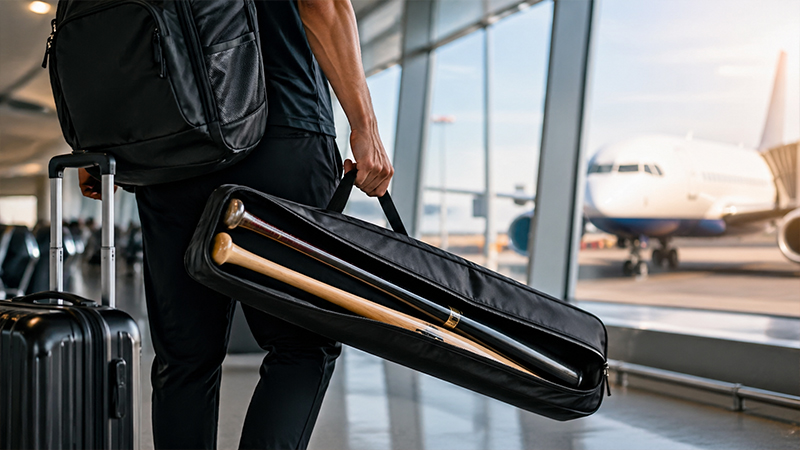
In the world of elite travel ball and collegiate athletics, your equipment is more than just gear—it is a significant financial investment and the primary tool of your trade.
With high-end composite bats like the USSSA DeMarini Zoa or BBCOR powerhouses often retailing for upwards of $400, the stakes of air travel are high.
For the modern athlete or travel-ball parent, the logistics of getting from home base to a major tournament like Cooperstown All-Star Village or a Perfect Game showcase involve navigating a complex web of TSA regulations and airline baggage policies.
One wrong move at the security checkpoint could result in a confiscated bat or a damaged barrel that loses its “pop” before the first pitch.
This comprehensive guide, designed for the high-performing athlete and the meticulous travel coordinator, breaks down everything you need to know about flying with baseball bats.
We combine federal safety protocols with “field-tested” hacks from the community to ensure your gear arrives ready for the championship game.
The Regulatory Landscape: Decoding TSA and Airline Protocols
The most critical baseline for any traveler is understanding where their equipment belongs. There is a common misconception among new travel-ball families that a baseball backpack—which fits comfortably in an overhead bin—is an acceptable carry-on even when loaded with bats.
The “Bludgeon” Rule
According to official TSA and airline regulations, baseball bats are strictly prohibited in carry-on luggage. The federal government classifies sports equipment that can be used as a “bludgeon”—specifically including bats and clubs—as potential weapons.
Key Takeaways for Compliance:
- Checked Luggage Only: You must pack your bats in checked bags.
- Security Rejection: If you attempt to bring a bat through a security checkpoint, even in a sleek backpack, it will be rejected.
- Zero Tolerance: Unlike some tools or liquids, there is no “small size” exemption for bats; if it’s a bat, it’s a bludgeon in the eyes of the law.
Protecting the Investment: Why Standard Luggage Isn’t Enough
While checking your bat is a legal requirement, simply throwing it into a soft-sided duffel bag is a recipe for disaster.
The baggage handling process is notoriously rigorous. Bats, especially composite models, are susceptible to structural damage if subjected to extreme pressure or blunt impact during transit.
The Financial Math of Protection
Consider this: an extra-large, 32-inch hard-sided suitcase can often be found at discount retailers for approximately $100. When compared to the $400+ cost of a premium bat, the suitcase pays for itself four times over by preventing a single dent or hairline fracture.
Expert Recommendation: For maximum protection, always opt for a hard-sided, padded case. This provides a rigid exoskeleton that shields the bat’s barrel from being crushed by heavier suitcases in the cargo hold.
The “Pro-Hack” Playbook: Creative Solutions for the Frequent Flyer
Seasoned travelers have developed several ingenious methods to bypass common logistical hurdles, such as bag length limitations and “oversized” baggage fees.
1. The Golf Bag “Loophole.”
One of the most effective ways to transport longer gear is to use a golf bag.
- The Advantage: Most airlines have specific policies for golf clubs that do not classify them as “oversized,” provided they meet weight requirements.
- The Hack: By checking a golf bag and identifying it as “golf stuff,” travelers have reported saving significant amounts (sometimes $15 or more per flight) on specialty gear charges.
- Capacity: A golf bag is naturally long enough to accommodate multiple bats, and its structural padding provides excellent protection.
2. The “Nesting” and “Tripod” Method
For players who prefer a modular approach, the “nested” strategy offers unparalleled security.
- Original Packaging: Keep the original shipping box your bat arrived in. These boxes are engineered to withstand the rigors of transit.
- Nylon Totes: A clever community find is the use of a nylon tripod or camera tote (such as a 35-inch VidPro).
- The Setup: Wrap the bat in bubble wrap, slide it into the original box, and then place that box inside the tripod tote. This creates a snug, triple-layered shield that fits easily into the checked luggage stream.
3. The Rifle Case Debate
Some athletes utilize double rifle bags because they are heavy-duty, highly padded, and feature numerous pockets for extra clothes and cleats.
- The Risk: However, many travelers warn against this due to the “social and security tax”. Carrying a bag that clearly resembles a firearm container through an international airport can lead to increased scrutiny from law enforcement and may cause unnecessary anxiety for other passengers.
Elite Gear Recommendations: The Best Bags for the Job
If you prefer purpose-built sports luggage over “hacks,” several brands dominate the market for their durability and “travel-friendly” designs.
| Brand | Model/Type | Key Features for Travel |
|---|---|---|
| Boombah | Beast/Rolling Bags | Features built-in bat sleeves along a solid spine, providing structural integrity that prevents bats from bending. |
| Bownet | The Commander | Often considered “not oversized” by many airlines; includes high-quality wheels and enough space for full gear sets. |
| Ogio | Rig 9800 / Luggage | Known for extreme durability and “sled” technology that protects the bottom of the bag during rough handling. |
| Smash it Sports | Various | Offers a wide array of specialized bags specifically sized for different bat lengths and quantities. |
Strategic Packing: The “Diagonal Method”
When you don’t have a specialized bag, a standard large suitcase can still work—if you know the geometry.
- The 32-Inch Standard: You will generally need at least a 32-inch suitcase to fit a standard adult bat.
- The Diagonal Placement: Do not try to fit the bat parallel to the sides. Place the bat diagonally from one corner to the opposite corner to maximize the available length.
- The Clothing Buffer: Surround the bat with rolls of clothes, uniforms, and towels. This uses your soft goods as a free, high-density shock absorber to prevent the bat from shifting and hitting the suitcase walls.
Logistics and Tech: Managing the “Invisible” Risks
Flying with gear involves more than just physical protection; it requires managing the digital and financial aspects of the journey.
Real-Time Tracking with AirTags
Lost luggage is a nightmare for a tournament-bound athlete. A recurring “best practice” is to hide an Apple AirTag (or similar GPS tracker) deep inside the bat sleeve or a zippered pocket of your bag.
This allows you to verify that your gear made it onto the plane before you even leave the tarmac.
Managing Hidden Fees
Airlines are increasingly aggressive with “oversized” and “overweight” fees.
- Verify Dimensions: Before buying a bag, check the linear inch limit (Length + Width + Height) for your specific carrier.
- Weight Limits: Large 32-inch suitcases filled with multiple bats, cleats, and heavy uniforms can easily exceed the 50lb weight limit. Always use a handheld luggage scale before leaving for the airport.
Alternatives: When Flying the Bat Isn’t the Best Play
In some cases, the cost and hassle of checking a bat outweigh the benefits.
- Shipping Ahead: You can avoid the airport altogether by shipping your bat to your hotel or the tournament facility. Services like UPS or FedEx provide tracking and insurance that often exceeds airline coverage.
- Purchasing Locally: If you are traveling for a long-duration event or an internship, consider buying a bat at your destination. For some, the $100+ round-trip baggage fees are better spent toward a new piece of equipment.
Enhanced FAQ: Your Questions Answered
Q: Can I bring my baseball backpack as a carry-on if the bats are removed?
A: Yes. Many players use their standard baseball backpack as their carry-on for personal items and then check their bats separately in a larger bag or dedicated case.
Q: Are wooden bats treated differently from composite bats?
A: From a TSA perspective, no—both are “bludgeons.” However, from a protection perspective, wooden bats are more susceptible to snapping if weight is pressed against the middle of the handle. Use a “solid spine” bag or the “nested box” method for wood bats.
Q: What should I do if the airline loses my bat bag?
A: Immediately file a claim at the baggage service office before leaving the airport. This is where your AirTag data and photos of your equipment (taken before you packed) become invaluable for insurance claims.
Conclusion: Preparation is the Ultimate Competitive Advantage
Success on the diamond starts long before the first inning; it begins with the discipline of preparation.
By understanding the bludgeon rule, utilizing the golf bag hack, and investing in hard-sided protection, you ensure that your most important tool is ready to perform when the game is on the line.
Actionable Next Step: Before your next flight, measure your bats and compare them against the diagonal length of your current luggage.
If they don’t fit with at least two inches of clearance on each side, it’s time to invest in a 32-inch hard-shell case or a specialized Boombah/Ogio travel bag.