
In the modern era of baseball, the role of the pitcher has evolved from a simple test of arm strength into a sophisticated discipline of biomechanical efficiency and psychological warfare.
Achieving greatness on the mound requires more than raw talent; it demands the integration of fluid physical mechanics, explosive total-body power, and a refined mental approach that can withstand the highest levels of competitive pressure.
This guide provides a comprehensive framework for developing the attributes of a world-class pitcher, focusing on the essential pillars of delivery, physical conditioning, and strategic execution.
I. The Foundation: Mastering Biomechanical Fluidity
The most critical component of a sustainable and effective pitching career is the mastery of smooth, repeatable mechanics.
Without a foundation of proper movement, even the most powerful athletes will eventually succumb to inconsistency or injury.
The Role of Fluid Motion
A great pitcher must prioritize a fluid motion throughout the delivery. The presence of unnecessary body tension is the primary enemy of both velocity and command.
When a pitcher is “tight,” the muscles fight against one another, shortening the stride and disrupting the natural whip of the arm.
By removing tension, the delivery becomes smooth and repeatable, allowing the pitcher to hit their spots with surgical precision.
Repeatability is the hallmark of professional-grade pitching. If the delivery changes from pitch to pitch, the results will inevitably fluctuate.
A fluid motion ensures that the body moves as a single, cohesive unit, reducing the stress on the elbow and shoulder while maximizing the transfer of energy from the ground to the release point.
Establishing Equilibrium and Balance
The delivery begins long before the ball leaves the hand. To maintain control over the baseball, a pitcher must first maintain control over their own center of gravity.
This starts with balance. During the initial leg lift, a pitcher must remain stable and centered over their back leg.
Instability at the start of the delivery leads to a “leak” of power. If the pitcher’s weight shifts too early or too late toward home plate, the kinetic chain is broken.
By staying stable over the back leg, the pitcher creates a platform of potential energy that can be unleashed toward the plate in a controlled, explosive burst.
II. The Kinetic Engine: Generating Power and Velocity
While the arm is the final point of release, it is not the primary generator of power in an elite delivery. High-velocity pitching is a total-body effort that begins at the feet and travels through the legs and core.
Driving from the Lower Body
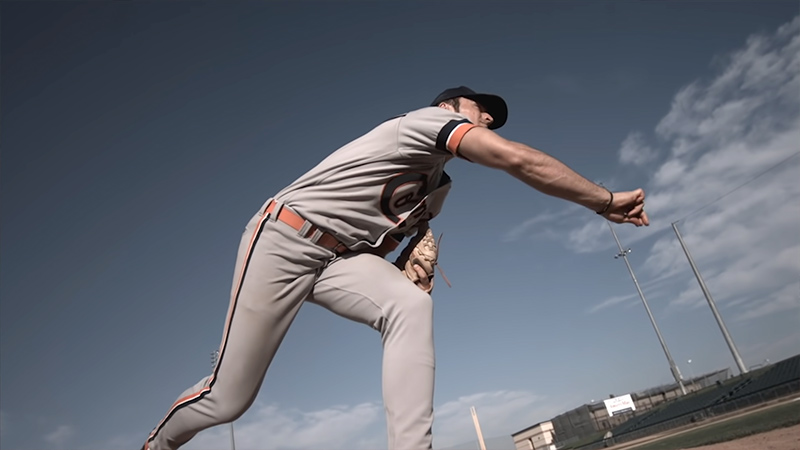
To become a great pitcher, one must shift the focus away from “throwing with the arm” and toward “driving with the lower body.” Explosive velocity is generated through the legs and core.
The legs are the strongest muscles in the body; by using them to drive toward home plate, a pitcher can generate significant force without overtaxing the smaller, more fragile muscles of the rotator cuff.
This lower-body drive creates a “whip” effect. As the lead foot plants, the energy generated by the legs is transferred through the core and eventually into the arm.
This sequence allows the arm to move faster with less perceived effort, leading to higher velocity and improved long-term health.
Physical Conditioning and Stamina
Greatness is not measured by the first inning alone, but by the ability to maintain peak performance late into a contest. Conditioning is the tool that allows a pitcher to maintain velocity and accuracy deep into games.
A professional conditioning program for pitchers should focus on two areas:
- Aerobic and Anaerobic Capacity: Building the heart and lungs to recover quickly between pitches and innings.
- Functional Strength: Ensuring the muscles responsible for the delivery—the glutes, hamstrings, and obliques—do not fatigue. When a pitcher tires, their mechanics break down, usually leading to elevated pitches and lost velocity.
Safeguarding the Arm: Shoulder Health
Longevity in baseball is predicated on arm health. Because the pitching motion is inherently stressful, a pitcher must be proactive in protecting their arm through targeted exercises. Utilizing rotator cuff exercises and resistance bands is essential for strengthening the stabilizing muscles of the shoulder. These exercises do not necessarily build “bulk,” but rather ensure that the shoulder joint remains stable and resilient against the repetitive force of the delivery.
III. The Art of Deception: Command and Pitch Sequencing

In the professional ranks, velocity is a tool, but deception is the master key. A pitcher who throws 100 miles per hour but lacks deception will eventually be timed by elite hitters. True dominance is achieved through the marriage of arm speed and pitch variation.
Matching Arm Speed and Slots
One of the most profound secrets to “fooling hitters” is the ability to match arm speed across the entire pitch repertoire.
Whether a pitcher is throwing a 95-mph fastball or an 82-mph changeup, the delivery, arm speed, and arm slot must remain identical.
Hitters are trained to look for “tells”—slight changes in the pitcher’s rhythm or arm path that signal a breaking ball or off-speed pitch.
When a pitcher can throw a changeup using the same aggressive arm speed as their fastball, the hitter’s brain is tricked into expecting velocity. By the time the hitter realizes the ball is moving slower, their timing is already disrupted.
Strategic Pitch Sequencing
Strategic success requires a “smart pitch sequencing” approach. Pitching is a game of disrupting the hitter’s timing and balance. This is achieved by changing speeds and locations.
A master pitcher rarely throws the same pitch in the same location twice in a row. By mixing fastballs with breaking balls and changeups, and by altering targets between high and low zones, the pitcher keeps the hitter in a defensive mindset.
Moving the ball “up and down” changes the hitter’s eye level, while “in and out” forces the hitter to cover the entire width of the plate.
Scouting and Hitter Analysis
At the highest levels, pitching is as much a mental exercise as a physical one. To gain an advantage, pitchers must study hitters to identify weaknesses. Every hitter has a “cold zone”—a specific location or pitch type they struggle to handle.
By analyzing which pitches an opposing batter finds difficult to hit, a pitcher can develop a game plan that plays to their own strengths while exploiting the batter’s deficiencies.
IV. The Mental Fortress: Performance Under Pressure

The mound is one of the loneliest places in sports. When the bases are loaded and the game is on the line, the physical tools of a pitcher are only as good as the mind that directs them.
Cultivating a Mental Focus
Developing a sharp mental focus under pressure is a non-negotiable requirement for greatness. The ability to block out the noise of the crowd, the stakes of the game, and the fear of failure is what separates “throwers” from “pitchers.”
The Power of the Routine
Anxiety is the byproduct of focusing on the outcome rather than the process. To combat this, elite pitchers use a consistent pre-pitch routine to block out anxiety and remain present in the moment.
Whether it’s a specific way of adjusting the cap, a deep breath, or a focal point on the catcher’s mitt, the routine serves as a mental reset. It tells the brain that regardless of the situation, the task remains the same: execute the next pitch.
Staying Calm and Executing
The objective is to stay calm and execute under pressure. When a pitcher becomes emotional or hurried, their mechanics often become tense, leading back to the issues discussed in the foundation of this guide.
By maintaining a steady heart rate and a clear mind, the pitcher ensures that their body is free to perform the fluid, powerful motions they have practiced.
Conclusion
Becoming a great baseball pitcher is a journey of continuous refinement. It is a pursuit that begins with the discipline of smooth mechanics and balance. It is fueled by the explosive power of the lower body and the dedication to long-term arm health.
It is won through the strategic manipulation of the strike zone and the deceptive use of arm speed. And finally, it is mastered through the psychological resilience to remain calm when the pressure is at its peak.
By integrating these physical and mental pillars, an athlete moves beyond the role of a participant and becomes a master of the mound. The path to greatness is paved with repetition, intelligence, and an unwavering commitment to the craft