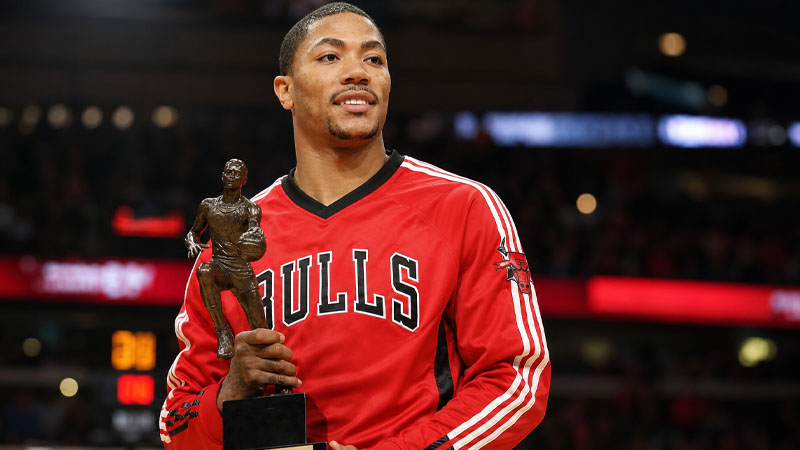
Derrick Rose is highly likely to make the Naismith Memorial Basketball Hall of Fame despite having lower career totals than typical inductees. His candidacy rests on the “MVP Precedent,” as every eligible MVP winner in history has been enshrined.
While injuries curtailed his prime, his status as the youngest MVP ever and a cultural icon gives him significant historical weight. Furthermore, the Hall evaluates his entire career, including two FIBA gold medals and a dominant college run.
While advanced metrics give him only a 10.5% probability, the human voting committee traditionally values historic peaks and cultural impact over pure volume.
Why the NBA MVP Precedent Virtually Guarantees Induction
The most compelling argument for the induction of Derrick Rose is a historical trend that has never been broken in the history of the sport.
The MVP award is considered the ultimate individual achievement, and the committee has traditionally viewed it as an automatic ticket to Springfield.
The History of the Unbroken MVP Streak
In the history of the league, every single eligible player who has won the Most Valuable Player trophy has been inducted into the Hall of Fame. This list includes legends whose careers were long and those whose primes were relatively brief.
If the committee were to reject Rose, he would become the first-ever retired MVP winner excluded from the Hall, a move that would fundamentally alter the perceived value of the league’s highest individual honor.
Unlike other sports like baseball or football, where numerous MVPs are not in their respective Halls of Fame, basketball places a much higher premium on this specific accolade because an individual player has more power to influence a game’s outcome.
Historical Relevance and the LeBron James Factor
Derrick Rose’s 2011 MVP season was not just an impressive statistical year; it was a historically significant moment that shifted the narrative of the league.
At just 22 years old, he became the youngest player to ever win the award, leading the Chicago Bulls to 62 wins. Perhaps more importantly, Rose is the reason LeBron James did not win five consecutive MVPs between 2009 and 2013.
This level of peak dominance and historical relevance is a key component of what the committee looks for, often weighing the height of a player’s ceiling more heavily than the length of their career.
Analyzing the Statistical Obstacles to Enshrinement
While the historical precedent favors Rose, a purely analytical look at his career reveals significant gaps when compared to the average Hall of Fame resume.
Most statistical models struggle to account for the impact of a player whose career was bifurcated by a catastrophic injury.
| Accolade / Metric | Derrick Rose’s Career Total | Typical HOF Baseline |
|---|---|---|
| MVP Awards | 1 (2011) | 100% of eligible winners are in |
| All-Star Selections | 3 | Usually 6 or more |
| All-NBA Selections | 1 | Usually 4 or more |
| Career Points | 12,573 | Usually 15,000–20,000+ |
| Career Assists | 3,770 | Usually 5,000+ |
The analytical case against Rose centers on his lack of longevity and cumulative volume. Following his 2012 ACL tear, he never regained the explosive form that made him an MVP, leading to a “barren” resume outside of his initial peak.
Basketball Reference’s Hall of Fame probability model gives him only a 10.5% chance because it relies heavily on total All-Star selections and leaderboard statistics—metrics Rose was unable to accumulate after his injuries.
Furthermore, his three All-Star selections are exceptionally low; most modern inductees boast at least six.
However, supporters argue that Rose’s “fame” threshold was reached so definitively during his prime that his later years as a respected Sixth Man should not detract from his early brilliance.
The Naismith Memorial Criteria: A Global Evaluation
It is essential to remember that the institution in Springfield is the Naismith Memorial Basketball Hall of Fame, not merely an NBA Hall. The voters are tasked with evaluating a player’s entire contribution to the game globally.
International Excellence and FIBA Success
One of the major gaps in the public debate regarding Rose is his success on the international stage. Rose was a vital member of Team USA during its resurgence, winning two FIBA World Cup Gold Medals (2010 in Turkey and 2014 in Spain).
These achievements provide a significant boost to his resume, as the committee values international contributions as much as professional league play.
For many voters, these gold medals, combined with his NBA MVP, create a complete picture of a player who succeeded at the highest levels of the sport.
The Blueprint of Bill Walton and Bob McAdoo
When searching for historical comparisons, Rose’s career mirrors those of Bill Walton and Bob McAdoo. Walton, like Rose, suffered career-altering injuries that limited his longevity but was inducted due to his immense peak dominance and a successful college career.
While Walton’s case is structurally stronger due to his two NBA championships and Finals MVP, Rose’s college dominance is also noteworthy.
He led the Memphis Tigers to the 2008 NCAA National Championship game, a feat that voters recognize even if the season was technically vacated by the NCAA.
Like McAdoo, who waited ten years after retirement for his induction, Rose may need to rely on the committee’s appreciation for short-lived brilliance.
Understanding the Secretive Voting Mechanics
The process for entering the Hall of Fame is significantly different from other professional sports, relying on specialized sub-committees and a human element that often ignores statistical models.
The Screening and Honors Committee Roles
When Rose becomes eligible in 2028, his name will first be vetted by the North American Screening Committee. This anonymous panel requires a candidate to receive 5 out of 9 votes to advance.
If he passes this stage, his candidacy moves to the Honors Committee, a rotating 24-person panel consisting of Hall of Famers, media members, and executives.
To be inducted, he needs a staggering 18 out of 24 votes. This secretive process favors Rose because it allows for a nuanced discussion of his impact rather than a rigid adherence to box score totals.
The Power of Peer Influence and Cultural Impact
The Honors Committee is often populated by Rose’s contemporaries and former coaches who witnessed his peak firsthand. This “human element” is why many insiders dismiss low statistical probability scores.
There is an immense emotional reverence for Rose’s mental toughness in reinventing his career after multiple surgeries, transitioning from a superstar to a valued veteran mentor.
The 2026 retirement of his No. 1 jersey by the Chicago Bulls further solidified his cultural legacy, signaling to the committee that he remains one of the most significant figures of his era regardless of his final career totals.
When Will Derrick Rose Be Inducted?
The debate is rarely about if he will make it, but rather when the committee will decide to extend the invitation. While he may lack the hardware of a first-ballot lock, his eventual induction feels inevitable to many.
The Timeline for the Class of 2028
Following his retirement in September 2024, Rose must be retired for three full seasons before he can appear on a ballot. This sets his first eligibility year for the Class of 2028.
While some purists may argue that his lack of longevity should keep him waiting, the “MVP Precedent” usually moves candidates to the front of the line.
If he is not a first-ballot inductee, he will likely be a frequent finalist until the Honors Committee decides to preserve the legacy of the MVP trophy by voting him in.
Managing Legacy and Historical Expectations
Derrick Rose has expressed a grounded view of the debate, stating that his focus remains on his personal journey rather than the opinions of future generations.
However, for the sport itself, his induction is a necessity for the Hall to remain a true museum of basketball history. You cannot tell the story of the NBA over the last fifteen years without discussing the meteoric rise, the tragic fall, and the resilient second act of Derrick Rose.
His inclusion will ultimately serve as a testament to peak excellence and the cultural impact of a player who changed the game at age 22.
Frequently Asked Questions About Derrick Rose’s Hall of Fame Bid
Will Derrick Rose be the first MVP to miss the Hall of Fame?
If rejected, yes. Currently, every eligible NBA MVP is in the Hall of Fame. Rose is the only retired MVP whose induction is a matter of serious debate due to his injury-shortened prime.
How do his stats compare to other Hall of Famers?
His 12,573 points and 3,770 assists are lower than the typical baseline of 15,000 points and 5,000 assists. However, he has more career points than inductee Mo Cheeks and a higher individual peak (the MVP) than Mitch Richmond or Tim Hardaway.
Does his college career help his case?
Yes. The Hall of Fame considers a player’s entire basketball life. Leading Memphis to the 2008 National Championship game and his high school dominance in Chicago are significant “trust signals” for the committee.
How many gold medals did Derrick Rose win?
Rose won two FIBA World Cup Gold Medals with Team USA in 2010 and 2014. These international accolades are crucial for any “Basketball” Hall of Fame resume.
Final Thoughts on a Polarizing Legacy
The candidacy of Derrick Rose challenges our understanding of what a Hall of Famer should be. Is it a reward for fifteen years of steady excellence, or a museum dedicated to the most famous and impactful players to ever step on the court?
Because Rose reached a level of fame and dominance that few have ever touched, he has likely done enough to secure his place among the legends in Springfield.
Whether it happens in 2028 or further down the road, the youngest MVP in history is destined for enshrinement.