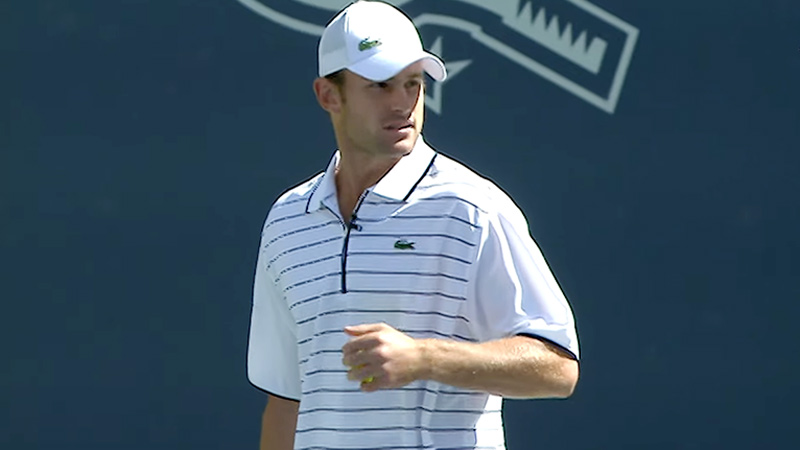
Andy Roddick’s serve was historically elite because it combined unprecedented racquet-head speed, a revolutionary abbreviated backswing, and flawless kinetic chain execution to generate blistering velocity and heavy topspin.
While typical power servers stand near 6’10”, Roddick achieved a world-record 155 mph (249 km/h) at just 6’2” through extreme biomechanical optimization.
His success stemmed from a unique “half-motion” takeback that minimized timing errors, 90-degree knee flexion for explosive vertical drive, and rapid forearm pronation that generated lethal topspin.
Statistically, he maintained an elite first-serve accuracy of 65% to 74%, making his delivery both the fastest and one of the most reliable in tennis history.
Analyzing How Good Was Roddick’s Serve Statistically
Roddick’s serve is widely considered one of the greatest weapons in tennis history, placing him in the elite top five servers of the Open Era.
Unlike many “serve bots” who rely solely on height, Roddick’s effectiveness was built on a foundation of both raw power and high-percentage consistency.
The 155 MPH World Record and Velocity Consistency
The hallmark of Roddick’s career was the 155 mph (249 km/h) serve he recorded during a 2004 Davis Cup match. This mark held the world record for approximately seven years and remains a benchmark for biomechanical efficiency in players under 6’5″.
Beyond peak speed, Roddick maintained an average first-serve velocity between 124 and 138 mph. This consistency allowed him to maintain lethal pace deep into grueling five-set matches, tiring opponents who were forced to react to elite speeds repeatedly.
Precision and Holding Efficiency
A common misconception is that high-velocity servers suffer from low accuracy; however, Roddick routinely landed between 65% and 74% of his first serves.
This staggering percentage for a high-risk power server ensured he remained in control of his service games. Statistically, this precision allowed him to dictate points from the first strike, minimizing the number of break points he faced throughout his career.
The Unplayable Kick Second Serve
Roddick’s second serve was arguably as dangerous as his first due to its violent topspin. Clocked at roughly 100–105 mph, the “kick” serve involved the racquet brushing upward so rapidly that the ball would sharply dive into the service box.
Upon impact, the ball would explode upward and outward, jumping out of the opponent’s ideal hitting zone and often forcing a weak return or an outright error.
The Biomechanical Architecture of the Bionic Serve
The “Bionic Serve” was not a product of traditional tennis coaching but a departure into specialized sports science. His motion differed dramatically from the fluid, circular strokes utilized by his contemporaries.
The Abbreviated “Hammer” Takeback
Unlike Pete Sampras or Roger Federer, who used long, looping wind-ups, Roddick utilized an abbreviated “half-motion” takeback. He brought the racquet directly up into a “pre-throw” or “hammer” position as he tossed the ball.
This shortened path reduced the time required for the racquet to travel, significantly minimizing timing errors and making it harder for returners to track his racquet’s trajectory.
90-Degree Knee Flexion and Vertical Launch
Roddick utilized perfect 90-degree knee flexion, loading his lower body like a compressed springboard. This deep compression allowed him to launch vertically into the ball with more force than nearly any other player on tour.
This explosive leg drive acted as the primary engine for his kinetic chain, converting ground reaction forces into upward momentum before the upper body even began its rotation.
Squaring Up and Kinetic Energy Transfer
At the moment of impact, Roddick was completely square to the ball. While many servers hit with a tilted or sideways torso, Roddick’s full uncoiling of the hips and torso ensured that 100% of his rotational power was channeled forward into the ball.
By utilizing the entire kinetic chain—from the legs through the core to the arm—he maximized energy transfer, ensuring no power was “leaked” during the swing.
Maximum Pronation and “The Whip”
The defining feature of Roddick’s contact was the speed of his forearm pronation, or inward rotation. As he struck the ball, his hitting arm remained relaxed, allowing the racquet to drop deeply down his back like a catapult.
The subsequent rapid inward wrist snap created a “whipping” effect, generating extreme racquet-head speed that produced both velocity and heavy topspin.
Equipment and Training Factors in Power Generation
Roddick’s serve was also a product of specific equipment choices and unconventional training methods that prioritized explosive output over traditional form.
The Babolat Pure Drive + Advantage
Roddick optimized his equipment by using the Babolat Pure Drive +, an extended-length racquet. The extra length provided a longer lever, which increased the swingweight of the racquet.
This geometry acted as a catapult, allowing the racquet to drive through the ball with more mass and speed than a standard-length frame.
Training Methodology: Bricks and High Fences
Roddick’s team employed specific drills to reinforce his unique mechanics. To maximize his upward hand snap, he practiced bouncing balls over high fences from the service line.
To ensure he maintained a vertical leg drive rather than drifting forward too early, he used bricks as physical hurdles to jump over during his service motion.
These drills prioritized the vertical “launch” aspect of his serve, which was critical for his 90-degree knee flexion.
The Accidental Discovery of Form
Roddick’s abbreviated motion was actually born out of junior-level frustration. While struggling with a conventional full-loop motion, he spontaneously bypassed the wind-up and “smacked” the ball with a shortened stroke.
His coach, Tariq Benhabiles, recognized the explosive potential of this “half-motion” and encouraged Roddick to refine it rather than return to traditional form.
Comparative Analysis: Who is Considered the Best Server in Tennis?
While Roddick’s serve was a biomechanical marvel, the debate for the “best server” often involves several other legends of the Open Era based on different statistical categories.
Statistical Leaders: Isner and Karlovic
John Isner is frequently cited as the statistical G.O.A.T. of serving, holding the record for over 14,000 career aces and winning over 91% of his service games.
Similarly, Ivo Karlovic holds records for the highest peak ace count in a single match and the highest percentage of first-serve points won.
Both players benefit from immense height (6’10”+), which provides a higher contact point and sharper downward angles than Roddick could achieve at 6’2”.
Strategic Excellence: Sampras and Federer
In terms of “clutch” serving, Pete Sampras is often ranked at the top for his ability to produce aces on critical break points with pinpoint accuracy.
Roger Federer is noted for having the most aesthetically perfect and well-disguised serve, relying on placement and deception rather than raw 150+ mph speed.
Roddick bridges the gap between these groups, offering more raw power than Federer or Sampras while maintaining higher accuracy than many pure “ace-leaders”.
| Metric | Andy Roddick | John Isner | Pete Sampras |
|---|---|---|---|
| Peak Velocity | 155 mph | 157.2 mph | ~135 mph |
| Avg. First Serve | 124–138 mph | High 120s | Mid 120s |
| First Serve Accuracy | 65%–74% | ~69% | ~59%–62% |
| Key Mechanical Feature | Abbreviated “Hammer” | Height Advantage | Pinpoint Placement |
Frequently Asked Questions
Has Roddick ever beaten Federer?
Yes, Andy Roddick defeated Roger Federer 3 times in their 24 career professional matches. While Federer famously won their most high-profile encounters in Grand Slam finals (Wimbledon 2004, 2005, 2009, and the 2006 US Open), Roddick secured notable victories at the 2003 Montreal Masters, the 2008 Miami Masters, and the 2012 Miami Masters.
Why was Roddick’s backswing so short?
Roddick used an abbreviated “half-motion” backswing to minimize timing errors and better disguise his serve. This motion was accidentally discovered during a frustrated practice session as a junior and was later refined into a “hammer” position that allowed for a faster acceleration phase.
How did Roddick generate more power than taller players?
Roddick utilized a 90-degree knee bend and an explosive kinetic chain that squared his torso completely at impact. This allowed him to transfer 100% of his rotational and vertical energy into the ball, whereas taller players often rely more on the natural leverage of their height.
Aided by an extended-length Babolat racquet, he maximized racquet-head speed through extreme forearm pronation.
Conclusion
Andy Roddick’s serve remains a gold standard for technical efficiency in tennis. By bypassing traditional “fluidity” in favor of an abbreviated, explosive motion, he proved that biomechanical optimization could allow a player of average height to out-serve giants.
His combination of a 155 mph peak velocity, high first-serve percentage, and a devastating 105 mph kick serve cemented his legacy as one of the most effective and feared servers the sport has ever seen.