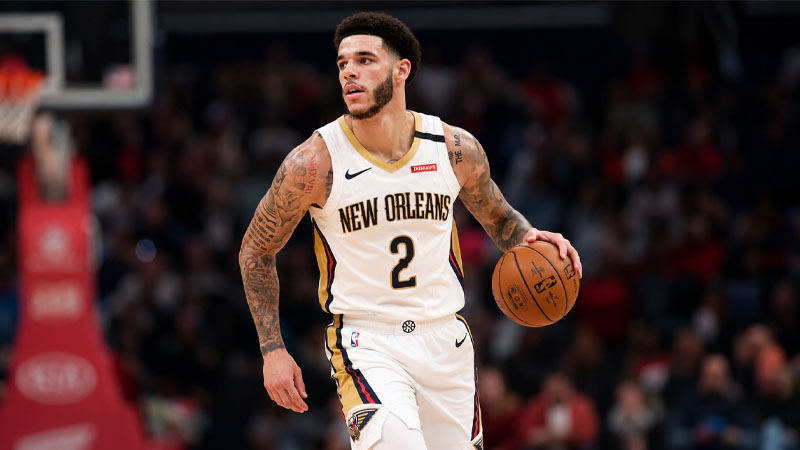
Lonzo Ball was traded primarily due to shifting franchise priorities, contract valuation gaps, and long-term health concerns.
Originally the second overall pick, his first trade from the Lakers to the Pelicans was a blockbuster move to acquire Anthony Davis. Later, a sign-and-trade to Chicago occurred when New Orleans declined to match his $85 million contract.
His subsequent moves to Cleveland and Utah were driven by a need for roster reshaping after major knee surgeries and tactical salary cap management to avoid luxury tax penalties.
These transactions highlight how a player’s value evolves from a premier asset to a financial tool.
Why Did the Lakers Trade Lonzo Ball in 2019?
The Los Angeles Lakers drafted Lonzo Ball with the second overall pick in 2017, viewing him as a cornerstone of their future.
However, his tenure in Southern California lasted only two seasons before he was included in one of the most significant trades in modern basketball history.
The organization’s philosophy underwent a radical shift when LeBron James signed with the team, moving from a patient rebuilding strategy to an immediate championship mandate.
This shift required veteran superstars rather than developing prospects, making Ball the primary piece of a massive trade package.
The Pursuit of Anthony Davis and a Championship
The core motivation for trading Ball was the opportunity to acquire Anthony Davis from the New Orleans Pelicans. Los Angeles recognized that pairing James with an elite co-star was the fastest path to a title.
To secure Davis, the Lakers had to part with a substantial haul, including Ball, Brandon Ingram, Josh Hart, and multiple high-level draft picks.
This decision was validated almost immediately when the Lakers won the 2020 NBA Championship, proving that sacrificing young talent for established greatness can yield the highest level of success in professional sports.
Lonzo Ball as the Premier Rebuilding Asset
At the time of the 2019 trade, Ball was considered the “premier asset” in the deal for New Orleans.
Despite questions about his shooting mechanics, his elite court vision, defensive instincts, and size made him a highly coveted piece for a rebuilding Pelicans franchise. By including Ball, the Lakers were able to outbid other potential suitors for Davis.
For Ball, the move to New Orleans provided a less pressurized environment where he could refine his game, eventually transforming his shooting form and becoming a more complete offensive threat during his two developmental seasons there.
The Pelicans and the 2021 Sign-and-Trade Explained
By 2021, Lonzo Ball had developed into a high-level perimeter defender and an efficient three-point shooter in New Orleans. As he entered restricted free agency, the organization faced a complex decision regarding his long-term fit.
While Ball had improved significantly, the Pelicans were navigating a roster evolution that prioritized different playmaking styles, ultimately leading to a sign-and-trade agreement with the Chicago Bulls that sent Ball to the Midwest on an $85 million contract.
The Rise of Zion Williamson and System Changes
A major factor in the decision to move on from Ball was the emergence of Zion Williamson as a “point-forward.” The Pelicans began shifting primary playmaking duties to Williamson, which naturally minimized Ball’s traditional role as the lead guard.
As the offensive system evolved to maximize Williamson’s unique gravity and scoring ability, the front office became hesitant to commit a massive long-term salary to a player whose on-ball opportunities were being reduced.
This strategic shift made Ball more expendable in the eyes of the Pelicans’ leadership.
Navigating the $85 Million Contract Valuation
The financial aspect of the 2021 move was just as critical as the tactical fit. Ball signed a four-year, $85 million deal as part of the transaction.
New Orleans chose not to match heavy contract offers, preferring to acquire assets rather than letting him walk for nothing in free agency. By facilitating a sign-and-trade, the Pelicans received Tomas Satoransky, Garrett Temple, a draft pick, and cash.
This allowed the Bulls to secure a defensive anchor and floor spacer while the Pelicans maintained financial flexibility for future roster moves around their core stars.
How Injuries Impacted Lonzo Ball’s Move to Cleveland
Lonzo’s time in Chicago began with immense promise, as his arrival helped transform the team into a defensive powerhouse and an Eastern Conference leader.
Unfortunately, physical setbacks changed the trajectory of his career and his role within the Bulls’ long-term strategy.
After a series of devastating knee injuries and multiple surgeries that sidelined him for over two full seasons, the Bulls eventually decided to pivot in a new direction, leading to a 2025 trade that sent Ball to the Cleveland Cavaliers.
A Roster Reset After Catastrophic Knee Issues
The Bulls’ decision to trade Ball in 2025 was largely a response to his extended absence. Ball suffered a meniscus injury in January 2022 that kept him off the court for an unprecedented amount of time.
Although he made an “inspiring return” and even signed a two-year extension with Chicago, the team’s competitive window had shifted during his recovery.
The front office determined that a roster reset was necessary, and trading Ball for Isaac Okoro allowed them to acquire a younger, more durable defensive wing while moving on from the uncertainty surrounding Ball’s long-term health.
Cleveland’s Need for Short-Term Backcourt Depth
From the Cavaliers’ perspective, acquiring Ball was a calculated risk aimed at bolstering their veteran presence. At the time of the trade, Cleveland was managing its own set of roster injuries and sought short-term help in the backcourt.
They viewed Ball as a high-IQ veteran who could contribute in limited minutes as a backup guard.
During his 35-game stint in Cleveland, Ball averaged 4.6 points and 3.9 assists, providing the stability the Cavaliers needed during a transitional period for their rotation.
Why Was Lonzo Ball Traded to the Jazz in 2026?
The final trade of Ball’s career journey occurred in February 2026. This move was less about his on-court performance and more about the complex financial landscape of the modern NBA.
By this stage, Ball’s $10 million contract had become a tool for cap management rather than a reflection of his status as a starting-caliber player.
As Cleveland looked to optimize its luxury tax position, Ball was moved in a three-team deal involving the Utah Jazz and Atlanta Hawks.
Escaping the Luxury Tax Second Apron
The primary driver for the 2026 trade was “major luxury tax relief” for the Cleveland Cavaliers.
Following high-profile midseason acquisitions like James Harden and Dennis Schröder, Cleveland found itself facing severe financial penalties associated with the NBA’s luxury tax second apron.
To avoid these restrictions, which can hamper a team’s ability to make future moves, the Cavaliers utilized Ball’s $10 million expiring contract as a “salary dump”. This transaction allowed Cleveland to save millions in tax payments while clearing a roster spot.
The Role of Expiring Contracts in NBA Strategy
The Utah Jazz accepted Ball not for his playmaking, but to “collect draft picks” and cash considerations. In the modern NBA, teams with cap space often act as facilitators for tax-paying teams, taking on unwanted contracts in exchange for future draft capital.
Utah received two second-round picks (2028 and 2032) for their participation in the trade. As part of a pre-planned strategy, the Jazz placed Ball on waivers immediately after the deadline, allowing him to enter free agency and seek a new opportunity with a team of his choosing.
Summary of Lonzo Ball’s Trade History
The following table outlines the specific movements and core motivations behind each of the four trades involving Lonzo Ball throughout his professional career.
| Year | From | To | Primary Motivation | Core Assets Exchanged |
|---|---|---|---|---|
| 2019 | L.A. Lakers | New Orleans | Acquire Anthony Davis | Ball, Ingram, Hart, Draft Picks |
| 2021 | New Orleans | Chicago | Sign-and-Trade / Zion’s Role | Ball ($85M Contract), Satoransky |
| 2025 | Chicago | Cleveland | Roster Reset / Injury History | Isaac Okoro, Lonzo Ball |
| 2026 | Cleveland | Utah | Luxury Tax / Salary Dump | Draft Picks, Cash, Tax Relief |
Frequently Asked Questions About Lonzo Ball’s Career Moves
How many times has Lonzo Ball been traded?
Lonzo Ball has been officially traded four times since his debut in 2017. His journey has taken him through five different organizations: the Lakers, Pelicans, Bulls, Cavaliers, and briefly the Jazz, though he never played a game for Utah before being waived.
Why did the Pelicans not keep Lonzo Ball in 2021?
The Pelicans chose to trade Ball because they were moving toward a system centered on Zion Williamson as a primary playmaker.
Additionally, they were hesitant to match the high salary demands of Ball’s $85 million contract, preferring to use those financial resources elsewhere.
What is the “Second Apron” and how did it affect Lonzo?
The second apron is a threshold in the NBA’s collective bargaining agreement that imposes strict penalties on high-spending teams. Cleveland traded Ball in 2026 specifically to get under this threshold and avoid the associated financial and roster-building restrictions.
Was Lonzo Ball’s last trade based on his performance?
Not entirely. While his offensive numbers had declined following his injuries, the 2026 trade to Utah was described as a “pure salary cap dump”. His contract was valuable to Cleveland as a way to shed salary and to Utah as a way to acquire draft picks.
Conclusion: The Evolving Value of an NBA Star
The transactional history of Lonzo Ball serves as a fascinating case study in how value is perceived in the NBA. Early in his career, he was a blue-chip prospect capable of being the centerpiece for a superstar like Anthony Davis. Mid-career, he was a highly sought-after specialist who commanded a massive multi-year contract.
By the end of his initial extension, injuries and the league’s increasingly complex salary cap rules transformed his contract into a strategic financial asset used for tax mitigation.
Despite the frequent moves, Ball’s resilience remains a highlight of his story. Returning to the court in 2025 after missing two full seasons demonstrated a level of professional dedication that few players possess.
As he enters free agency following his release from Utah, his ability to provide veteran leadership and high-level basketball IQ will likely make him a target for teams looking for low-risk, high-reward depth.
The “why” behind his trades has changed over the years, but his impact on the court, when healthy, continues to be respected across the league.