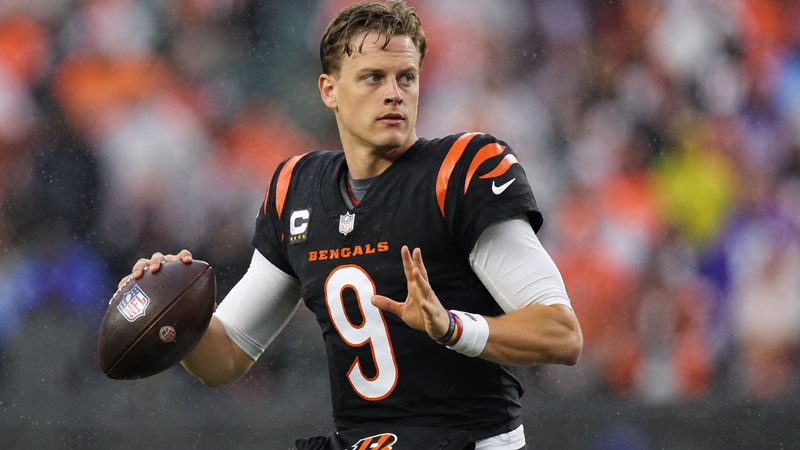
Evaluating the trajectory of a professional quarterback requires a delicate balance between on-field talent and statistical reliability within the specific scoring frameworks of fantasy football.
For years, Joe Burrow has been hailed as one of the league’s premier signal-callers, a player capable of dissecting defenses with surgical precision.
However, as the game’s landscape shifts toward dual-threat dynamism, a growing number of analysts are sounding the alarm.
Among the most prominent voices of caution is Liz Loza, whose recent analysis suggests that despite his name value, Burrow may be a player to avoid in upcoming drafts.
This assessment is not a critique of Burrow’s actual ability to win football games, but rather a calculation of risk versus reward in a competitive environment where draft capital is the most precious resource.
To understand why an expert would advise passing on a player of this caliber, one must look closely at the convergence of health, team infrastructure, and the evolving “meta” of fantasy scoring.
The Fundamental Conflict of the Pocket Passer
In the modern era of fantasy football, the “Konami Code”—the ability of a quarterback to generate significant points through rushing—has moved from a luxury to a necessity for top-tier production. This is where the first major hurdle for Burrow’s value emerges.
Burrow is a traditionalist in a world of outliers; he relies almost exclusively on the passing game to generate his fantasy output.
While his arm talent is undeniable, the math often fails to favor a pure pocket passer. In most standard scoring formats, four rushing yards are equal to one passing yard, and a rushing touchdown is worth 50% more than a passing touchdown.
Because Burrow provides “very little production via rushing stats,” his path to a weekly QB1 finish requires nearly flawless passing volume and efficiency.
This lack of a rushing floor “caps his weekly upside,” meaning that if the passing game is stymied by a strong secondary or poor weather, there is no secondary statistical stream to buoy his score.
The Durability Dilemma: A Recurring Narrative
Perhaps the most significant factor in the recommendation to pass on Burrow is his “recurring injury history”. Availability is the most critical metric in any fantasy season, and Burrow’s track record has been punctuated by significant interruptions.
He has “missed significant time over his career,” which creates a cascade of “availability and consistency concerns for fantasy managers”.
When a manager spends a high-round draft pick on a quarterback, they are investing in a cornerstone. If that cornerstone is frequently sidelined, the manager is forced to rely on the “waiver wire,” where the talent pool is shallow.
The risk here is twofold: not only do you lose the points Burrow would have provided, but you also lose the flexibility of your bench, as you must carry a secondary quarterback to mitigate the constant threat of injury.
Liz Loza’s hesitation stems from this reality; in a season-long grind, the most talented quarterback in the world provides zero value from the training room.
The Infrastructure Problem: Protecting the Asset
A quarterback is only as effective as the five men standing in front of him. For Burrow, the “offensive line context” remains a persistent shadow over his production.
Despite various attempts by the organization to bolster the front five, “pass-blocking metrics for the team raise flags regarding his safety and clean pocket time”.
A “shaky offensive line” does more than just increase the risk of another injury; it fundamentally alters the way a quarterback plays.
When a pocket is constantly collapsing, a quarterback is forced to get rid of the ball faster, often checking down to shorter routes rather than letting deep plays develop.
For a player like Burrow, who thrives on timing and intermediate-to-deep accuracy, a lack of “clean pocket time” directly translates to a decrease in explosive plays.
If he is under constant duress, the high-volume passing numbers required to offset his lack of rushing production become even harder to achieve.
Expert Analysis: The Strategic Pivot
Liz Loza’s stance is a masterclass in risk mitigation. In the early-to-mid rounds of a draft, the goal is often to avoid losing the league rather than winning it with a “hero” pick.
By “advising passing on Joe Burrow,” she is advocating for a strategy that prioritizes players with more stable floors or higher ceilings relative to their cost.
The opportunity cost of drafting Burrow is high. By selecting him, a manager passes on other quarterbacks who might offer 500+ rushing yards and five or more rushing touchdowns, or they pass on elite wide receivers and running backs who could solidify their starting lineup.
Given the “shaky offensive line” and the “recurring injury history,” the probability of Burrow outperforming his draft position is statistically lower than many of his peers in the same tier.
The Anatomy of a Fantasy “Fade”
When an analyst “fades” a player, it is rarely because they believe the player is “bad.” Instead, it is a statement about the player’s current market value. Burrow’s name recognition often keeps his Average Draft Position (ADP) higher than his projected statistical output justifies.
- Reliability: The historical data shows a player who has struggled to stay on the field for 17 games.
- Infrastructure: The metrics suggest he will continue to be one of the most pressured quarterbacks in the league.
- Statistical Ceiling: Without rushing upside, he is essentially playing with one hand tied behind his back in most scoring formats.
For these reasons, the smart play in 2026 is to look for value elsewhere. Whether that means waiting longer to draft a quarterback with similar passing upside but less injury risk, or jumping early for a true dual-threat option, the consensus among experts like Loza is that the Burrow “trap” is one to be avoided.
Final Verdict for the 2026 Season
The decision to pass on Joe Burrow is not a slight against his talent or his leadership. It is a data-driven decision based on the three pillars of fantasy failure: injury risk, poor protection, and a capped ceiling.
As Liz Loza suggests, the path to a fantasy championship is rarely paved with players who carry this much “recurring” baggage. In your upcoming drafts, prioritize health and rushing upside—two things Burrow currently cannot guarantee.