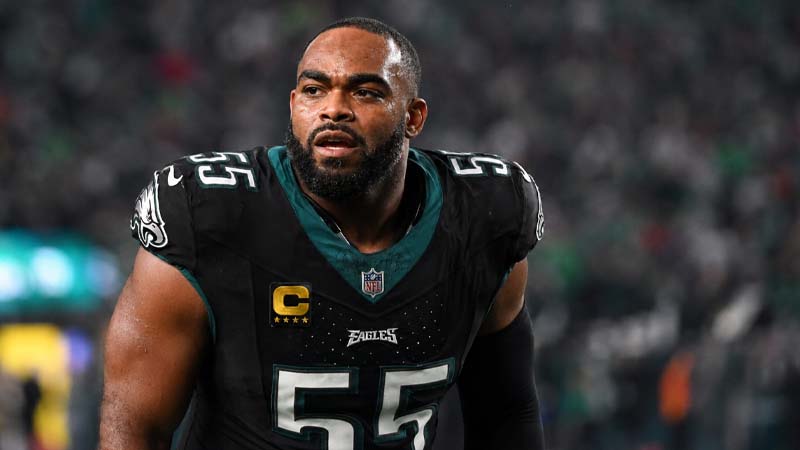
The sight of Brandon Graham’s name appearing on the transaction wire as a free agent has sent waves of concern through the Philadelphia fan base.
For over a decade, Graham has been more than just a defensive end; he has been the emotional cornerstone of the franchise.
However, the current reality of his absence from the active roster is not a signal of an ending, but rather a sophisticated exercise in modern professional football management.
To understand why a franchise legend is currently unattached to the team, one must look past the emotional ties and into the intricate machinery of the league’s financial regulations.
The current status of the veteran pass rusher is the result of a calculated, procedural maneuver designed to optimize the team’s resources while keeping the door open for a final chapter in Philadelphia.
The Anatomy of a Procedural Release
In the landscape of professional sports, the term “released” often carries a heavy, final weight. In this specific instance, however, the move is defined as a “procedural post-June 1 roster release”. This distinction is critical for understanding the “why” behind the headline.
The June 1 threshold is a pivotal date in the league’s calendar. Before this date, any remaining “dead money”—guaranteed money already paid to a player but not yet accounted for against the salary cap—hits the team’s books immediately upon the player’s release.
By designating a release after this date, a team is permitted to spread that financial burden across two seasons.
For a team like Philadelphia, which consistently operates near the upper limits of the salary cap to maintain a competitive roster, this accounting flexibility is not just helpful; it is essential.
Brandon Graham is currently a free agent because the technical structure of his previous agreement necessitated this move to manage salary cap spacing.
By moving him to the free-agent pool now, the front office can effectively distribute the dead money through future seasons, ensuring they have the liquidity to sign draft picks, manage mid-season injuries, or make late-summer trades.
The Legacy of the 2025 Return
The complexity of Graham’s current contract status can be traced back to his unique path over the last year. It is important to recall that Graham previously navigated a brief retirement during the 2025 season.
His decision to return to the field was met with immense enthusiasm, and he was brought back on a short-term deal specifically tailored to facilitate his comeback.
This short-term agreement was not a standard contract. It included what are known as “structural void years”. In the world of high-level roster management, void years are essentially placeholder seasons added to a contract.
They allow a team to spread a signing bonus over a longer period, lowering the immediate “cap hit,” even if the player is only expected to be under contract for a single year.
When those void years “trigger,” or when the active portion of the contract concludes, the remaining bonus money accelerates onto the current year’s cap.
This is precisely what triggered the procedural designation we see today. The release was the administrative mechanism required to finalize the accounting of that 2025 comeback deal.
The “Mutual Fit” Equation: Analyzing Roster Depth
While the financial explanation provides clarity on the “how,” the question of “when” or “if” he returns depends on the concept of “mutual fit”.
Professional rosters are living organisms, constantly shifting based on performance, health, and the development of younger talent.
For the Philadelphia front office, the decision to re-sign Graham involves several variables:
- Roster Depth: The organization must evaluate its current rotation of edge rushers. If younger prospects have shown significant growth during off-season programs, the “need” for a veteran presence—even one as storied as Graham—may change. Conversely, if the unit lacks a consistent veteran voice or situational pass-rushing depth, the value of Graham’s return increases.
- Health and Conditioning: At this stage of a career, physical readiness is paramount. Graham has proven his resilience time and again, but the team will undoubtedly monitor his status to ensure he can still contribute at a level that justifies a roster spot.
- The Role: Graham’s potential return would likely be in a specialized capacity. Whether as a third-down specialist or a locker-room mentor, both the player and the team must agree on what that role looks like for the upcoming campaign.
Communication between Graham and team leadership remains open. This is a testament to the trust and transparency that has defined his tenure in Philadelphia. Unlike many free-agent situations that are adversarial, this process appears to be a collaborative waiting game.
The Strategic Value of Dead Money Management
To the average observer, “dead money” sounds like a failure of management. To a top-tier strategist, it is a tool for competitive advantage.
By distributing Graham’s dead money into future seasons, the Eagles are essentially taking a “loan” from their future self to pay for current flexibility.
This strategy allows the team to remain aggressive. In a league where the window for championship contention can close rapidly, the ability to save several million dollars in current-year cap space can be the difference between signing a key mid-season contributor or being forced to stand pat.
The procedural release of Brandon Graham is a textbook example of prioritizing the collective health of the salary cap over the optics of a transaction wire.
Cultural Impact: Why This Isn’t a Standard “Cut”
If this were any other player, the conversation might end with the financial analysis. But this is Brandon Graham. He represents the “heartbeat” of the organization, a player whose career arc mirrors the most successful era in the team’s history.
His status as a “free agent” is a technicality, but his influence on the locker room persists. Even without an active contract, Graham’s presence loomed large over the 2025 season after his return from retirement.
The organization understands that his value extends beyond the stat sheet. He is a primary culture-setter, teaching younger players the “Philadelphia way” of professional conduct and relentless effort.
This cultural equity is why the team has kept the lines of communication so wide open. The front office is not looking to move on from Graham; they are looking for the most efficient way to keep him involved without compromising the long-term financial health of the franchise.
Navigating the Summer: What Fans Should Watch For
As we move deeper into the preseason, there are specific signals that will indicate whether a reunion is imminent.
- Preseason Performance: If the current group of defensive ends struggles with consistency or discipline, the pressure to bring back a proven commodity like Graham will mount.
- Injury Reports: In the unfortunate event of a training camp injury to the defensive front, the “mutual fit” becomes much more urgent.
- The “Vested Veteran” Factor: There is often a strategic advantage to signing veterans after the first week of the regular season, as their contracts may not be fully guaranteed for the entire year. While Graham’s situation is unique, the timing of a signing is always a factor in roster optimization.
The Outlook for the Upcoming Campaign
The Philadelphia Eagles have built a reputation for being one of the most forward-thinking organizations in professional sports. Their handling of Brandon Graham’s transition is a prime example of this philosophy.
By utilizing a procedural post-June 1 release, they have successfully balanced the books while maintaining a respectful and open relationship with a franchise icon.
For the fans, the message is clear: do not let the “free agent” tag cause alarm. The “departure” is a standard contract maneuver rather than a permanent split.
In the high-stakes world of roster management, sometimes you have to move a piece off the board temporarily to ensure you have the resources to win the game in the long run.
The story of Brandon Graham in Philadelphia has always been about resilience and unexpected returns. From his early career struggles to his Super Bowl heroics and his 2025 comeback, he has consistently defied the odds.
This current procedural pause is likely just another chapter in that storied journey. Whether he returns to the field for one final ride or transitions into a new role within the organization, his impact is far from over.
As the team navigates the complexities of the upcoming campaign, the door remains open for the return of number 55.
Until then, the front office will continue to manage the roster with the surgical precision required to compete at the highest level, proving once again that in Philadelphia, the “business of football” is always conducted with an eye on the next championship trophy.