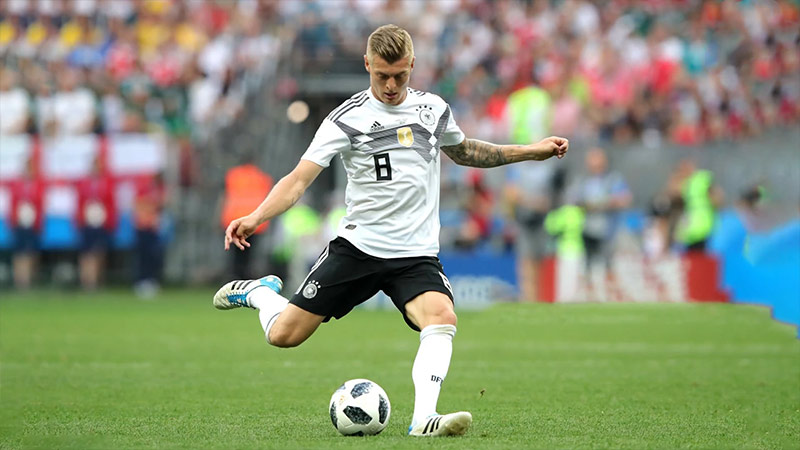
In the modern era of professional football, where the emphasis often shifts toward raw athleticism, blistering sprint speeds, and high-intensity physical duels, Toni Kroos stands as a testament to the enduring power of the intellect.
Often referred to as “The Metronome,” Kroos has redefined the role of the central midfielder, proving that the ability to control time and space is more valuable than any physical attribute.
While many players excel in moments of individual brilliance, Kroos operates on a different plane, dictating the entire tempo of a match through elite game intelligence and unmatched composure.
This analysis deconstructs the specific technical and mental pillars that have solidified his reputation as one of the greatest midfielders of his generation.
1. Elite Passing and Visionary Execution
The cornerstone of Toni Kroos’s game is his metronomic passing accuracy. In an environment as volatile as the UEFA Champions League, maintaining a high volume of passes while sustaining an accuracy rate above 90% is statistically improbable for most, yet it is the standard for Kroos.
His vision extends beyond merely seeing the open man. He is a “sniper” of the midfield, possessing the rare ability to visualize passing lanes before they have even fully materialized. This predictive capability allows him to:
- Execute Pinpoint Short Passes: Maintaining possession in tight triangles to bait the opposition press.
- Deliver Intricate Through-Balls: Breaking defensive lines with verticality that catches opponents off-balance.
- Distribute Sweeping Long Diagonals: Shifting the point of attack instantly to exploit the “weak side” of a defensive formation.
His execution is characterized by a “flawless” quality; he rarely breaks a sweat while delivering a 50-yard diagonal pass that lands perfectly on a teammate’s boot.
2. Composure Under High-Intensity Pressure
In modern tactical systems, the “press” is designed to force errors by reducing a player’s time to think. Kroos, however, is notoriously difficult to rattle. Regardless of the intensity of the opposition’s defensive pressure, he remains composed, never succumbing to panic.
This composure is a functional tool. By calmly scanning the field and adjusting his body shape, he can play one-touch passes that immediately relieve pressure. More importantly, Kroos often intentionally invites pressure toward himself.
By absorbing the attention of multiple defenders, he creates a vacuum of space and time elsewhere on the pitch, allowing his teammates to push forward into advantageous positions.
3. The “Quarterback” Role: Tactical Intelligence
Toni Kroos does not just play the game; he reads it like a book. His role is frequently compared to that of a quarterback in American football—a central figure who evaluates the defensive coverage and decides the best course of action for the entire unit.
His tactical intelligence manifests in his mastery of tempo. He possesses an innate understanding of the match’s rhythm, knowing exactly when to slow the pace down to frustrate an opponent and maintain possession, and exactly when to accelerate the play to launch a dangerous transition. This ability to govern the speed of the game makes him tactically indispensable to any manager.
4. Technical Perfection and Ball Control
At the highest level of the sport, technical errors are often the difference between victory and defeat. Kroos operates with a degree of technical perfection that minimizes these risks.
His first touch is foundational; it always sets him up for his next move, ensuring the ball is shielded or positioned for a quick release.
This technical excellence extends to his striking ability. Beyond his distribution, he is known for a lethal and precise strike from distance. His goals are rarely about power; they are about placement and the same “sniper” mentality he applies to his passing.
5. Set-Piece Dominance and Dead-Ball Mastery
Toni Kroos is widely regarded as one of the most dangerous set-piece takers in the world. In matches where open-play opportunities are limited, his ability to deliver pinpoint free-kicks and corners becomes a primary offensive weapon.
His delivery is characterized by consistent trajectory and pace, making it significantly easier for his attackers to connect with the ball in the box. This specialized skill set transforms every dead-ball situation into a high-probability goal-scoring opportunity.
6. Positional Discipline and Defensive Shielding
While often celebrated for his offensive contributions, Kroos’s defensive utility is rooted in his positioning. He understands the geometry of the pitch, knowing exactly where to stand to shield his defensive line and effectively recover the ball.
He does not rely on sliding tackles or physical intimidation; instead, he uses his intelligence to intercept passes and close down passing lanes before the opposition can exploit them.
7. The “Kroos Zone” and Spatial Manipulation
Tactical analysts often point to the left-half space—sometimes called the “Kroos Zone”—where he typically operates. From this position, he can see the entire field.
By hovering in this specific area, he forces opposition wingers and midfielders into a dilemma: do they stay narrow to protect the center, or do they push out to close him down?
If they push out, he passes inside; if they stay narrow, he switches the play. This constant manipulation of the opponent’s defensive shape is a hallmark of his mastery.
8. Mental Resilience and Big-Game Pedigree
Greatness is often defined by performance in the most significant moments. Kroos has consistently delivered at the pinnacle of the sport, including multiple Champions League titles and a FIFA World Cup.
His ability to maintain his 90%+ pass accuracy in these high-stakes environments suggests a level of mental resilience that few athletes ever achieve. He treats a World Cup final with the same clinical detachment as a training session.
9. Efficiency of Movement
Kroos is a master of “economy of movement.” He rarely engages in unnecessary sprints, instead moving intelligently to ensure he is always an available passing option.
This efficiency allows him to remain fresh throughout the full 90 minutes, ensuring his decision-making remains sharp even in the closing stages of a match.
10. Intellectual Leadership
Finally, Kroos provides a form of leadership that is quiet but profound. By dictating the tempo, he provides a sense of security to his teammates.
When the team is under pressure, they look for Kroos, knowing that once the ball is at his feet, the chaos of the match will be organized into a structured attack.
Enhanced FAQ: Understanding the “Metronome” Effect
How does Toni Kroos maintain such high passing accuracy?
His accuracy is a result of elite vision and technical execution. He “pre-scans” the pitch constantly, meaning he knows where his teammates and opponents are before he even receives the ball. This allows him to make decisions faster than the defense can react.
Why is he called “The Metronome”?
The nickname refers to his ability to dictate the tempo of a match. Just as a metronome keeps time for a musician, Kroos keeps time for his team, deciding when the game should be fast or slow.
Is Toni Kroos a defensive or offensive midfielder?
He is best described as a deep-lying playmaker or a “quarterback”. While he has the technical skill to contribute to the attack and the intelligence to shield the defense, his primary role is to act as the bridge between the two, controlling the transition and flow of the game.
What makes his set-pieces so effective?
It comes down to technical perfection. He delivers the ball with consistent pace and a specific “whip” that makes it difficult for goalkeepers to judge but easy for his own players to attack.
How does he handle teams that try to man-mark him?
Kroos uses his composure and body shape to bypass man-marking. He will often drop deeper between his own center-backs or move into wide areas to drag his marker out of position, thereby creating space for other midfielders to exploit.
The Legacy of a Tactical Icon
Toni Kroos’s career serves as a blueprint for the modern midfielder. He has proven that elite success is not merely a product of physical dominance, but a result of technical discipline, tactical foresight, and a calm mind under pressure.
For any student of the game, watching Kroos is a lesson in the art of the possible—a demonstration of how one individual can control the destiny of twenty-two players simply by deciding where a ball should go.
His departure from the pitch marks the end of an era, but the “Kroos standard”—defined by that legendary 90% accuracy and the ability to read the game like a book—will remain the gold standard for generations to come.