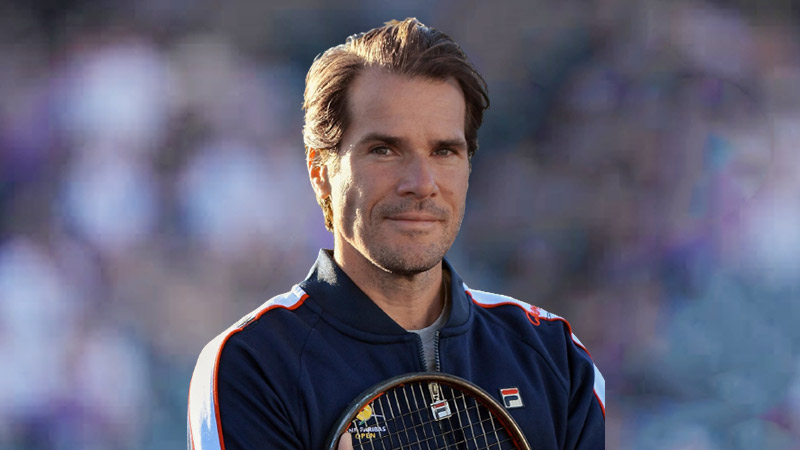
Tommy Haas is famous for his extraordinary 22-year tennis career, defined by his peak ranking as World No. 2 and his unparalleled physical resilience.
Despite undergoing nine major surgeries on his shoulders, hip, and elbows, Haas repeatedly fought back to the sport’s elite level, earning him the title of the “Comeback King.”
His legacy includes an Olympic Silver Medal, 15 ATP singles titles, and a rare ability to defeat legends across generations, from Pete Sampras to Roger Federer.
Today, he remains a powerhouse in the sport as the successful Tournament Director of the prestigious BNP Paribas Open.
Reaching the Summit of Professional Tennis
Achieving elite status in professional tennis requires more than just talent; it demands a level of consistency and mental fortitude that few players ever master.
Tommy Haas is widely recognized for reaching the upper echelons of the sport during one of its most competitive eras.
His rise to the top was not a sudden burst but a steady progression of skill and determination that culminated in several of the sport’s most prestigious honors.
The World Number 2 Ranking
On May 13, 2002, Tommy Haas reached his career-high ranking of World No. 2. This milestone placed him among the greatest players to ever pick up a racket, serving as a testament to his versatility and skill across all playing conditions.
Maintaining such a high ranking required him to navigate the transition between the serve-and-volley era of the 1990s and the baseline-dominated modern game, proving his adaptability.
Olympic Glory and Masters Success
One of the defining moments of Haas’s career came at the 2000 Sydney Olympic Games. Representing Germany, he embarked on a historic run to the final, eventually securing the Olympic Silver Medal after a grueling five-set battle against Yevgeny Kafelnikov.
Additionally, his excellence in the ATP Masters 1000 series was cemented in 2001 when he captured the Stuttgart Masters title, defeating Max Mirnyi in straight sets to win his marquee shield on home soil.
Why is Tommy Haas Called the “Comeback King”?
The narrative of Tommy Haas is inseparable from his history of physical setbacks and subsequent triumphs. While many athletes would have retired after a single major operation, Haas faced a series of medical challenges that would have ended most careers.
His ability to maintain a high level of play despite these interruptions is what truly cemented his fame among global tennis fans.
| Category of Setback | Details of the Physical Challenge |
|---|---|
| Total Major Surgeries | Nine distinct operations including both shoulders, right elbow, and hip. |
| Prime Year Interruptions | Missed the entire 2003 season during what should have been his physical peak. |
| Severe Injuries | Suffered from a torn hip labrum and multiple fractured ankles. |
| Ranking Recovery | Successfully jumped from outside the top 200 back into the elite top 20. |
| Official Recognition | Awarded the 2012 ATP Comeback Player of the Year. |
Defeating the Legends: Haas as the “Giant Killer”
To understand the impact of Tommy Haas, one must look at his performance against the most iconic names in tennis history. He was never intimidated by the reputation of his opponents, often finding ways to outplay the greatest athletes the sport has ever seen.
His career spanned several generations, allowing him to challenge everyone from the legends of the 90s to the modern “Big Three”.
- Victories Over Roger Federer: Haas secured four career wins against Federer, including a famous victory on grass during the 2012 Halle Final.
- Success Against Novak Djokovic: He recorded three wins against the Serbian legend, most notably a straight-sets victory at the 2013 Miami Masters.
- Battles with the 90s Icons: Haas held his own against American legends, recording three wins over Pete Sampras and four wins over Andre Agassi.
- The 500-Win Club: He is part of an elite group of players in the Open Era to surpass 550 career singles victories, reaching the 500-win milestone in 2012.
- Grand Slam Consistency: Although a major title eluded him, he reached four Grand Slam semifinals and advanced to at least the quarterfinals of every major tournament.
A Versatile Champion Across Three Decades
Longevity is a rare commodity in professional sports, and Tommy Haas managed to remain a title threat from the late 1990s until his final seasons in the late 2010s.
His 15 ATP singles titles represent a career that flourished regardless of the surface or the evolution of equipment and technology. This versatility is a core reason for his lasting influence on the ATP Tour.
| Tournament & Year | Surface Type | Key Opponent in Final |
|---|---|---|
| Memphis (1999) | Hard (Indoor) | Jim Courier |
| Stuttgart Masters (2001) | Hard (Indoor) | Max Mirnyi |
| Long Island (2001) | Hard | Pete Sampras |
| Houston (2004) | Clay | Andy Roddick |
| Halle (2012) | Grass | Roger Federer |
| Munich (2013) | Clay | Philipp Kohlschreiber |
| Vienna (2013) | Hard (Indoor) | Robin Haase |
Leading the Future of Tennis at Indian Wells
Tommy Haas’s fame did not dissipate when he stopped competing on the court; instead, it evolved as he took on a critical leadership role within the tennis industry.
His transition from player to administrator has been one of the most successful in the history of the sport, further proving his deep understanding of the game’s business and player needs.
Tournament Director of the BNP Paribas Open
In 2016, even before his professional retirement was officially finalized, Haas was appointed as the Tournament Director for the BNP Paribas Open at Indian Wells.
Often referred to as the “fifth Grand Slam,” this tournament is the most popular event outside of the four majors.
Under his guidance, the event has consistently flourished, benefiting from his unique perspective as a former high-ranking professional who understands the expectations of both players and spectators.
Maintaining Excellence in Administration
The success of Indian Wells under Haas’s leadership is not merely anecdotal; it is reflected in the official feedback from his peers. The event has been repeatedly voted by the players as the ATP Masters 1000 Tournament of the Year.
His ability to organize and elevate a world-class sporting event has made him a highly visible and respected figure in modern tennis administration, ensuring his influence remains strong long after his playing days.
What Defines the Haas Playing Style?
While stats and titles provide a framework for his fame, the “how” of Tommy Haas’s play is what captured the hearts of fans.
He was often described as a “player’s player,” possessing a technical mastery of the sport that made his matches a display of tactical intelligence and athletic grace.
The Signature One-Handed Backhand
Haas was one of the premier exponents of the elegant, one-handed backhand, a shot that is becoming increasingly rare in the modern game. This stroke allowed him to create angles and generate pace that caught many opponents off guard.
His ability to blend this fluid style with a fierce fighting spirit created a unique contrast on the court—he could outplay you with finesse or outlast you in a physical war of attrition.
Mastery of All Court Surfaces
Unlike many specialists who excel only on clay or hard courts, Haas was a threat regardless of where the match was held. He reached the Australian Open semifinals three times and the Wimbledon semifinals in 2009.
His 15 titles were earned across hard, clay, and grass courts, highlighting a completeness in his game that allowed him to remain competitive for over twenty years.
Frequently Asked Questions About Tommy Haas
Did Tommy Haas ever win a Grand Slam?
While he never won a Grand Slam title, he was a four-time semifinalist at major tournaments, including three appearances in the Australian Open semifinals (1999, 2002, 2007) and one at Wimbledon in 2009.
He also reached the quarterfinals of every Grand Slam event, demonstrating exceptional consistency at the highest level of the sport.
What is the most impressive record held by Tommy Haas?
Many experts point to his resilience as his most impressive record. He underwent nine major surgeries and managed to return to the world top 20 multiple times.
Additionally, he is one of the few players in the Open Era to achieve more than 550 career victories and win ATP titles in three different decades.
Is Tommy Haas still involved in professional tennis?
Yes, he is highly active in the sport. Since 2016, he has served as the Tournament Director for the BNP Paribas Open in Indian Wells, California.
This role has kept him at the center of the tennis world, where he oversees one of the largest and most successful tournaments on the ATP and WTA calendars.
What awards did Tommy Haas win during his career?
Beyond his titles and rankings, Haas was famously awarded the ATP Comeback Player of the Year in 2012. This award recognized his incredible journey from outside the top 200 back into the global elite, a feat he accomplished after years of injury struggles.
He also holds an Olympic Silver Medal from the 2000 Sydney Games.
Conclusion: The Enduring Impact of a True Fighter
Tommy Haas is famous because he represents the ultimate spirit of perseverance. His career record of 569–338 and his 15 titles are impressive, but they only tell half the story.
The other half is found in the training rooms and surgical centers where he repeatedly reclaimed his career from the brink of retirement.
By combining technical elegance with an iron will, he became a symbol of what is possible when an athlete refuses to quit.
Whether it was defeating a prime Roger Federer or managing one of the world’s greatest tournaments, Haas has consistently demonstrated excellence at every stage of his professional journey.