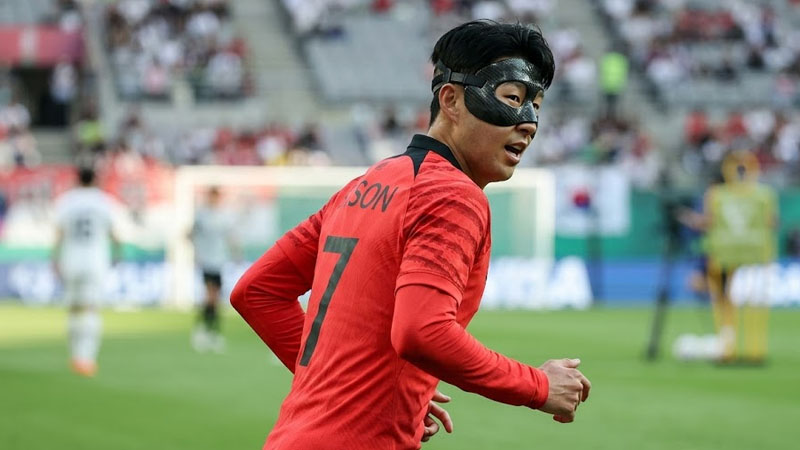
The visual was unmistakable: South Korean captain Son Heung-min leading his team onto the pitch in Qatar, his face shielded by a sleek, black carbon-fiber mask.
For casual observers, the “Korean Batman” look was a curious fashion statement, but for the footballing world, it represented a high-stakes race against time.
Son’s decision to play despite a severe facial injury became one of the most compelling narratives of the 2022 World Cup.
This protective gear was not just a medical requirement; it was a symbol of a striker’s refusal to let a career-threatening injury sideline his national duty.
The Incident: How Son Heung-min Sustained His Injury
The journey to the mask began on a chilly November night in Marseille during a high-tension UEFA Champions League encounter.
As Tottenham Hotspur fought for their European survival, their talismanic forward suffered a blow that sent shockwaves through the sporting community.
Playing against Marseille on November 1, 2022, Son Heung-min was involved in a heavy aerial collision with defender Chancel Mbemba.
The impact was immediate and devastating, leaving the South Korean star visibly shaken and forced to leave the field early. Initial fears were confirmed shortly after the match when medical assessments revealed the extent of the damage.
The Medical Diagnosis and Surgical Response
The collision resulted in multiple fractures to the orbital bone around Son’s left eye socket. Given the proximity to the eye and the structural importance of the orbital rim, doctors determined that immediate surgical intervention was necessary to stabilize the bone structure.
The timing could not have been worse; with the World Cup in Qatar just weeks away, the surgery placed Son’s participation in significant jeopardy.
Despite the narrow recovery window, the surgery was performed successfully, transitioning the focus from immediate health to professional rehabilitation.
A Race Against Time for Qatar
Following the procedure, the primary question was whether Son could recover in time for South Korea’s opening match against Uruguay on November 24.
The typical recovery period for such a fracture often exceeds a month, but Son was adamant about his participation, famously stating, “I won’t miss this for the world”.
To make this possible, the medical team had to look beyond traditional healing and utilize specialized protective equipment that would allow him to compete at the highest level while his bones were still knitting back together.
Engineering Protection: Features of the Carbon-Fiber Mask
To return to the pitch safely, Son required a piece of equipment that was as durable as it was light. The resulting black mask became an iconic piece of sports technology during the 2022 tournament, designed specifically to withstand the rigors of elite professional football.
The mask was meticulously crafted to meet the specific needs of a high-intensity athlete. Unlike standard medical braces, this was a bespoke piece of equipment tailored to the unique contours of Son’s face.
| Feature | Description |
|---|---|
| Primary Material | High-strength, lightweight carbon fiber. |
| Functional Purpose | Absorbs and redistributes force from physical contact. |
| Weight Factor | Designed to be “not an inconvenience” to the player’s movement. |
| Duration of Use | Worn during World Cup, Premier League, and FA Cup fixtures. |
Advanced Material Science in Sports
The choice of carbon fiber was essential for ensuring that the gear acted as an external shield without adding significant weight.
In a sport where every gram can affect a player’s speed and balance, the carbon fiber’s high strength-to-weight ratio provided the necessary impact protection against accidental elbows, ball strikes, or collisions with the ground.
The mask functioned by taking the kinetic energy of a blow and dispersing it across the entire surface of the shield rather than allowing the force to concentrate on the fragile, recovering eye socket.
Integration into the Playing Kit
South Korea’s manager, Paulo Bento, noted that the integration of the mask was handled naturally within the team’s training sessions. The goal was to ensure Son felt as “at ease” as possible during competitive play.
While it was an unusual addition to a football kit, it was deemed a necessary compromise that allowed one of Asia’s greatest players to lead his nation on the world’s biggest stage.
The Challenge: Playing with Limited Sight
While the mask provided the physical safety required to step onto the grass, it introduced a new set of tactical and sensory challenges. For a striker who relies on split-second timing and spatial awareness, the transition was anything but seamless.
Son Heung-min was remarkably candid about the difficulties he faced while wearing the protective gear, highlighting that elite performance is as much about perception as it is about physical fitness.
The Impact on Peripheral Vision
The most significant hurdle was the narrowing of Son’s peripheral vision. Because the mask wraps around the upper face to secure the eye socket, it inevitably creates blind spots.
Son admitted that it was occasionally difficult to track the ball, especially when it approached him at high speeds or from side angles.
In a high-stakes match against world-class opponents like Brazil or Portugal, these milliseconds of lost visual data can be the difference between a goal and a missed opportunity.
The Psychological Motivation
Interestingly, Son revealed that he continued to wear the mask longer than was medically strictly necessary. His primary motivation for doing so was not his own fear of pain, but rather to provide peace of mind to his family and friends.
His parents were reportedly very concerned about the possibility of a secondary injury, which could have had long-term consequences for his vision and career.
Wearing the mask was a gesture of reassurance to his support system, allowing them to watch him play without the constant anxiety of another “massive blow” to his face.
The Masked Warriors: A Global Trend in 2022
Son Heung-min was far from the only “masked warrior” to grace the pitches of Qatar. The 2022 World Cup saw a notable increase in players utilizing this technology, reflecting the growing intensity of the modern game and the advancements in sports medicine.
The presence of multiple masked players across different teams highlighted a shared resilience among athletes who refused to let facial injuries end their tournament dreams.
- Joško Gvardiol (Croatia): Wore a black mask while recovering from a broken nose sustained just before the tournament.
- Thomas Meunier (Belgium): Utilized a mask after suffering a fractured cheekbone while playing for Borussia Dortmund.
- Ellyes Skhiri (Tunisia): Competed for the full duration of his team’s matches while wearing protective facial gear.
This trend underscores a shift in how facial injuries are managed in professional sports. Previously, a broken nose or a fractured cheekbone might have sidelined a player for several weeks.
Today, the availability of custom-molded carbon-fiber shields allows players to maintain their match fitness and contribute to their teams while the underlying injury heals in real-time.
Frequently Asked Questions: Understanding the Mask
Why exactly did Son wear the mask?
Son wore the mask to protect multiple fractures around his left eye socket sustained during a Champions League match against Marseille on November 1, 2022.
The mask was designed to absorb impacts and prevent a secondary injury that could displace the surgically stabilized bones.
Is Son Heung-min still wearing the mask?
While Son wore the mask throughout the World Cup and into the early months of 2023 for Tottenham, he eventually stopped wearing it once the fractures had fully healed and his medical team deemed the risk of reinjury to be back at standard levels. He has since returned to playing without any facial protection.
Did the mask affect his performance?
Yes, Son acknowledged that it was difficult to see the ball at times due to reduced peripheral vision.
However, his presence on the pitch was considered vital for South Korea’s morale and tactical structure, as evidenced by their successful qualification for the Round of 16 after a dramatic victory over Portugal.
Final Thoughts on Son’s Resilience
The story of Son Heung-min’s mask is a testament to the modern athlete’s dedication to their craft and country. When he suffered that “massive blow” in Marseille, many assumed his World Cup dreams were over.
Instead, through a combination of rapid surgical intervention, advanced carbon-fiber engineering, and sheer willpower, he was able to lead South Korea through one of their most memorable tournament runs.
The mask did more than just protect an eye socket; it allowed a national hero to fulfill his promise of “not missing this for the world”.
While it presented challenges in vision and comfort, the gear served as a physical manifestation of the sacrifices required to compete at the pinnacle of global sport.
As Son has since discarded the mask and returned to his peak form, the image of the “Korean Batman” remains a definitive snapshot of the 2022 World Cup—a reminder that even a broken bone cannot easily break the spirit of a world-class competitor.