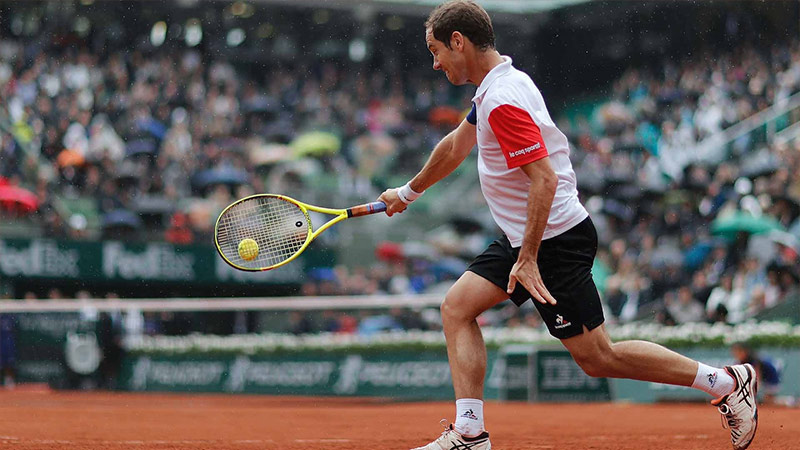
Richard Gasquet is famous for his legendary one-handed backhand, widely regarded as the most aesthetic and effective stroke in tennis history.
Known as the “Mozart of Tennis,” he rose to prominence as a child prodigy who defeated Rafael Nadal at age 12 and made his professional debut at just 15.
Beyond his technique, Gasquet is celebrated for his incredible longevity, amassing over 600 career wins and spending 956 consecutive weeks in the world’s Top 100.
His 23-year career, marked by 16 titles and a Davis Cup victory, concluded with an emotional retirement at the 2025 French Open.
The Artistic Mastery of the Gasquet Backhand
While many players utilize a two-handed approach for stability, Gasquet’s fame is inextricably linked to his commitment to the one-handed backhand.
This stroke became a hallmark of his identity, drawing praise from fans and technical analysts alike for its complexity and raw power.
Technical Breakdown: The Winding Backswing
The mechanics of Gasquet’s backhand were unlike any other on the ATP Tour. The motion was defined by an exceptionally high and winding takeback, which acted as a coil to generate massive potential energy.
This was followed by an explosive wrist snap at the point of contact, allowing him to accelerate the racket head through the ball with immense velocity.
This technique enabled him to strike devastating winners even when pinned deep behind the baseline, a feat that few of his contemporaries could replicate with such consistent elegance.
Aesthetic vs. Efficiency: A Purist’s Dream
For tennis purists, watching Gasquet play was often described as watching an artist at work. The theatrical follow-through of his backhand was not merely for show; it was essential for generating the heavy topspin that made the ball dip sharply inside the lines.
This combination of visual beauty and clinical efficiency ensured that he remained a favorite at Grand Slam venues like Wimbledon and Roland Garros, where the crowd appreciated the craftsmanship of a classic style in an era of homogenization.
Generational Rivalry: Gasquet vs. Wawrinka
Whenever the conversation arises regarding the greatest backhand of the 21st century, Gasquet is routinely cited alongside Stan Wawrinka as the gold standard.
While Wawrinka’s backhand was known for its sheer brute force and flatter trajectory, Gasquet’s version was lauded for its variety, spin, and ability to open up impossible angles on the court.
Together, these two players kept the tradition of the single-handed stroke alive against an overwhelming tide of two-handed baseline grinders.
Richard Gasquet Career Statistics and Historic Longevity
To understand why Gasquet remains a prominent figure in sports history, one must look at the sheer weight of his statistical achievements.
His career was a testament to durability, spanning over two decades of high-level competition against the greatest generation the sport has ever seen.
| Statistical Category | Career Achievement Details |
|---|---|
| Total Singles Wins | 610 Victories |
| Career-High Ranking | World No. 7 (July 2007) |
| Weeks in Top 100 | 956 Consecutive Weeks (Over 18 Years) |
| ATP Singles Titles | 16 Titles out of 33 Finals |
| Career Prize Money | $21,504,662 (31st All-Time) |
| Match Win Percentage | 59.9% Across All Surfaces |
| Aces Served | 5,248 Aces |
How the “Mozart of Tennis” Became a Child Prodigy
The narrative of Richard Gasquet’s life is framed by the immense pressure of early stardom. Before he had even reached his teenage years, he was already being hailed as the savior of French tennis, a burden that would define the expectations of his entire professional journey.
The 1996 Tennis Magazine Prophecy
The “Mozart” nickname was not an exaggeration of the media’s interest; it was a reflection of his undeniable genius. At just nine years old, Gasquet appeared on the cover of France’s prestigious Tennis Magazine.
The headline famously asked if he was “the champion that France is waiting for,” setting a standard of excellence that would have been overwhelming for almost any other child.
This early exposure ensured that every move he made from that point forward was scrutinized by a global audience.
The Famous Victory Over Rafael Nadal
One of the most enduring stories of Gasquet’s youth is his encounter with a young Rafael Nadal. At the age of 12, Gasquet defeated the future “King of Clay” at the Les Petits As junior tournament, which is widely considered the unofficial world championship for that age group.
This victory became a part of tennis folklore, serving as the benchmark for his potential and a reminder of the natural talent that he possessed from the very beginning.
The Monte Carlo Masterpiece at Age Fifteen
Gasquet’s transition to the professional ranks was just as meteoric as his junior career. In 2002, at the age of 15, he received a wildcard into the Monte Carlo Masters.
He stunned the world by winning his opening match, becoming one of the youngest players in history to win a match at the ATP Masters 1000 level.
This milestone cemented his status as a “teenage master” and validated the years of hype that had preceded his debut on the world stage.
Significant Achievements and Professional Accolades
Despite playing in the “Big Three” era alongside Federer, Nadal, and Djokovic, Gasquet amassed an trophy cabinet that ranks him among the elite of his generation.
His success was not limited to individual play but extended to representing his country on the biggest stages.
- 16 ATP Tour Singles Titles: He proved his versatility by winning titles on clay, hard, and grass courts throughout his career.
- Three Grand Slam Semifinals: He reached the final four at Wimbledon twice (2007, 2015) and the US Open once (2013), proving he could compete with the best in best-of-five-set formats.
- 2017 Davis Cup Champion: He played a pivotal role in helping France lift the prestigious team trophy, a crowning achievement for a player so dedicated to his national colors.
- Olympic Bronze Medalist: At the 2012 London Olympics, he secured a bronze medal in men’s doubles alongside Julien Benneteau.
- 2004 French Open Mixed Doubles Champion: He tasted Grand Slam glory early in his career, winning the mixed doubles title at Roland Garros with Tatiana Golovin.
- Three Masters 1000 Finals: He reached the championship match at Hamburg (2005) and Toronto (2006, 2012), consistently challenging for the biggest non-slam titles on the circuit.
The 2009 Miami Incident: The “Pamela” Kiss Defense
No discussion of Gasquet’s fame would be complete without mentioning the unique controversy that briefly threatened his career in 2009.
This incident became one of the most famous legal cases in sports history due to its highly unusual circumstances and subsequent resolution.
Legal Proceedings and the Cocaine Transfer Theory
In 2009, Gasquet tested positive for trace amounts of cocaine following the Miami Masters.
Faced with a potentially career-ending ban, he presented a defense that sounded like a movie script: he claimed that the substance had entered his system inadvertently via a kiss with a woman named “Pamela” at a nightclub.
While the sporting world was initially skeptical, Gasquet and his legal team meticulously built a case to prove the accidental nature of the transfer.
Vindicated by the Court of Arbitration for Sport
The independent tribunal and the Court of Arbitration for Sport ultimately accepted his explanation, noting the miniscule amount of the substance found in his system. Gasquet was cleared of intentional wrongdoing and allowed to return to the tour.
This event, while stressful, actually increased his global profile and showcased his resilience, as he managed to rebuild his career and return to the world’s Top 10 shortly after the ordeal.
Why Did Richard Gasquet Retire at the 2025 French Open?
The conclusion of Gasquet’s 23-year journey was as poetic as his backhand. Choosing to retire at his home Grand Slam, the 2025 French Open, allowed him to say goodbye to the fans who had supported him since he was a nine-year-old on a magazine cover.
Final Moments on Court Philippe-Chatrier
For his final professional match, Gasquet stepped onto the iconic Court Philippe-Chatrier to face the reigning World No. 1, Jannik Sinner.
Despite the age gap and the physical toll of a two-decade career, Gasquet displayed flashes of the brilliance that made him famous.
The atmosphere was electric, with the French crowd providing a thunderous backdrop for the “Little Mozart’s” final symphony on the red clay.
Tributes from the Legends: Djokovic and Sinner
Following the match, the court was transformed into a stage for a celebration of his entire career. He received a massive standing ovation that lasted several minutes, a heartfelt tribute from a nation that viewed him as an icon of elegance.
Video messages from legends like Novak Djokovic highlighted the respect he commanded in the locker room, emphasizing that his legacy was defined by more than just wins and losses—it was defined by the way he played the game.
The Impact of the Big Three Era on His Legacy
Context is vital when evaluating Gasquet’s place in history. He was often labeled an “underachiever” by those who expected multiple Grand Slam titles, but a deeper analysis of the era in which he played reveals a different story of immense success.
Competing Against Federer, Nadal, and Djokovic
Gasquet’s career coincided perfectly with the peak of the three greatest players to ever pick up a racket. Reaching three Grand Slam semifinals and winning 16 titles during this period is an extraordinary feat.
Many analysts argue that in any other era, Gasquet’s natural talent and 600-win consistency would have likely resulted in several major trophies. His ability to remain competitive for 23 years in such a punishing landscape is perhaps his greatest achievement.
Redefining Success Beyond Grand Slam Titles
The fame of Richard Gasquet serves as a reminder that tennis is not just a game of results, but a game of style. He proved that a player can become a global icon through artistic expression and grit.
His record of 956 consecutive weeks in the Top 100 shows a level of daily professionalism that is rare in professional sports. He retired not just as a former child prodigy, but as one of the most respected “iron men” of the ATP Tour.
Frequently Asked Questions: Richard Gasquet’s Career
How many matches did Richard Gasquet win?
Richard Gasquet finished his professional career with a total of 610 singles match victories.
He was the first French male player in history to join the prestigious “600-win club,” a milestone that underscores his remarkable consistency across more than two decades on the tour.
Why was he called the Mozart of Tennis?
He earned the nickname “Mozart of Tennis” due to his status as a child prodigy with extraordinary natural talent.
Starting with his appearance on a national magazine cover at age nine and his victory over Rafael Nadal at age 12, his early mastery of the sport’s technical aspects—particularly his backhand—drew comparisons to the musical genius of Wolfgang Amadeus Mozart.
What is Richard Gasquet’s highest ranking?
Richard Gasquet reached a career-high singles ranking of World No. 7 on July 9, 2007. This peak came during a year when he reached his first Grand Slam semifinal at Wimbledon, establishing himself as one of the elite competitors in the world during a highly competitive era.
Conclusion
Richard Gasquet’s retirement marks the end of an era for tennis purists. From his days as a “Little Mozart” to his final salute at Roland Garros, he remained true to an elegant style of play that prioritized artistry as much as athleticism.
His 610 wins, 16 titles, and legendary one-handed backhand ensure that he will be remembered as one of the most significant figures in French sporting history.
For fans around the world, Gasquet was more than just a player; he was the definitive example of how beautiful the game of tennis can be.