
In the landscape of the professional football draft, evaluation is a complex equation of physical measurements, medical projection, and risk management.
Few cases in recent history illustrate the volatility of this equation more clearly than that of linebacker Nakobe Dean.
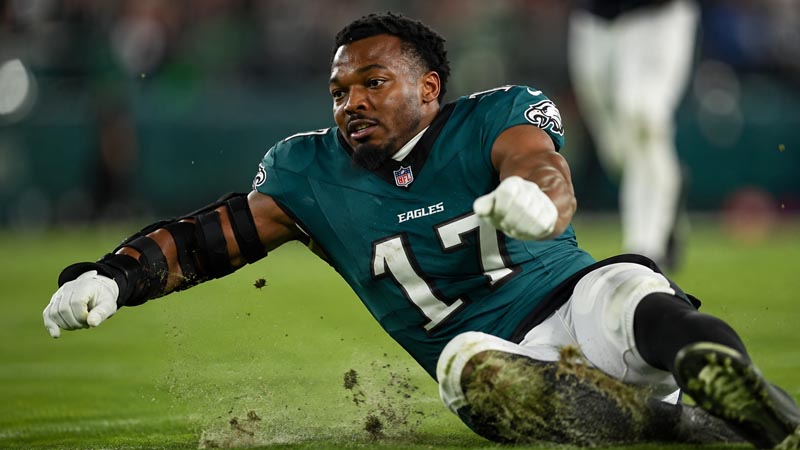
Entering the 2022 NFL Draft, Dean was widely projected as a premier, first-round talent. Yet, when the draft unfolded, his name went uncalled during the entire first round, extending through the second round, until the Philadelphia Eagles selected him in the third round with the 83rd overall pick.
To understand why a player with a first-round pedigree experienced such a significant slide, we must analyze the convergence of three distinct risk factors: an active pectoral injury, an undersized physical frame, and highly damaging late-stage medical rumors.
This analysis deconstructs these elements to show how a consensus top-tier prospect became a third-round value acquisition.
The Injury Catalyst: The Pectoral Strain and the Surgery Dilemma
The primary catalyst for Dean’s draft slide was a significant medical concern that arose during the critical pre-draft training window. While preparing for the draft, Dean suffered a pectoral strain.
In the high-stakes environment of professional scouting, any soft-tissue injury to an upper-body muscle group is highly scrutinized. However, the issue was compounded by the player’s recovery strategy:
- The Decision to Decline Surgery: Rather than opting for an immediate surgical operation to repair the pectoral strain, Dean chose to undergo a non-operative recovery path.
- The Front-Office Reaction: This decision to decline surgery “concerned NFL clubs”.
For professional front offices, a prospect’s willingness to undergo surgery is often viewed as a structured, predictable path to recovery, complete with established rehabilitation timelines. When a player elects to bypass an operation, it introduces an element of medical uncertainty.
NFL decision-makers, who are inherently risk-averse when investing millions of dollars in first-round capital, interpreted this non-surgical choice as a significant medical flag.
The lingering question of whether the pectoral muscle would heal with the necessary structural integrity without surgery immediately compromised his standing on multiple draft boards.
The Prototype Challenge: Navigating the Undersized Frame
In addition to the immediate pectoral injury, Dean’s draft evaluation was heavily impacted by historical scouting prototypes. Modern professional defenses value speed and lateral agility, but physical size remains a foundational metric for durability.
Dean’s official pre-draft measurements fell noticeably below the traditional baseline for elite inside linebackers:
- Height: 5-foot-11
- Weight: 229 pounds (roughly 230 pounds)
Standing under 6 feet tall and weighing less than 230 pounds, Dean presented a physical profile that diverged sharply from the classic NFL linebacker mold.
The Durability Argument
Professional offensive linemen routinely weigh between 310 and 330 pounds. Consequently, team evaluators expressed significant worry regarding Dean’s physical durability.
The primary scouting concern was straightforward: could a linebacker of his dimensions consistently absorb the physical punishment of shedding blocks from professional offensive linemen over a grueling season without breaking down?
When combined with an active pectoral strain, his smaller frame became a compounding risk factor. For teams holding first-round picks, the overlapping concerns of an active, unoperated injury and a lighter frame made it difficult to justify a premium selection.
The Rumor Mill: The Cost of Late-Stage Speculation
The final phase of Dean’s draft-day slide was driven not by verified medical data, but by the rapid spread of late-stage speculation. In the days immediately preceding the draft, the valuation of prospects can shift dramatically based on whispers within the scouting community.
For Dean, this speculation manifested as unverified reports and rumors that questioned his immediate availability for the upcoming season:
- The Nature of the Rumors: The primary speculation centered on whether his physical condition would prevent him from being ready to play during his rookie season.
- The Practical Impact: Because these reports surfaced late in the pre-draft process, teams had limited time to independently verify or dispute the claims with their own medical staffs. In the absence of clarity, risk-averse franchises simply chose to defer to other prospects on their boards.
- The Player’s Perspective: Dean later addressed these late-stage rumors directly, labeling them entirely false. However, the damage was already done. By the time he was selected at pick 83, the spread of these unverified reports had proved to be incredibly costly to his draft position and initial rookie contract valuation.
Strategic Synthesis: The Risk-Reward Equation for Philadelphia
The slide of a projected first-round talent to the third round is rarely the result of a single flaw. Rather, it is a cascading effect where multiple concerns validate one another.
For thirty-one NFL franchises, the combination of a pectoral strain without surgical intervention, a sub-6-foot frame, and late rumors regarding rookie availability proved too risky for a day-one or early day-two selection.
However, this collective risk aversion created a unique opportunity for the Philadelphia Eagles. By securing Dean with the 83rd overall pick, the Eagles executed a classic value-acquisition strategy:
[First-Round Projection] ──> [Compounding Risk Flags (Injury, Size, Rumors)] ──> [Value Cliff (Pick 83)]
                                                                                      │
                                                                             [Eagles Stop the Slide]
At pick 83, the risk-reward ratio shifted dramatically in the team’s favor. The Eagles acquired a player with consensus first-round capability at a fraction of the draft capital typically required to secure such talent, halting one of the most talked-about slides of the 2022 draft.






