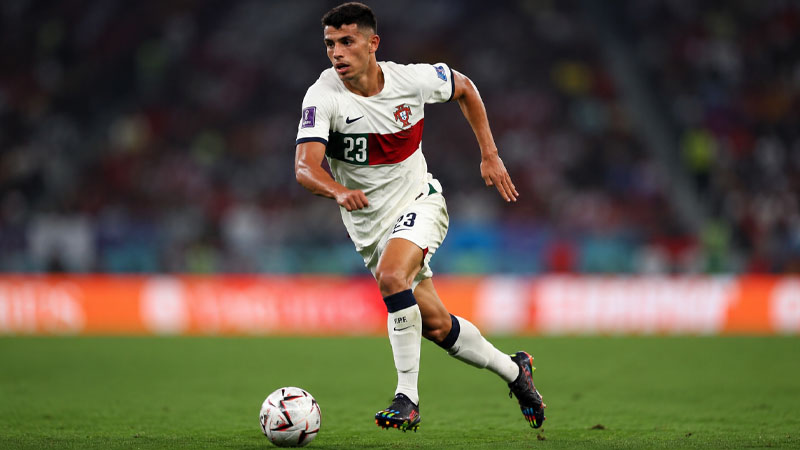
The tactical landscape of modern football is defined by versatility, and few managers exemplify this better than Pep Guardiola.
The decision to reposition Matheus Nunes from a dynamic central midfielder to an inverted right-back at Manchester City has sparked significant intrigue.
While initially appearing as a temporary solution to squad depth, this transition is a calculated response to specific tactical deficiencies and a desire to maximize Nunes’ elite physical profile.
This move reflects a broader philosophy of internal player evolution, turning a struggling midfielder into a high-functioning defensive asset who thrives on the touchline rather than in the congested center.
The Strategic Shift from Midfield to Defense
The transition of Matheus Nunes was not a random experiment but a response to both a blunt tactical diagnosis and a structural necessity within the first-team squad.
Guardiola’s public evaluations provided the primary driver for this shift, as the coaching staff recognized that Nunes’ natural tendencies were being stifled in the high-pressure central corridors of the Etihad system.
Moving a player of Nunes’ profile requires a deep understanding of how individual attributes translate across different zones of the pitch.
By shifting him out wide, the management aimed to address two distinct challenges: the departure of a club legend and the need for a more composed build-up phase.
Identifying the Tactical Vacuum
A major catalyst for this change was the departure of Kyle Walker, which created a significant tactical vacuum on the right side of Manchester City’s defense.
For years, Walker served as the team’s defensive insurance policy, using his recovery speed to neutralize counter-attacks. When the club opted not to pay premium fees for external replacements like Tino Livramento, the focus shifted toward internal solutions.
Nunes, with his explosive burst and imposing frame, was identified as the player with the raw physical tools most capable of replicating that elite level of physical coverage.
The Legacy of Positional Conversion
This conversion follows a well-established pattern of Guardiola reimagining the roles of talented midfielders.
Historically, players like Fabian Delph and Oleksandr Zinchenko successfully transitioned from midfield roles to the backline, proving that technical proficiency in the center can be a massive asset on the flanks.
Nunes represents the latest chapter in this legacy, moving from a role where his spatial awareness was questioned to a position where his verticality and directness can be fully weaponized.
Analyzing the Physical and Technical Blueprint
The rationale for playing Matheus Nunes at right-back centers on his “special physicality” and how those traits interact with the spatial demands of the Premier League.
In central midfield, the game is played in 360 degrees, requiring a level of composure and lightning-quick decision-making that Guardiola felt Nunes occasionally lacked.
By moving him to the touchline, the field of vision is restricted to 180 degrees, allowing him to process the game more effectively.
This change in environment allows Nunes to utilize his physical gifts without being trapped in the “pressing cages” often found in the middle of the park. The move effectively trades central congestion for wide verticality.
Leveraging Special Physicality
Guardiola has specifically praised Nunes for a level of acceleration and pace that the squad lacked in other areas. At right-back, this “special physicality” is utilized to defend long balls and match the speed of fast opposing wingers.
Unlike traditional defenders who may struggle with recovery, Nunes’ background as a dynamic box-to-box athlete allows him to cover vast distances, effectively acting as a transition monster who can shut down counter-attacks before they materialize.
Escape from Central Pressing Traps
In the center of the pitch, Nunes’ decision-making sometimes lagged behind the elite requirements of a City anchor, leading to turnovers in dangerous areas. However, when given “expansive green grass” along the touchline, these flaws largely disappear.
Out wide, he is no longer subject to the same intense 360-degree pressing traps. Instead, he can use his elite ball-carrying ability to drive past defensive lines from deep positions, providing a directness that traditional full-backs often lack.
The Inverted Role: How Nunes Operates in Possession
Matheus Nunes does not function as a standard, touchline-hugging defender; he operates as an inverted full-back. This hybrid role is essential to City’s ability to control matches through possession and numerical superiority in the midfield.
His natural instincts as a former Sporting CP and Wolves midfielder allow him to glide seamlessly into central areas during the build-up phase.
When the team commands possession, Nunes moves inside to create a “box-four” configuration or a 3-4-2-1 overload.
This tactical maneuver provides an extra passing lane, helping the team to safely suffocate opposing counter-pressing schemes while maintaining defensive security.
Positional Comparison: Midfield vs. Inverted Right-Back
To understand why this move has been so successful, it is helpful to look at the differences in his functional responsibilities across both roles:
| Feature | Central Midfielder (Previous) | Inverted Right-Back (Current) |
|---|---|---|
| Field of Vision | 360-degree (Highly Congested) | 180-degree (Touchline Protected) |
| Primary Tool | Short Passing & Pivot Turns | Progressive Carries & Wide Verticality |
| Defensive Duty | Area Marking & Second Balls | One-on-One Recovery & Far Post Guarding |
| Tactical Goal | Controlling Tempo in the Hole | Creating Overloads & Transition Control |
| Space Target | Between the Lines | Exploiting Expansive Green Grass |
Statistical Validation: The Data Behind the Dominance
The decision to keep Nunes in the backline is reinforced by a significant spike in his performance metrics during the 2025–26 season.
The data suggests that he is not just a “makeshift” solution but is actually performing at a higher level than he did as a traditional midfielder. His ability to progress the ball and impact the game defensively has seen a measurable transformation.
These numbers provide a clear indication that the positional shift has unlocked a level of productivity that was previously dormant. The following table highlights the radical shift in his per-90-minute output.
Performance Metric Analysis (Per 90 Minutes)
| Metric | As a Central Midfielder | As an Inverted Right-Back |
|---|---|---|
| Progressive Carries | 2.14 | 4.89 |
| Tackles in Defensive Third | 1.02 | 2.68 |
| Passing Accuracy | 86.4% | 90.1% |
| Chances Created | 0.85 | 1.42 |
| Successful Crosses | 0.12 | 1.15 |
The most striking data point is the doubling of his progressive carries and tackles in the defensive third. This confirms that Nunes is using his pace more effectively to drive the team forward while becoming a much more reliable defensive anchor.
His passing accuracy has also improved, likely due to the clearer passing lanes available on the flank compared to the crowded center.
Fan Perspectives and the Professional Evolution
The reaction from the supporters and the footballing community has evolved from skepticism to genuine appreciation. Initially, many fans questioned the £53M price tag for a player who didn’t seem to fit the midfield profile.
However, his “mentality” and willingness to persevere in a new role have won over the Etihad faithful. Many now view him as a reliable and high-quality asset who has saved the club significant capital in the transfer market.
As Nunes continues to develop his defensive wrinkles, the conversation has shifted from whether he can play right-back to whether he is now one of the best in the league in that position.
Mentality and Professional Growth
Critics of the move often pointed to the lack of a “natural” right-back in the squad, but Nunes has silenced much of this doubt through sheer reliability.
Supporters have praised his ability to keep his head down and make himself valuable in a different way after the midfield role didn’t immediately click.
His growth in reading the offside trap and timing his sliding challenges shows a player who is studiously dedicated to mastering his new craft.
Is This a Permanent Evolution?
While the move began as a tactical experiment born of necessity, Guardiola has indicated that it is likely a permanent evolution of Nunes’ career. The manager believes Nunes has the attributes to become one of the best right-backs in world football.
Even if the club eventually signs another defender, the ability for Nunes to rotate between the pivot and the flank makes him a highly versatile tactical asset for the long term.
Frequently Asked Questions
Did Matheus Nunes play right-back before joining Manchester City?
While he was primarily known as an 8 or a box-to-box midfielder at Sporting CP and Wolves, he was occasionally utilized as a right wing-back during his early career at Sporting under Ruben Amorim.
However, his development into a specialized inverted right-back was entirely engineered by Guardiola.
How does his playing style differ from a traditional right-back?
A traditional full-back typically focuses on early crosses and staying wide to stretch the pitch. Nunes acts more as an elite ball-carrier who slices inward through the half-spaces.
He combines the traits of an interior playmaker with the recovery speed of a defensive specialist.
Why didn’t City just buy a new right-back?
The club’s hierarchy opted out of bidding wars for traditional options, trusting that the internal conversion of Nunes would yield a more versatile asset at a lower net expenditure.
This allowed the club to avoid overpaying in a hyper-inflated market while maximizing a player they had already invested £53M in.
What is the “Inverted” aspect of his role?
The “inverted” part refers to his movement when City has the ball. Instead of staying wide, he moves into the center of the pitch to act as an extra midfielder.
This creates a numerical advantage (overload) that helps City dominate possession and prevent the opposition from counter-attacking through the middle.
Is Nunes better than Kyle Walker was?
It is difficult to compare a club legend to a new conversion, but Nunes offers different qualities.
While Walker was a pure recovery specialist, Nunes provides more creativity, better ball-carrying stats (4.89 progressive carries per 90), and more frequent chance creation (1.42 per 90).
Strategic Conclusion: A Masterclass in Player Development
The reinvention of Matheus Nunes is a testament to the fact that talent profiles are often more important than fixed positions.
By identifying that Nunes’ “special physicality” and verticality were being wasted in a crowded midfield, the Manchester City coaching staff have essentially “discovered” a world-class right-back within their own ranks.
This move has not only solved a structural defensive problem following Kyle Walker’s exit but has also increased Nunes’ statistical output across every major category.
Understanding these modern positional rotations is key to appreciating how elite football is evolving. Nunes is no longer just a “midfielder playing out of position”; he is a specialized hybrid asset who provides City with a unique tactical edge.
For fans and analysts alike, his transformation serves as a reminder that with the right coaching and a resilient mentality, a player’s greatest strengths can often be found where they are least expected.