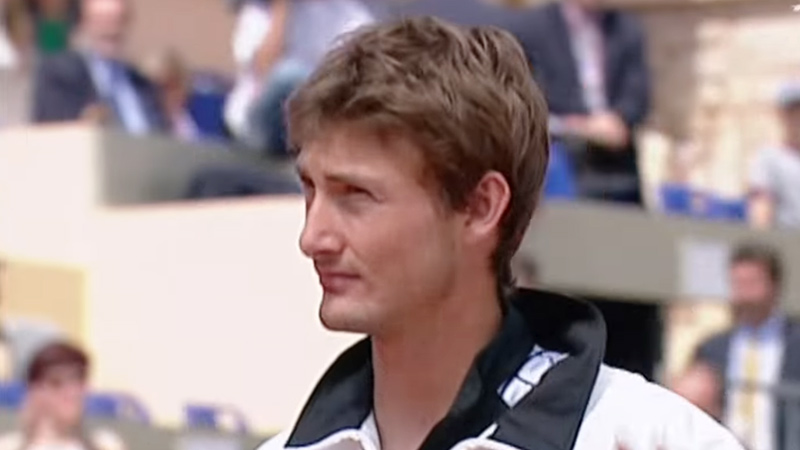
Juan Carlos Ferrero is a legendary figure famous for reaching World No. 1 and winning the 2003 French Open title. Nicknamed “El Mosquito” for his lightning speed and stinging forehand, he redefined Spanish tennis as an all-court threat, reaching major finals on both clay and hard courts.
Beyond his 16 ATP titles and three Davis Cup trophies, Ferrero is celebrated globally as the tactical mastermind who mentored Carlos Alcaraz from age 14 to superstardom.
Through his JC Ferrero Equelite Sport Academy, he continues to shape the sport’s future, solidifying his enduring legacy as both a premier champion and the ultimate architect of modern tennis excellence for future generations to come.
What are Juan Carlos Ferrero’s Biggest Achievements?
The ascent of Juan Carlos Ferrero to the top of the tennis world was marked by a series of high-stakes victories and a level of consistency that few players in history have matched.
His career is defined by a commitment to excellence that saw him transition from a promising young talent to a global sporting icon within a few short years. By analyzing his major milestones, we can understand why his name remains synonymous with tennis royalty.
Reaching the World No. 1 Ranking
On September 8, 2003, Juan Carlos Ferrero reached the summit of the Pepperstone ATP Rankings, becoming only the second Spanish man in history to hold the World No. 1 position.
This achievement was the result of years of sustained performance at the highest level. Ferrero was not a “one-hit wonder”; he spent an incredible 176 consecutive weeks ranked inside the global Top 10 from 2001 through late 2004.
His tenure at the top solidified his reputation as the premier player of his generation, proving he could outlast and outplay the best in the world.
Winning the 2003 French Open Title
The crowning jewel of Ferrero’s playing career came in 2003 at Roland Garros. After finishing as the runner-up in 2002, he returned to Paris with a focused determination to claim the trophy that had narrowly eluded him.
He dominated the tournament, eventually defeating Martin Verkerk in a straight-sets final to capture the French Open singles title.
This victory was more than just a personal milestone; it was a statement of his dominance on clay, a surface where he maintained a career winning percentage of 72.8%.
A Triple Threat in the Davis Cup
Beyond individual glory, Ferrero was a national hero who thrived in the team environment of the Davis Cup. He was instrumental in leading Spain to its historic first-ever Davis Cup title in 2000.
His commitment to the national team remained steadfast throughout his career, as he helped secure additional championships in 2004 and 2009.
These three titles highlight his ability to perform under the immense pressure of representing his country, further endearing him to fans in Spain and across the globe.
Why Was He Nicknamed “El Mosquito”?
In the world of professional sports, nicknames often capture the essence of a player’s style, and “El Mosquito” is perhaps one of the most accurate descriptors in tennis history.
This moniker was not merely a comment on his physical appearance but reflected how he physically overwhelmed opponents through sheer mobility and precision.
It represented a unique blend of physical attributes and tactical execution that made him a nightmare to face on any surface.
Explosive Speed and Slender Physique
The nickname “El Mosquito” was originally coined to describe Ferrero’s incredibly slender frame and his blistering speed across the court.
Unlike some of the more muscular power hitters of his era, Ferrero relied on his lightning-fast footwork to track down balls that seemed out of reach.
This mobility allowed him to reset points and force opponents into making extra shots, often leading to unforced errors. His agility was his primary defensive weapon, turning him into a backboard that was nearly impossible to bypass.
The Lethal Baseline Sting
While his speed provided the defense, his forehand provided the “sting” that justified the nickname. Ferrero utilized an incredibly heavy and aggressive baseline forehand that could dictate play from the back of the court.
He had the rare ability to transition from a defensive position to an offensive one in a single stride, catching opponents off guard with the sudden pace of his shots.
This combination of rapid movement and a sharp, penetrating strike allowed him to “sting” his rivals from any corner of the stadium.
Comprehensive Breakdown of Career Statistics
To truly appreciate the scale of Ferrero’s impact, one must look at the data that defined his fourteen-year professional journey. His statistics reveal a player who was not only a specialist on clay but a formidable competitor across all tennis environments.
The following table illustrates his efficiency and success rate on the various surfaces of the ATP Tour.
| Surface | Career Win-Loss | Win % | Career Titles | Best Grand Slam Result |
|---|---|---|---|---|
| Clay | 254–95 | 72.8% | 13 | Champion (French Open, 2003) |
| Hard | 178–134 | 57.1% | 3 | Runner-up (US Open, 2003) |
| Grass | 30–19 | 61.2% | 0 | Quarterfinals (Wimbledon, 2007, 2009) |
| Carpet | 17–14 | 54.8% | 0 | — |
| Total | 479–262 | 64.6% | 16 | — |
Data indicates his broad success and significant prize earnings of $13,998,165 before his retirement in 2012.
How Did He Transform Spanish Tennis Culture?
Before the rise of the modern era, Spanish players were frequently categorized by international media as specialists who only excelled on the red clay of Europe.
Ferrero was a pivotal figure in dismantling this narrow perception, proving that Spanish grit could translate to any environment. His career served as a bridge between the traditional clay-court specialists of the past and the all-surface icons of the present.
Breaking the Clay-Court Specialist Mold
Ferrero famously broke the stereotype that Spanish players were ineffective on fast surfaces. While his heart was on clay, he proved his versatility by reaching the final of the US Open on hard courts in 2003 and making two quarterfinal appearances at Wimbledon on grass.
By showing that an aggressive baseline game could win on the fastest courts in the world, he gave future Spanish players the confidence to compete for titles at every Grand Slam, regardless of the surface.
Paving the Way for Future Generations
Contemporaries such as David Ferrer have credited Juan Carlos Ferrero with breaking down mental barriers for an entire generation of athletes. He demonstrated that a Spanish player could not only reach World No. 1 but stay there by competing globally.
This shift in mindset paved the way for the “Golden Generation” of Spanish tennis, including the likes of Rafael Nadal, who would go on to dominate the sport for decades.
Ferrero’s legacy is woven into the fabric of every major victory achieved by his compatriots who followed his lead.
Exploring His Coaching Success with Carlos Alcaraz
While many former champions struggle to translate their playing experience into effective coaching, Ferrero has found a second calling that has arguably made him more famous than his playing days.
His transition into a masterclass coach is a rare success story of mentorship and long-term vision. He chose a path of development rather than seeking immediate results with established veterans, a decision that has fundamentally altered the landscape of modern tennis.
Mentoring a Teen Prodigy at Equelite
The partnership between Ferrero and Carlos Alcaraz began when the latter was just 14 years old at the JC Ferrero Equelite Sport Academy. Ferrero saw a raw, undeniable talent in the young boy from Murcia and decided to dedicate his career to molding him.
In an industry where top coaches often chase high-profile players for quick paychecks, Ferrero turned down offers from established stars to focus entirely on the long-term development of Alcaraz.
This commitment laid the foundation for one of the most successful player-coach relationships in history.
Engineering a Meteoric Rise to the Top
Under Ferrero’s guidance, Carlos Alcaraz underwent a transformation that stunned the sporting world. Ferrero engineered a rise that saw Alcaraz become the youngest World No. 1 in the history of men’s tennis and a multiple-time Grand Slam champion.
For his efforts, Ferrero was recognized as the ATP Coach of the Year, a testament to his ability to translate tactical knowledge into championship results.
This seven-year journey has made Ferrero a modern icon for a new generation of fans who may not have seen him play but recognize him as the mastermind behind the sport’s newest superstar.
The JC Ferrero Equelite Sport Academy Legacy
The physical manifestation of Ferrero’s dedication to the sport is his world-class training center, the JC Ferrero Equelite Sport Academy. This facility is more than just a set of tennis courts; it is a laboratory for creating champions.
By establishing this academy, Ferrero ensured that his knowledge and the Spanish tennis philosophy would be preserved and passed down to future generations.
The academy emphasizes a holistic approach to player development, focusing on the same all-court versatility that Ferrero championed during his playing days. It has become a hub for international talent, attracting players who wish to emulate the success of Alcaraz and his mentor.
Through this institution, Ferrero has transitioned from an individual competitor to a guardian of the sport’s future, ensuring that the “Ferrero Dynasty” will continue long after he steps away from the court.
Frequently Asked Questions About Juan Carlos Ferrero
When did Juan Carlos Ferrero become World No. 1?
He reached the top spot on September 8, 2003, after a stellar season that included a French Open title and a US Open final.
How many Grand Slam titles did he win as a player?
He won one Grand Slam singles title at the 2003 French Open, though he reached two other Major finals.
Which players did he coach?
His most famous student is Carlos Alcaraz, whom he has mentored since Alcaraz was 14 years old.
What was his career win-loss record?
He finished his professional playing career with a record of 479–262, a winning percentage of 64.6%.
How many Davis Cup titles does he have?
He won the Davis Cup three times with Spain, in the years 2000, 2004, and 2009.
Where is his academy located?
The Juan Carlos Ferrero Equelite Sport Academy is located in Spain and serves as a premier training ground for professional and aspiring players.
The Lasting Impact of a Tennis Mastermind
Juan Carlos Ferrero is a rare individual who has managed to leave an indelible mark on tennis through two entirely different roles. As a player, he was the “Mosquito” who used speed and a stinging forehand to climb to World No. 1 and secure a Grand Slam.
He shattered the limitations placed on Spanish athletes and proved that they could be champions on every surface the tour had to offer.
His second act as a coach has been equally, if not more, impactful. By guiding Carlos Alcaraz to the top of the rankings, he has proved that his understanding of the game is truly elite.
Ferrero is no longer just a champion of the past; he is the architect of the present and the future. Whether it is through the trophies in his cabinet or the champions training at his academy, the legacy of Juan Carlos Ferrero is a permanent fixture in the history of sport.