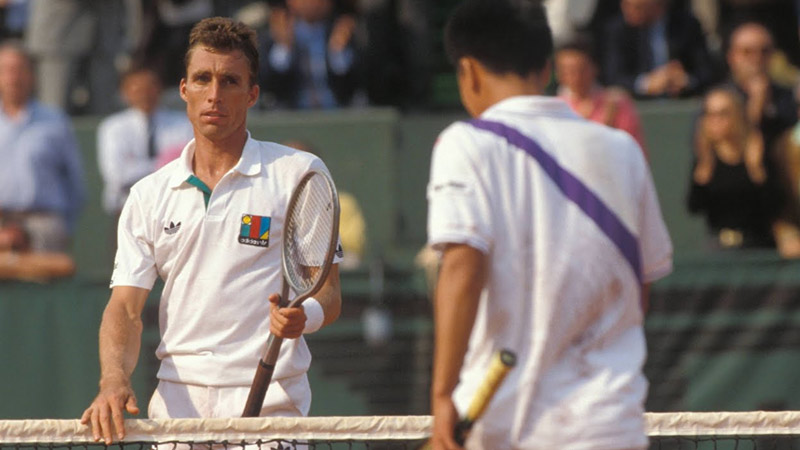
Ivan Lendl is famous for revolutionizing tennis into the baseline-driven power game seen today. Dominating the 1980s, he secured eight Grand Slam titles and spent 270 weeks as World No. 1.
Lendl is celebrated for his relentless work ethic, pioneering scientific training, strict dieting, and physical conditioning—standardizing professionalism for future generations.
His career is defined by 94 singles titles and a record eight consecutive US Open finals. Beyond his playing days, Lendl gained further fame as the elite coach who guided Andy Murray to multiple major victories and the top global ranking.
What Made Ivan Lendl’s Playing Style So Revolutionary?
Ivan Lendl did not just play tennis; he engineered a new way to win. Before his arrival, the game was often defined by touch, finesse, and the classic serve-and-volley approach.
Lendl shifted the focal point of the match to the baseline, using raw power and athletic endurance to dictate play.
The Birth of the Heavy Baseline Game
Lendl pioneered the use of heavy, topspin-heavy groundstrokes that pushed opponents deep behind the baseline.
His forehand was widely considered one of the most fearsome weapons in the sport, capable of “crushing” opponents with a combination of velocity and extreme rotation.
This style allowed him to control the tempo of a match, making it difficult for traditional net-rushers to find an opening.
By staying back and grinding through points with relentless consistency, he laid the tactical blueprint for modern champions like Rafael Nadal and Novak Djokovic.
Leveraging Technological Innovation
While many of his contemporaries were slow to abandon traditional equipment, Lendl was a first mover in the technological evolution of the sport. He was among the first elite players to fully utilize custom-molded graphite racquets.
These frames provided significantly more stiffness and power than the wood or early composite racquets used by previous generations.
By pairing this advanced equipment with his aggressive swing paths, Lendl maximized both his shot-making control and his total power output, creating a physical disadvantage for anyone not using similar technology.
A Legacy Defined by Record-Breaking Consistency
The fame surrounding Ivan Lendl is deeply rooted in his staggering statistical output. He wasn’t just a flash in the pan; he was a model of industrial-level efficiency for over a decade.
His ability to reach the deep stages of every tournament he entered created a sense of inevitability whenever he stepped onto the court.
| Statistic | Career Total / Record | Historical Context |
|---|---|---|
| Career Record | 1,068–242 | 5th most match wins in the Open Era |
| Match Win % | 81.5% | One of the highest in history |
| Singles Titles | 94 | 3rd most titles in the Open Era |
| Grand Slam Titles | 8 | Tied for 11th all-time |
| Grand Slam Finals | 19 | 4th most in men’s tennis history |
| Weeks at No. 1 | 270 | 5th longest reign in history |
Lendl’s dominance was particularly evident in his ability to maintain the top spot in the rankings. He finished as the Year-End No. 1 four times (1985, 1986, 1987, and 1989).
His consistency in the season-ending Masters Grand Prix—now known as the ATP Finals—is also legendary, as he captured five titles and reached nine finals, including a record eight consecutive title matches.
How Did Ivan Lendl Change Professional Sports Training?
One of the primary reasons Lendl remains a household name in sports science is his introduction of the “modern athlete” persona to tennis. He viewed tennis as a discipline that required more than just talent; it required a scientific approach to the human body.
Scientific Conditioning and Nutrition
Before Lendl, many tennis players viewed fitness as secondary to skill. Lendl changed this by introducing meticulous physical conditioning and strict dieting into his daily routine.
He worked with specialists to ensure his body was a fine-tuned machine, allowing him to maintain peak performance during five-set marathons in the blistering heat.
This dedication to “scientific training methods” was revolutionary at the time and forced the rest of the tour to either adapt or face obsolescence.
The Professionalization of the Tour
Lendl’s influence extended to how players managed their careers. He treated his tennis career with the seriousness of a corporate executive, focusing on every detail from recovery to equipment maintenance.
This high-intensity approach eventually became the gold standard for professional athletes across all sports.
His emphasis on physical wearing-down of opponents became a trademark of his game; he knew that if a match went long, his superior conditioning would almost certainly guarantee a victory.
Iconic Rivalries of the 1980s Golden Era
Lendl’s fame was forged in the fires of intense competition. He played during what many consider the “golden era” of tennis, facing off against legendary figures whose personalities often clashed with his own stoic, disciplined demeanor.
- John McEnroe: This was a clash of fire and ice. While McEnroe was emotional and lived on instinct, Lendl was methodical. Although Lendl trailed early in their rivalry, his superior fitness eventually took over, leading him to win 9 of their last 11 meetings to finish with a 21–15 head-to-head advantage.
- Jimmy Connors: Lendl’s rivalry with Connors is a testament to his persistence. He lost his first eight matches against the American legend. However, in one of the most dramatic “script flips” in sports history, Lendl won their final 17 consecutive meetings.
- Boris Becker and Stefan Edberg: As the 1980s transitioned into the 1990s, Lendl faced the next generation of stars. His matches against the serve-and-volley specialist Edberg (14–10) and the powerhouse Becker (11–10) were highlights of late-stage Grand Slams, showcasing a classic battle between baseline defense and net attack.
Why Is the 1984 French Open Final So Significant?
If there is one match that defines the legend of Ivan Lendl, it is the 1984 French Open final against John McEnroe. Entering the match, McEnroe was on an incredible 42-match winning streak and appeared invincible.
Lendl, conversely, was struggling with the reputation of a player who could not win the “big one” after losing several previous major finals.
After falling behind by two sets, Lendl staged a historic comeback to win his first Grand Slam title. This victory was a psychological watershed moment.
It didn’t just end McEnroe’s streak; it shattered the psychological dynamic of their rivalry and gave Lendl the confidence to begin his long reign at the top of the sport.
The “Missing Piece” and the Wimbledon Challenge
Despite his overwhelming dominance, Lendl is also famous for the one trophy he could never quite grasp: the Wimbledon challenge. While he mastered clay and hard courts, the grass of SW19 remained elusive.
- Finalist Heartbreak: Lendl reached the Wimbledon finals twice, in 1986 and 1987, falling to Boris Becker and Pat Cash respectively.
- Consistent Effort: Even on his least favorite surface, his discipline shone through as he reached five additional semifinals.
- The Completion of a Great: His inability to win Wimbledon is often discussed not as a failure, but as the “missing piece” that highlighted the specialized nature of grass-court tennis during that era.
A Second Act: Coaching and Continued Influence
Lendl’s fame found a new chapter in the 21st century through his work as an elite coach. He proved that his methodical approach to the game was transferable to the next generation.
His most notable success came as the mentor to Andy Murray. Under Lendl’s guidance, Murray broke a historic drought for British tennis, winning his first three Grand Slam titles and reaching the World No. 1 ranking.
Lendl is credited with helping Murray develop the mental toughness and physical resilience required to compete with the “Big Three.”
This coaching success cemented Lendl’s legacy as a true “architect” of the sport, proving his theories on power tennis and professionalism remained valid decades after his retirement.
Frequently Asked Questions About Ivan Lendl
How many Grand Slam titles did Ivan Lendl win?
Ivan Lendl won a total of 8 Grand Slam singles titles: three at the French Open (1984, 1986, 1987), three at the US Open (1985, 1986, 1987), and two at the Australian Open (1989, 1990).
Why did Ivan Lendl never win Wimbledon?
Despite being one of the greatest players in history, Lendl struggled with the specific demands of grass-court tennis, which favored serve-and-volleyers. He reached two finals and five semifinals but could never secure the title.
What is the “Lendl Model” of training?
The “Lendl Model” refers to the scientific approach to tennis, including off-court physical conditioning, a strict diet, and meticulous preparation. He was the first to treat professional tennis with this level of athletic rigor.
How long was Ivan Lendl ranked number one?
Lendl held the world No. 1 ranking for a total of 270 weeks. This remains one of the longest reigns in the history of the sport, surpassed only by a few individuals like Novak Djokovic and Roger Federer.
Who was Ivan Lendl’s biggest rival?
While he had many, his rivalries with John McEnroe and Jimmy Connors are the most iconic. He famously turned the tide against both players, ending his career with a winning head-to-head record against each.
Conclusion: A Transformation That Endures
Ivan Lendl’s fame is not merely the result of his trophies, but the result of his impact on the very DNA of tennis. By combining technological innovation with an unprecedented level of physical and mental discipline, he moved the sport into a new era.
Today, when we see players dominating from the baseline with high-velocity groundstrokes and elite fitness, we are seeing the enduring legacy of the man who truly built the modern power game.
His transition from a dominant player to a championship-winning coach only further proves that his understanding of the game is timeless.