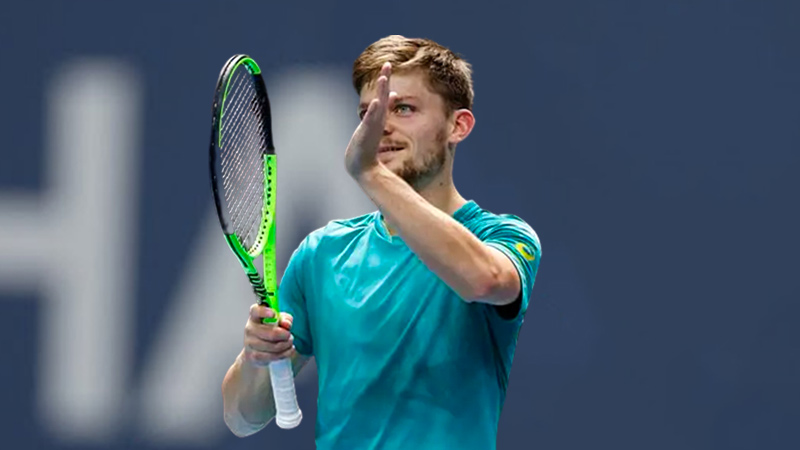
David Goffin is not playing in major ATP main-draw events primarily due to a significant ranking drop and persistent physical injuries. Currently ranked 241st, the Belgian star no longer qualifies for direct entry into Grand Slams.
His absence from the 2026 Australian Open and recent early exits in qualifying rounds at Roland Garros and Wimbledon stem from chronic knee wear-and-tear and a previous plantar fascia tear.
Consequently, Goffin has officially announced that 2026 will be his final professional season, as mental fatigue and the physical toll of the tour have made competing at the highest level unsustainable.
Why is David Goffin Not Playing in Major Main Draws?
The current absence of David Goffin from the world’s most prestigious tennis courts is a multifaceted issue involving both administrative standing and physical capability.
As a veteran of the tour, his ability to participate is no longer guaranteed by his historical achievements but is strictly dictated by his current metrics.
The Obstacle of a Plummeting World Ranking
Goffin’s world ranking has dropped to 241, which fundamentally changes how he accesses professional tournaments.
In the professional tennis ecosystem, players usually require a ranking inside the top 100 to ensure direct entry into the main draws of Grand Slams and Masters 1000 events.
By falling outside this elite bracket, Goffin is relegated to the qualifying tiers, where he must win multiple high-pressure matches just to enter the first round of a major tournament.
This precipitous drop in standing makes it difficult for a veteran player to maintain a consistent schedule against younger, lower-ranked opponents in qualification brackets.
Recent Qualifying Setbacks and Performance Trends
His recent attempts to enter major tournaments have been met with resistance from the next generation of players.
During his announced final season in 2026, Goffin participated in the qualification stages of Roland Garros and Wimbledon but was unable to secure a spot in either main draw.
Specifically, he suffered a second-round qualifying loss to Toby Samuel in Paris and a first-round qualification defeat to Andrea Guerrieri at the All England Club.
These results highlight the physical and competitive difficulty of navigating the “low-level” brackets that he is now forced to play in as his career nears its conclusion.
David Goffin Injury History: A Timeline of Freak Accidents
One of the most significant reasons David Goffin is not playing at his former level is a career-long history of unusual and “freak” injuries. These incidents repeatedly derailed his momentum at critical moments, ultimately leading to the chronic conditions he faces today.
| Date / Period | Injury Description | Recovery Duration | Impact on Career |
|---|---|---|---|
| Sept 2013 | Left wrist fracture (required surgery) | ~4 months | Missed remainder of 2013 season. |
| June 2017 | Right ankle injury (tripped on court tarp) | 6 weeks | Forced retirement at Roland Garros; missed Wimbledon. |
| Feb 2018 | Freak eye injury (ball hit own racket into eye) | 4 weeks | Retired from Rotterdam semis; missed Masters events. |
| Oct 2018 | Right elbow bone bruise | 5 weeks | Cut the 2018 season short, missing Asian/European swings. |
| June 2021 | Left ankle hyper-extension (slipped on grass) | 8 weeks | Retired mid-match in Halle; missed Wimbledon 2021. |
| Sept 2021 | Left knee bone bruise and strain | ~4 months | Ended the 2021 season after US Open first-round exit. |
| April 2025 | Plantar fascia partial tear (Madrid Open) | 2 months | Retired against Alexandre Müller; missed Roland Garros. |
| Late 2025 | Chronic Left Knee wear-and-tear | Ongoing | Withdrew from 2026 Australian Open; led to retirement news. |
The Physical and Mental Toll Leading to Retirement
Beyond the specific incidents listed above, the cumulative effect of a decade-plus on the ATP tour has created a barrier to continued performance. The decision to step away is as much about the mind as it is about the body.
Chronic Knee Wear-and-Tear and Recovery Challenges
The most pressing reason for Goffin’s current lack of play is his chronic left knee condition. This wear-and-tear issue, which intensified in late 2025, has proven to be unrecovered and ongoing.
This specific injury forced him to shut down his late 2025 schedule and prevented him from competing in the 2026 Australian Open.
At 35 years of age, the biological capacity for rapid recovery is diminished, making the “chronic” nature of this knee strain a definitive hurdle for a player whose game relies on movement and agility.
Mental Fatigue and the Motivation Gap
The physical recovery process is only one half of the struggle; the mental endurance required to rebuild a career from scratch is the other. Goffin has openly noted that the process of returning from his 2025 foot and knee issues destroyed his mental motivation.
The reality of plummeting in the rankings means he can no longer get direct entries into the tournaments he spent a decade headlined in.
For a former world No. 7, the prospect of grinding through Challenger events and qualification rounds while managing constant pain has led to significant mental fatigue.
When is David Goffin Retiring from Professional Tennis?
The questions regarding his absence were finally addressed through an official statement regarding his future in the sport. This timeline provides clarity for fans and analysts following his final months on the court.
Official Retirement Announcement Details
On March 27, 2026, David Goffin officially announced via Instagram that the current 2026 season will be his final year on the ATP Tour.
He cited the combination of physical challenges and the mental toll of the professional circuit as the primary drivers for this decision.
While he intended to compete in his final year, the ongoing knee issues have already severely restricted his appearances, leading to his withdrawal from major events like the Australian Open earlier this year.
Reflection on the Legacy of a World No. 7
As we analyze why he is not playing now, it is essential to remember the heights he reached before the “freak” accidents took their toll. Goffin reached a career-high world ranking of No. 7 in late 2017, a year that remains the gold standard of his career.
During that period, he achieved the rare feat of defeating both Rafael Nadal and Roger Federer in back-to-back matches.
Many analysts believe the ankle injury he suffered at the 2017 French Open—tripping on a tarp—shattered his best opportunity to claim a Grand Slam title, a “what-if” that defines much of his career narrative.
Understanding the “What-If” Year of 2017
To understand the frustration behind Goffin’s current absence, one must look back at 2017, the season where he was arguably the most dangerous player on tour outside of the “Big Three.”
His movement was elite, and his ability to take the ball early allowed him to neutralize the power of much larger opponents.
The freak accident at Roland Garros that year was not just a medical setback; it was a momentum killer. At the time, Goffin was playing the best tennis of his life, yet a simple trip on a court-side tarp resulted in a six-week layoff and a missed Wimbledon.
While he recovered to reach the top 10 later that year, the recurring nature of such “unlucky” injuries—like the 2018 eye injury where a ball deflected off his own racket—prevented him from ever sustaining that world-class level for a multi-year period.
The Difficulty of the Challenger Circuit for Veterans
For a player who has spent the better part of a decade in the top 20, the transition to the Challenger Tour and qualification draws is a jarring experience.
These events often lack the infrastructure and prestige of the main ATP Tour, and the competition is fierce, consisting of hungry younger players with everything to prove.
Goffin’s current ranking of 241 means he is often playing in conditions that are less than ideal for a 35-year-old with chronic knee issues.
The physical intensity required to win three qualification matches just to reach a main draw is often more taxing than the main draw matches themselves.
This “ranking trap” is a primary reason why many veterans choose retirement over the arduous path of rebuilding their points from the ground up.
Frequently Asked Questions About David Goffin
Is David Goffin currently injured?
Yes, he is currently managing chronic wear-and-tear in his left knee, which has been an ongoing issue since late 2025. He also suffered a partial tear of the plantar fascia in his right foot earlier in 2025.
What is David Goffin’s current world ranking?
As of the most recent updates in his final season, David Goffin is ranked 241st in the world. This low ranking is the primary reason he is not appearing in the main draws of major tournaments.
Why did David Goffin withdraw from the 2026 Australian Open?
He withdrew due to the persistent knee injury and physical strain that prevented him from being match-ready for a five-set Grand Slam format.
Will David Goffin play any more matches before retiring?
While he has announced 2026 as his final season, his participation depends on his knee’s recovery. He has attempted to play in qualifiers for Roland Garros and Wimbledon but was unsuccessful in reaching the main draws.
What was David Goffin’s highest ranking?
David Goffin reached a career-high of world No. 7 in 2017.
Final Thoughts on the Belgian Star’s Departure
The story of David Goffin is one of immense talent frequently interrupted by circumstances beyond his control. From tripping on tarps to bizarre eye injuries, his career serves as a reminder of how fragile a professional athlete’s trajectory can be.
While his current absence from major tournaments is a result of a declining ranking and a failing knee, his legacy as a top-10 mainstay and a giant-killer remains intact.
As he moves through his final months on the tour, the tennis world says goodbye to a player who maximized his physical gifts and provided some of the most resilient performances of the last decade.