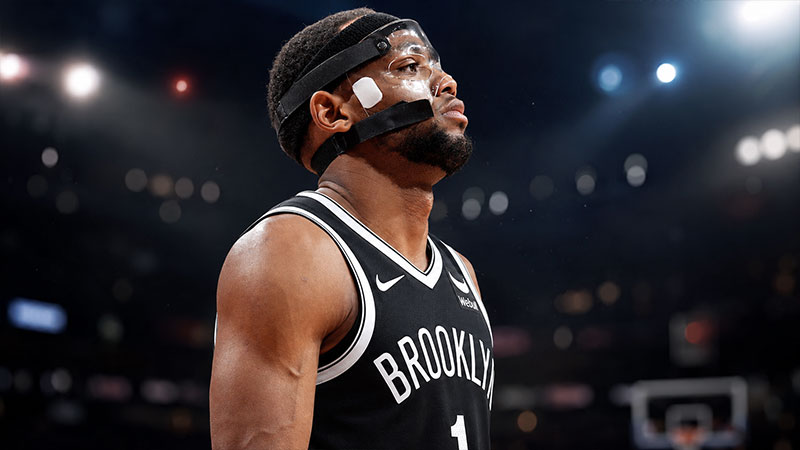
Bruce Brown wears a protective face mask due to a fractured nose suffered during a high-intensity practice session. The injury occurred on May 10, 2021, when he collided with teammate James Harden during a Brooklyn Nets scrimmage.
By donning a clear protective shield, Brown was able to return to the court just one day later, ensuring he didn’t miss critical games during the 2020–21 season.
These masks are essential medical tools that protect healing bones from further contact, allowing elite athletes to maintain peak performance despite significant facial trauma during professional gameplay.
The Anatomy of the Injury: A Teammate Collision
Professional basketball is a sport characterized by high-speed transitions and extreme physical proximity, where even a routine practice session can lead to significant physical setbacks for elite athletes.
The James Harden Scrimmage Incident
The specific reason for Bruce Brown’s mask dates back to May 10, 2021, during his successful tenure with the Brooklyn Nets.
In what the organization termed a “stay-ready” practice scrimmage—designed to keep the depth of the roster sharp and prepared for the postseason—Brown suffered a sudden collision with teammate James Harden.
This impact resulted in a fractured nose, an injury that typically requires a period of immobilization for the general population.
However, in the high-stakes environment of professional basketball, the medical objective shifts from total rest to managed protection, enabling a player to remain active within the rotation while the bone structure resets.
Immediate Return to Performance
Demonstrating remarkable resilience, Brown made his debut in the clear shield on May 11, 2021, a mere twenty-four hours after the fracture occurred.
Facing the Chicago Bulls, he proved that the medical hardware would not hinder his offensive output by scoring 15 points in the first half alone.
This quick turnaround is a testament to both the player’s personal toughness and the efficacy of modern protective equipment.
By utilizing the mask, Brown bypassed the traditional recovery timeline, providing his team with much-needed depth during a pivotal stretch of the regular season and ensuring he remained a viable asset for the coaching staff.
Why NBA Players Wear Masks During Games
The sight of a masked player has become a recurring motif in professional basketball history, often signaling a competitor who is prioritizing team success over physical comfort.
Protecting Nasal and Orbital Fractures
The primary utility of the facial shield is the protection of healing nasal, cheek, or orbital fractures.
These specific areas of the skull are particularly vulnerable in a sport where elbows, shoulders, and hands are constantly moving at eye level during rebounding and defensive contests.
Without the shield, a secondary impact to a healing fracture could lead to displaced bone fragments, requiring invasive surgical intervention and potentially ending a player’s season.
The mask acts as a critical shock absorber, distributing the force of any incidental contact across the broader, stronger surface areas of the forehead and cheekbones rather than the fragile nasal bridge.
Prevention of Reinjury from Contact
Beyond the initial healing phase, the mask serves as a preventative barrier against the “stray elbows” and hard fouls that are common in the paint. For a player like Brown, whose game often involves driving to the basket and battling for loose balls, the risk of reinjury is high.
The protective gear provides a psychological layer of security, allowing the athlete to maintain an aggressive style of play without the constant fear of a recurring injury.
This medical necessity ensures that the player does not subconsciously shy away from contact, which would otherwise diminish their effectiveness on both ends of the floor.
Material Engineering: Plastic vs. Carbon Fiber
While the function of the mask remains consistent, the materials used in their construction have evolved to meet the specific demands of high-intensity athletic performance.
| Feature | Clear Plastic Mask | Carbon Fiber Mask |
|---|---|---|
| Visibility | High; preferred for peripheral vision | Lower; often opaque or black |
| Weight | Standard; lightweight plastic | Extremely light; high strength-to-weight ratio |
| Common Use | Standard medical recovery (Bruce Brown) | Custom high-end variations (Jaylen Brown) |
| Durability | High impact resistance | Maximum structural integrity |
| Aesthetics | Professional and transparent | Often seen as “intimidating” or stylish |
Timeline and Duration of Facial Protection
For fans watching the game, the mask can sometimes feel like a permanent addition to a player’s uniform, but it is actually a temporary medical necessity with a defined timeline.
The Six-Week Recovery Window
Based on the documented timeline of Bruce Brown’s 2021 campaign, the standard duration for wearing such a device is approximately six weeks.
Brown wore his shield from the initial injury on May 10 until the conclusion of the Eastern Conference Semifinals on June 19, 2021.
This six-week window aligns with standard biological healing times for bone fractures in the human face, ensuring that the nasal bridge has regained sufficient structural integrity to withstand normal gameplay without a mechanical barrier.
Following this period, the risk of a simple impact causing a re-fracture drops significantly, allowing the player to return to their standard appearance.
Postseason Resilience and the Bucks Series
The timing of Brown’s injury was particularly sensitive, as it coincided with the lead-up to and execution of the 2021 NBA Playoffs. He wore the mask throughout the entirety of the high-intensity series against the Milwaukee Bucks.
In these high-pressure games, where every possession counts and the physical intensity of the game increases, the mask allowed Brown to play his signature style of defense without hesitation.
This resilience ensured his team maintained their defensive identity during one of the most physically demanding series in recent history, proving that the gear is as much a playoff tool as it is a medical one.
Comparing the Masked Icons: Brown vs. Brown
In recent years, the “masked player” trope has been dominated by two players with the same last name, leading to frequent confusion among casual viewers.
Jaylen Brown’s Black Mask Identity
While Bruce Brown utilized a standard clear plastic mask, Boston Celtics star Jaylen Brown famously opted for a black protective mask. Jaylen’s injury occurred under similar circumstances—a collision with a teammate, specifically Jayson Tatum—which resulted in a facial fracture. T
he choice of a black mask was largely aesthetic and personal, but it created a lasting image of “Masked Jaylen” that became a point of discussion across sports media.
This version of the mask is often custom-made and can be constructed from carbon fiber, offering a different visual profile than the transparent version worn by Bruce Brown.
The Evolution of the Clear Shield
Bruce Brown’s preference for the clear shield is the more traditional approach in the league. The transparent material is designed to be as unobtrusive as possible, minimizing the visual distraction for both the wearer and the opponents.
For a role player whose value lies in defensive positioning and timely cutting, maintaining a full field of vision is paramount.
By choosing the clear plastic iteration, Brown prioritized maximum visibility and a professional, functional look that allowed him to blend into the team’s system while still receiving the necessary medical protection for his healing fracture.
Statistical Impact: Performance While Shielded
One of the most impressive aspects of Bruce Brown’s masked stretch was the lack of statistical drop-off in his production. Many players find the mask to be a hindrance to their shooting or breathing, but the data suggests Brown adapted almost instantly.
Scoring and Efficiency Metrics
The following table highlights the immediate impact Brown had upon returning to the court after his injury.
| Game Date | Opponent | Points Scored | Highlight |
|---|---|---|---|
| May 11, 2021 | Chicago Bulls | 15 (First Half) | First game wearing the mask |
| May 12 – June 19 | Various (Reg Season/Playoffs) | Consistent Rotation Minutes | Played through ECSF |
| Injury Duration | ~6 Weeks | N/A | Total time masked |
Frequently Asked Questions About NBA Masks
Can any player choose to wear a mask?
Typically, the league requires a documented medical reason, such as a fracture, to wear protective headgear during official games.
Do masks affect a player’s shooting?
Many players report a brief adjustment period due to the weight on their nose and changes in peripheral vision, though Brown’s 15-point first-half performance suggests elite players can adapt quickly.
Why are some masks black and others clear?
While clear plastic is the standard for visibility, the league has occasionally allowed colored or carbon fiber masks if they meet safety and visibility requirements.
What happens if the mask is hit during a game?
The mask is designed to absorb and redistribute the force. If the mask itself is damaged, the player must typically swap it for a backup or leave the game for medical evaluation.
How are these masks fitted?
Modern masks are often custom-molded to a 3D scan of the player’s face to ensure a perfect, comfortable fit that doesn’t shift during sweat or contact.
The Medical Standards of Professional Basketball
The use of facial protection is a reflection of the advanced medical standards currently employed by professional sports organizations.
By utilizing data-driven recovery timelines and high-grade materials, teams can protect their most valuable assets—the players—without compromising the quality of the product on the court.
For Bruce Brown, the mask was not just a piece of equipment; it was a “defensive shield” that enabled him to contribute to a championship-contending team during the most critical weeks of the year.
Final Verdict: The Shield of a Professional
The story of Bruce Brown’s mask is a perfect example of the intersection between sports medicine and athletic grit.
It highlights how a potentially season-ending injury, like a fractured nose, can be managed through the use of specialized equipment, allowing a player to remain a “stay-ready” contributor even in the face of physical adversity.
Whether it is the clear shield of Bruce Brown or the black mask of Jaylen Brown, these tools have become a symbol of a player’s commitment to their team and their ability to overcome the physical tolls of an 82-game season.
What do you think about the “masked” look in the league? Do you think it gives players a psychological edge, or is it just a necessary nuisance? Drop a comment below and let us know your favorite masked performance in basketball history!