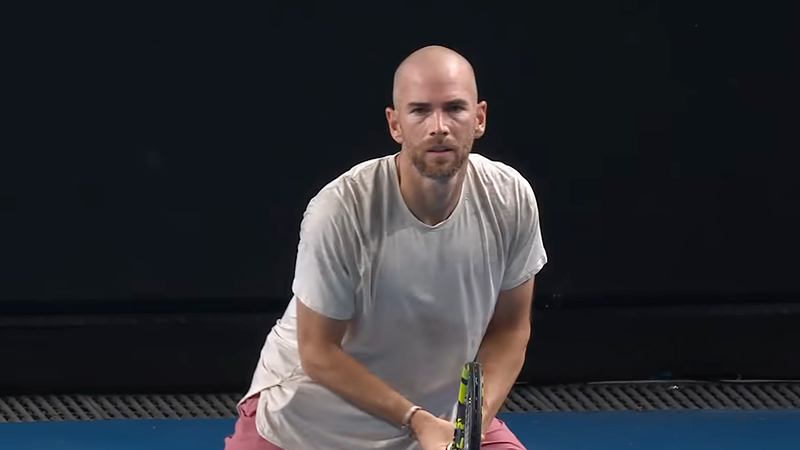
Adrian Mannarino is famous for defying every convention of modern professional tennis.
Unlike peers who rely on heavy topspin and high-tech endorsements, the French veteran is a cult icon celebrated for his unprecedentedly low racket tension (often just 19-24 pounds), a “bunting” playing style with almost no backswing, and a unique refusal to look at tournament draws until an hour before his matches.
Whether he is competing in unbranded t-shirts purchased from local stores or taking down Top 10 giants with his signature flat shots, Mannarino’s late-career renaissance proves that technical eccentricity can lead to elite success.
What Makes Adrian Mannarino’s Playing Style So Unique?
In an era dominated by hyper-athletic baseliners who hit the ball with massive amounts of topspin, Adrian Mannarino is a stylistic outlier.
His game is built on a foundation of tactical redirection and minimalist biomechanics that baffle opponents accustomed to a more traditional rhythm.
The Geometry of the “Bunting” Forehand
One of the most recognizable aspects of Mannarino’s game is his abbreviated, compact swing. Often described as a “bunting” style, he utilizes a tiny flick of the wrist with almost no backswing or take-back loop.
This short motion allows him to take the ball early and use the opponent’s pace against them, making his shots incredibly difficult to telegraph.
This minimalist approach was not merely a choice but a necessity; he adopted this unorthodox geometry after a severe wrist injury in 2011 forced him to completely reinvent his forehand mechanics.
Redefining Ball Flight with Flat Groundstrokes
While the average ATP professional looks to clear the net with significant margin and spin, Mannarino strikes the ball flatter than almost anyone else on tour. Statistically, he generates 35% less spin than the tour average.
This results in a ball that skims incredibly low over the net, forcing opponents to “hit up” on the ball and often throwing them completely out of their preferred hitting zones.
His ability to redirect pace with such flat precision has earned him a reputation as a master of court geometry.
How Low Is Adrian Mannarino’s Racket Tension?
The most legendary aspect of Mannarino’s technical profile is his equipment setup. While most tennis fans understand that strings are vital to performance, few realize how far Mannarino has pushed the boundaries of traditional stringing physics.
Understanding the Trampoline Effect
Most professional players string their rackets between 40 and 60 pounds to maintain control over their powerful swings. In stark contrast, Mannarino strings his rackets between 19 and 24 pounds (9 to 11 kg).
This is recorded as the lowest tension in professional tennis history. At this level, the string bed acts as a literal trampoline, absorbing the incoming pace of the ball and launching it back with effortless depth and minimal physical exertion from the player.
The Elite Touch Required for Control
While a “trampoline” effect provides power, it usually sacrifices immense amounts of control. For a standard player, such low tension would cause the ball to fly wildly out of bounds.
Mannarino’s success with this setup highlights his world-class wrist precision and elite level of touch. He possesses a rare ability to “feel” the ball on the strings, allowing him to guide it with surgical accuracy despite the inherent instability of such a loose string bed.
Why Does Adrian Mannarino Refuse to Look at Tournament Draws?
Beyond his physical game, Mannarino is famous for his idiosyncratic mental approach to competition. He employs a psychological strategy known as the “blind draw” method to manage the pressures of the professional tour.
Eliminating Pre-Match Overthinking
Mannarino famously refuses to look at tournament brackets. He actively avoids knowing who his next opponent is to prevent overthinking, scouting-induced stress, or pre-match anxiety.
By keeping himself in the dark regarding the “path” to a final, he focuses entirely on his own game and the immediate moment rather than the reputation or ranking of the person across the net.
The One-Hour Reveal Rule
To facilitate this strategy, his coaching staff and team play a vital role in his preparation. They are instructed to keep the opponent’s identity a secret until roughly one hour before the match begins.
This brief window gives him just enough time to receive basic tactical instructions without having the entire day to dwell on the specific challenges posed by a particular player.
This unique boundary between coach and athlete is one of the most talked-about quirks in the tennis world.
The “No-Sponsor” Look: Why Does He Wear Plain White T-Shirts?
In a sport where multi-million dollar clothing contracts are the norm for top players, Adrian Mannarino has often stood out for his lack of branding. This nonconformist aesthetic has contributed significantly to his cult-hero status among fans.
| Aspect of the No-Sponsor Aesthetic | Description |
|---|---|
| Purchasing Choice | Mannarino has routinely bought plain, unbranded white t-shirts from local athletic stores. |
| Motivation | Often playing without major clothing or footwear endorsements during his peak years. |
| Impact | Created a “blue-collar” or “everyman” persona that resonates with fans. |
| Consistency | He has worn these simple outfits even during high-stakes Grand Slam matches. |
A Statistical Look at Mannarino’s Elite Career
Despite his eccentricities, Mannarino’s career is defined by high-level consistency and significant financial success. He has played over 700 matches on the ATP Tour and has amassed nearly $15 million in career prize money.
| Career Milestone | Achievement Detail |
|---|---|
| Career-High Ranking | World No. 17 (Achieved January 29, 2024) |
| ATP Singles Titles | 5 (Newport, Astana, Sofia, Winston-Salem, Rosmalen) |
| ATP Singles Finals | 16 (5 titles, 11 runner-ups) |
| Top 10 Victories | Over 10 career wins against Top 10 ranked players |
| Best Grand Slam Result | Fourth Round (4x: Wimbledon, Australian Open) |
Why Is Mannarino Called the “Gatekeeper” of the ATP Tour?
The term “Gatekeeper” is often used by commentators to describe Mannarino’s role on the professional circuit. This label reflects the difficulty other players face when trying to move into the upper echelons of the sport.
The Ultimate Litmus Test for Elite Talent
Because his style is so unusual—low pace, flat balls, and redirected angles—Mannarino acts as a litmus test for his peers. A rising star or a top-tier veteran cannot simply overpower him with modern tennis mechanics.
To beat Mannarino, a player must be mentally disciplined and technically versatile enough to “solve” the geometric puzzle he presents on the court. If a player cannot navigate his craftiness, they are unlikely to belong in the elite ranks.
The Giant Killer Legacy
Despite never cracking the Top 10 himself, Mannarino has caused massive headaches for the legends of the sport over two decades.
His ability to claim more than 10 career victories against Top 10 opponents is a testament to how disruptive his “crafty vanguard” style can be.
He effectively acts as a hurdle that many elite players have tripped over throughout their careers.
How Did Adrian Mannarino Reach His Peak at Age 35?
While many athletes begin to decline in their thirties, Adrian Mannarino experienced a massive career renaissance. His late-stage success is a fascinating case study in professional longevity and tactical evolution.
The Record-Breaking 2023 Season
At age 35, Mannarino enjoyed what many call his “Golden Season.” In 2023, he collected a personal-best 43 singles wins and captured three of his five career titles in a single calendar year—winning in Newport, Astana, and Sofia.
This surge in performance propelled him to his career-high ranking of World No. 17 in early 2024. It is rare for a player to reach their absolute prime nearly twenty years after turning professional in 2004.
Longevity Through Low-Impact Mechanics
A major factor in his longevity is the physical efficiency of his game. His effortless, relaxed technique—characterized by the “trampoline” racket tension and short swings—minimizes the wear and tear on his joints and muscles.
Unlike players who rely on explosive, high-impact movements that lead to burnout or chronic injury, Mannarino’s style allows him to remain competitive at an age where many of his contemporaries have already retired.
Frequently Asked Questions about Adrian Mannarino
What is the lowest tension Adrian Mannarino has used?
Mannarino is famous for using strings as loose as 19 to 24 pounds (9 to 11 kg), which is significantly lower than the 40-60 pound range used by most of his colleagues.
How many ATP titles does Adrian Mannarino have?
He has won 5 ATP singles titles throughout his career, with three of those coming during his standout 2023 season at the age of 35.
Why doesn’t Adrian Mannarino have a clothing sponsor?
While he has had various arrangements over the years, he is famous for choosing to buy his own plain white t-shirts from local stores, preferring a nonconformist and unbranded look over traditional sponsorships.
Does Adrian Mannarino play left-handed?
Yes, Mannarino is a left-handed player who utilizes a two-handed backhand.
When did Adrian Mannarino turn professional?
He officially turned professional in 2004, leading to a career that has spanned over two decades on the ATP Tour.
Conclusion
Adrian Mannarino remains one of the most intriguing figures in professional sports. His career proves that there is no single “correct” way to play tennis, as he consistently defies the standard norms of modern professional play.
By embracing his own eccentric geometry and unique technical preferences, he has carved out a lasting legacy as a giant killer and a true original on the tour.
Whether you are a fan of his high-precision “trampoline” racket or his idiosyncratic “blind draw” mental tactics, his impact on the game is undeniable.
For more insights into the tactical world of professional tennis, subscribe to our newsletter for weekly deep dives into the sport’s most fascinating characters.