The trajectory of a professional athlete’s career is often reduced to a few binary metrics. In the high-stakes environment of the NFL, defensive ends are almost exclusively judged by a single column in the stat sheet: sacks.
For Brandon Graham, the legendary Philadelphia Eagles defensive lineman, this narrow focus created a persistent narrative early in his career that he was underperforming.
Critics pointed to his draft position and a perceived lack of “finishing” ability, often asking the same question year after year: Why doesn’t Brandon Graham get more sacks?
However, when we move beyond surface-level box scores and evaluate defensive impact through the lens of modern analytics and organizational strategy, a completely different picture emerges. Brandon Graham did not just “get sacks”; he redefined what it meant to be a disruptive force on the edge.
With over 75 regular-season sacks and a total exceeding 84 when including the postseason, Graham’s career is a masterclass in overcoming early adversity and thriving within a specific tactical framework.
This analysis deconstructs the “sack myth” surrounding Graham, exploring how injuries, scheme transitions, and a selfless rotational philosophy created a statistical gap between his perceived value and his actual dominance on the field.
The Genesis of the “Bust” Narrative: A Rocky Start
To understand why fans and analysts questioned Graham’s sack production, one must look back at the beginning of his tenure in Philadelphia.
Drafted 13th overall in 2010—notably ahead of future Hall of Fame safety Earl Thomas—Graham carried the heavy burden of high expectations.
In those formative years, two primary factors suppressed his statistical output:
- The Adaptation Period: Transitioning from the collegiate level at Michigan to the NFL is rarely instantaneous for edge rushers. Graham required a period of physical and mental calibration to handle the sophisticated blocking schemes of professional offensive tackles.
- The 2011 Knee Injury: Perhaps the most significant hurdle was a major knee injury sustained during the 2011 season. For an explosive player whose game relied on a powerful first step and “lower-half” strength, a torn ACL was a devastating setback.
During this recovery and rebuilding phase, critics were quick to apply the “bust” label. Because he wasn’t racking up double-digit sack seasons while regaining his form, the narrative took root that he lacked the elite finishing touch required of a first-round edge rusher.
In reality, he was fighting through a physical rehabilitation process that would have ended the careers of lesser athletes.
Tactical Friction: The Chip Kelly Scheme Transition
One of the most overlooked aspects of Graham’s statistical history is the period of tactical misalignment during the Chip Kelly era.
Graham was drafted as a natural 4-3 defensive end—a role that allowed him to put his hand in the dirt, leverage his low center of gravity, and drive directly toward the quarterback.
However, the team transitioned to a 3-4 defensive scheme under Kelly’s coaching staff, which required Graham to adapt to the role of an outside linebacker. This shift was fundamental:
- Coverage Responsibilities: Instead of focusing purely on the pass rush, Graham was frequently asked to drop into coverage, moving him further away from the quarterback.
- Space Management: Playing “in space” as a linebacker didn’t naturally suit his skill set as a power-based edge rusher.
Despite being a “square peg in a round hole” during these years, Graham remained productive, but his sack totals naturally suffered because he was no longer utilized in a way that maximized his primary strength: collapsing the pocket.
It wasn’t until the Eagles returned to a traditional 4-3 front that the rest of the world saw the true statistical potential of his game.
The Analytics of Disruption: Sacks vs. Pressures
If you ask an NFL quarterback what bothers them more—a defender who gets one sack and then disappears for the rest of the game, or a defender who is in their face on every third down—they will choose the latter. This is the essence of Brandon Graham’s value.
For much of his career, Graham was an “analytics darling.” While his raw sack numbers might have looked modest to a casual observer, his pressures, hurries, and quarterback hits were consistently among the highest in the league.
- The “Almost” Sack: A pressure that forces a quarterback to throw the ball away or check down to a running back is statistically as valuable as a sack in terms of “Expected Points Added” (EPA), yet it doesn’t show up in the traditional sack column.
- Forcing Errors: Graham’s relentless motor meant that even when he didn’t “convert” the sack, he was the primary reason for a teammate’s interception or a rushed throw.
The discrepancy between his sacks and his pressures was not a sign of failure; it was a sign of a player who was consistently winning his individual matchups and disrupting the timing of the opposing offense.
Organizational Strategy: The Power of the Rotation
The Philadelphia Eagles’ defensive philosophy over the last decade has been built on a “fastball” mentality—keeping defensive linemen fresh by utilizing a heavy rotation.
Unlike some elite edge rushers on other teams who might play 90% of defensive snaps to pad their individual stats, Graham and his teammates operated within a system of unselfishness.
- Freshness Over Volume: By playing fewer total snaps, Graham was able to maintain a higher intensity per snap. This benefited the team’s overall defensive efficiency but naturally capped his individual ceiling for counting stats like sacks.
- Long-Term Durability: This rotational approach contributed to Graham’s incredible longevity. By managing his workload, the Eagles ensured that Graham remained an effective player well into his 30s, eventually leading to his career-high sack totals later in his journey.
Graham’s willingness to embrace this role—prioritizing the health of the defensive unit over his own Pro Bowl resume—is a hallmark of the leadership that eventually led the Eagles to a championship.
Defining the Legacy: From “Bust” to Franchise Icon
The final rebuttal to the idea that Graham “doesn’t get sacks” is his actual career total. Accumulating 75 regular-season sacks is a feat few players in the history of the franchise have achieved.
When you factor in his postseason production, which brings that total to over 84, his status as an elite finisher is indisputable.
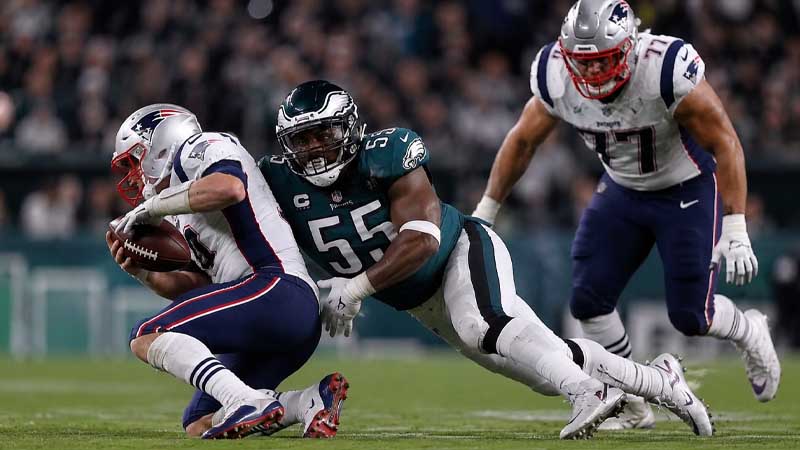
Perhaps the most famous play in Philadelphia Eagles history—the strip-sack of Tom Brady in Super Bowl LII—was a Brandon Graham sack. In the biggest moment, on the biggest stage, against the greatest quarterback of all time, Graham “finished” the play.
His career serves as a reminder that:
- Context Matters: Injuries and scheme changes can hide a player’s true talent for years.
- Efficiency is Key: Impact is measured in disruption, not just completions.
- Longevity is a Stat: Staying productive for over a decade is a testament to professional excellence.
Conclusion: A Masterclass in Persistence
Brandon Graham’s career is a powerful case study for any organization on the value of patience and the importance of looking beyond primary metrics.
By ignoring the noise of the “bust” narrative and focusing on the underlying data—the pressures, the work rate, and the tactical fit—the Eagles were rewarded with one of the most productive and beloved players in their history.
He didn’t just get sacks; he won games. He didn’t just play defensive end; he embodied the resilience of a city. As we look back at his 84+ total sacks, it is clear that the only thing missing from Brandon Graham’s game was the recognition he deserved much sooner.