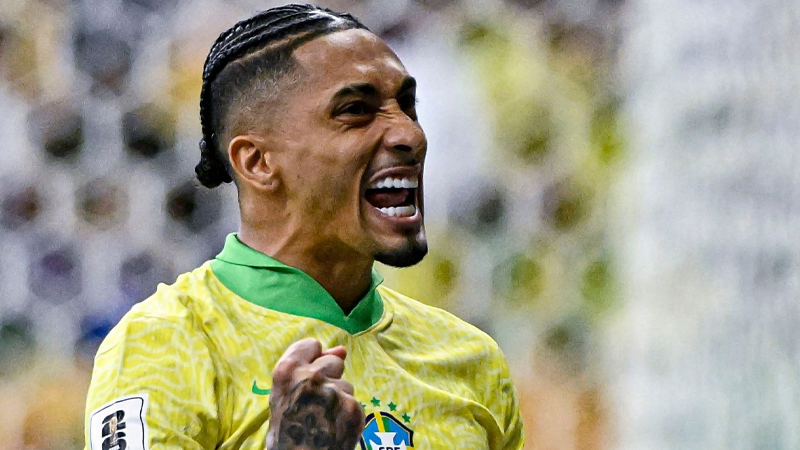
Fans and analysts watching FC Barcelona recently have noticed a recurring visual signature: a stark white bandage wrapped around the right hand of star winger Raphinha.
While it initially appeared to be a standard medical precaution, its persistent presence across multiple matches—and its adoption by several high-profile teammates—has sparked intense curiosity. Is it a lingering injury, a tactical advantage, or a deeper psychological tool?
This phenomenon has evolved from a simple medical necessity into a potent symbol of team unity and a defiant response to external criticism, marking a fascinating intersection of sports medicine and locker-room culture.
The Medical Catalyst: An International Incident
The story of the bandage began not in Barcelona, but during the high-stakes environment of international duty. In early 2025, while representing the Brazilian national team, Raphinha sustained a minor but significant blow to his right hand.
While the injury did not sideline him from competition, it required immediate intervention to ensure he could remain effective on the pitch without risking further aggravation.
Clinical Stabilization and Protection
To manage the injury, Barcelona’s medical staff implemented a protocol involving a tight compression bandage. The primary goal was to stabilize the wrist and the small bones of the hand, which are frequently subject to impact during the physical duels typical of elite football.
This wrap provided the necessary structural support, allowing Raphinha to maintain his aggressive style of play while the initial injury healed.
The Evolution of the Wrap
In most professional scenarios, a player discards medical tape once the physical trauma has subsided. However, Raphinha continued to wear the wrap long after the clinical necessity had passed.
This transition from “rehabilitation tool” to “permanent accessory” caught the attention of the media, suggesting that the bandage had taken on a new role within his match-day routine.
The Psychological Pivot: Decoding the Locker Room “Cabal”
In elite sports, the margin between victory and defeat often resides in the “mental game.” What began as a medical fix for Raphinha quickly permeated the FC Barcelona locker room, leading to what some inner circles have jokingly referred to as a “cabal” of wrapped hands.
The Spread of Team Superstition
Footballers are notoriously superstitious, often relying on specific rituals or “lucky” equipment to maintain their form.
Following Raphinha’s exceptional performances while wearing the hand wrap, several key teammates—including Lamine Yamal, Robert Lewandowski, and Frenkie de Jong—began sporting similar bandages despite having no underlying hand injuries.
This collective adoption transformed the bandage into a psychological uniform, creating a visual bond among the squad’s most influential players.
A “Mental Issue” Driven by Performance
Internal reports from Barcelona’s physiotherapy and medical departments have categorized this trend as a “mental issue”. In this context, the term does not imply a clinical disorder, but rather a psychological comfort.
The players believe that the bandage provides a boost in confidence and a sense of “extra armor” on the pitch. When a team is in world-class form, as Barcelona has been, any small ritual perceived to contribute to that success is protected and repeated with religious fervor.
The Art of Defiance: Mocking the Doping Conspiracy
The bandage moved from a local superstition to a global talking point during the high-pressure environment of El Clásico. The narrative took a darker turn when external critics attempted to find a more sinister explanation for the team’s physical dominance.
The Mihic Allegations
Former Real Madrid team doctor Nikola Mihic sparked a media firestorm by publicly suggesting that the hand wraps were not for injury or luck.
Instead, he proposed a conspiracy theory: that the Barcelona players were using the wrist tape to conceal needle marks from intravenous doping injections.
Given the fierce rivalry between the two clubs, these accusations were viewed as a direct attack on the integrity of the squad.
The El Clásico Celebration
Raphinha’s response was both calculated and theatrical. After scoring against Real Madrid, he didn’t just celebrate the goal; he celebrated the bandage.
He was observed aggressively pointing at his wrapped wrist multiple times—a gesture designed to mock the conspiracy theories. The message was clear: the team’s historic form was a result of natural talent and hard work, not the “hidden needles” suggested by their rivals.
This act of defiance effectively turned the bandage into a badge of honor for the entire club.
Technical Comparison: Medical Necessity vs. Superstition
To understand why elite athletes adhere to these practices, it is helpful to distinguish between the physical benefits and the psychological “edge” provided by the wrap.
| Feature | Medical Stabilization (Phase 1) | Tactical Superstition (Phase 2) |
|---|---|---|
| Primary Goal | Physical protection and wrist support. | Psychological comfort and confidence. |
| Duration | Temporary (until healing is complete). | Permanent (as long as form continues). |
| Participants | Injured players only. | Core squad members (Yamal, Lewandowski, etc.). |
| External Perception | Standard recovery procedure. | Symbol of defiance and unity. |
| Trigger | Physical blow/injury. | Performance-driven ritual. |
The Impact of Rituals on Elite Performance Metrics
The persistence of the hand wrap highlights a critical aspect of high-performance psychology: the placebo effect of gear. In the Fortune 500 equivalent of a boardroom, this would be comparable to a “power tie” or a specific ritual before a major negotiation.
For Raphinha and his teammates, the bandage acts as a physical anchor that triggers a high-performance state of mind.
Creating a Competitive Moat
By adopting a shared ritual, the Barcelona players have built an internal culture that is resistant to outside pressure.
When external figures like Nikola Mihic attempt to disrupt the team’s focus with doping allegations, the squad uses the very subject of the criticism—the bandage—to strengthen their resolve.
This ability to transform a negative narrative into a unifying force is a hallmark of world-class leadership and team chemistry.
The Viral Identity
In the age of social media, these small visual cues become part of a player’s personal brand. Raphinha’s bandage is now as recognizable as a signature celebration or a specific hairstyle.
For fans, it represents the “warrior” mentality of a player who has overcome injury and silenced his doubters on the biggest stage in world football.
Frequently Asked Questions (FAQ)
Did Raphinha actually break his hand?
No, the initial injury was described as a minor blow and injury sustained while playing for the Brazilian national team. It was not a major fracture, but it required stabilization to prevent the injury from worsening during high-intensity matches.
Why are Lamine Yamal and Robert Lewandowski wearing bandages?
Unlike Raphinha, these players did not necessarily have hand injuries. They adopted the wrap as part of a team superstition or “cabal”.
Because the team performed exceptionally well while Raphinha was wrapped, the other players began to view the bandage as a good luck charm that provided psychological comfort.
What was the meaning behind Raphinha’s celebration against Real Madrid?
Raphinha was directly responding to allegations made by former Real Madrid doctor Nikola Mihic, who suggested the bandages were hiding doping marks.
By pointing to his wrist after scoring, Raphinha was mocking the conspiracy and asserting that his performance was purely the result of natural ability.
Is it legal for players to wear hand wraps without an injury?
Yes, as long as the bandage does not pose a danger to other players (e.g., no hard casts or sharp objects), football regulations generally allow for soft compression tape and wraps. Many players use them for wrist support or simply as a matter of personal preference.
Will Raphinha ever stop wearing the bandage?
While the physical injury has likely healed, the bandage has become a “mental issue” for the players, providing a sense of confidence.
It is common for athletes to maintain such rituals as long as they continue to win, so we may see the wrap for as long as Raphinha remains in peak form.
Conclusion: A New Symbol of Modern Football
The story of Raphinha’s hand wrap is a masterclass in how a simple object can acquire layers of complex meaning.
What began as a standard medical intervention for a minor Brazilian international injury has been transformed into a psychological tool for elite performance and a shield against character attacks.
For the modern fan, the bandage is no longer just tape; it is the “Bandage of Defiance.” it represents a locker room that is tightly knit, highly superstitious, and fiercely protective of its reputation.
As Raphinha continues to lead Barcelona’s attack, that white wrap serves as a constant reminder that in the world of elite sports, the mind is just as important as the body.
Whether it is providing “extra armor” or silencing a rival’s conspiracy, Raphinha’s hand wrap has earned its place in the lore of the club.