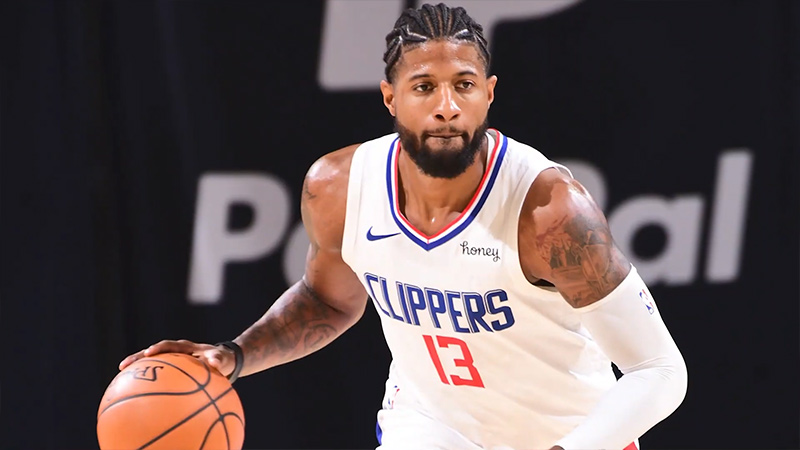
Paul George wears the number 13 primarily as a calculated branding move to adopt the highly marketable “PG-13” moniker.
Originally wearing No. 24 to honor Kobe Bryant, George transitioned to No. 13 ahead of the 2014-15 season following a suggestion by media personality Bill Simmons.
This shift allowed him to create a unique identity separate from his idols, framing his game as a primetime “show” for fans.
While he briefly wore No. 8 in Philadelphia due to retired numbers, George has consistently prioritized No. 13 across four franchises to solidify his status as an elite NBA superstar.
The Influence of Media and the Birth of a Brand
Exploring the origin of this jersey switch reveals a fascinating intersection between sports media influence and athlete self-perception, illustrating how a single suggestion can evolve into a global marketing powerhouse for a professional athlete.
The Bill Simmons Suggestion
The formal idea for the number change originated in the media sphere rather than the front office. In May 2013, sports media personality Bill Simmons published an article suggesting that George should abandon his original No. 24 in favor of No. 13.
Simmons argued that the transition would naturally create the “PG-13” nickname, a play on the Motion Picture Association of America (MPAA) rating system.
This clever wordplay was seen as an immediate way to make George a household name, transforming him from a promising young wing into a branded entertainment product.
At the time, George was already emerging as a star, and the nickname provided a hook that the general public could easily grasp and remember.
Mainstream Adoption via Jimmy Kimmel
While the idea started in print, it gained significant momentum through late-night television. In January 2014, George appeared on Jimmy Kimmel Live!, where the host explicitly asked him about the potential nickname.
George admitted during the interview that the name “had a ring to it”. This interaction served as a public litmus test for the brand’s viability.
The positive reception from fans and the media confirmed that the “PG-13” identity was more than just a passing thought; it was a legitimate business opportunity that could define his legacy for years to come.
Why Did Paul George Change from 24 to 13?
The logic behind the change was multi-faceted, involving a strategic push to enhance his marketability while simultaneously navigating the internal dynamics of the Indiana Pacers roster during his early career ascent.
Stepping Out of Kobe Bryant’s Shadow
For the first four years of his career (2010–2014), George wore No. 24 as a direct tribute to his childhood idol, Kobe Bryant. While this was a meaningful personal choice, it also tethered his identity to another player’s legacy.
Changing to No. 13 represented a personal milestone and a desire to step into his own spotlight. George explained that the switch was about “coming into my own” as a player.
By moving away from Bryant’s signature number, George signaled to the league and the fans that he was no longer just a disciple of the legends who came before him, but a superstar capable of leading his own “show.”
The Miles Plumlee Delay
The transition to No. 13 was not an overnight success and faced practical hurdles within the Indiana Pacers organization. George had actually considered and applied for the number change earlier than 2014, but he was blocked by roster constraints.
His teammate at the time, Miles Plumlee, was already wearing the No. 13 jersey. In the NBA, two players on the same roster cannot share a number, and George had to wait for the jersey to become available.
Once the logistical path was clear, he officially filed his request with the league office before the March 2014 deadline to ensure the change would take effect for the following season.
A Fresh Start Following the 2014 Injury
The timing of the number change became emotionally significant due to a career-altering event. In August 2014, shortly before the new season began, George suffered a severe leg injury during a Team USA scrimmage.
Because the number change had already been approved months prior, the move to No. 13 coincided with his grueling recovery process. It effectively marked a “fresh start” for his career.
When he finally returned to the court, he was no longer the young No. 24; he was the resilient “PG-13,” a narrative shift that helped fans rally around his comeback.
Branding Logic and the Meaning of “Enjoy the Show”
Beyond the catchiness of the nickname, the selection of the number 13 was deeply rooted in a philosophy of entertainment and high-level performance that George wanted to project to fans.
The Motion Picture Analogy
The primary appeal of “PG-13” was its cultural ubiquity. George noted that everyone is familiar with the PG-13 rating in television and film, which denotes content that is generally accessible but carries a level of intensity.
He wanted his game to mirror this concept—being fun to watch and providing a high-quality “show” for the audience.
This branding successfully aligned his on-court performance with the entertainment industry, making his highlights feel like “must-see” cinema. It transformed his individual statistics into a broader narrative of entertainment and primetime excellence.
Evolution into an Elite Superstar
The number change served as a visual marker for George’s evolution from a defensive specialist into a premier two-way wing.
During his years wearing No. 13, he achieved his highest levels of production, including finishing as an MVP finalist and leading the league in steals during his tenure with the Oklahoma City Thunder.
The “PG-13” era saw him become a nine-time All-Star and a multi-time All-NBA selection. The number became synonymous with his prime, representing a decade of dominance where he was consistently ranked among the top players in the world.
Managing the Logistics and Financial Impact of the Switch
Navigating a jersey change within a single franchise involves strict league protocols and significant financial considerations that demonstrate an athlete’s commitment to their brand and their fan base.
- League Buyout Requirements: NBA rules typically mandate that if a player changes their jersey number while remaining on the same team, they must purchase all remaining “old” jersey inventory currently on the market. This ensures that retailers and the league do not lose money on obsolete merchandise.
- The NBA Waiver: Because George submitted his application before the league’s March deadline, the NBA technically waived the requirement for him to buy out the No. 24 jerseys.
- A Token of Appreciation: Despite the waiver, George chose to personally buy out the remaining stock of No. 24 jerseys anyway. He did this as a gesture of gratitude toward the Indiana Pacers franchise and the fans who had supported him during his early years.
- Market Alignment: By clearing the old stock, George ensured that the “PG-13” brand would have a clean rollout, with new merchandise reflecting his evolved identity immediately available for the public to purchase.
A Comparison of Paul George’s Jersey Numbers and Statistics
To understand the impact of the “PG-13” era, it is essential to look at the hard data comparing his performance across the different numbers he has worn throughout his 16-year career.
| Jersey Number | Franchises | Games Played | Points Per Game | Rebounds Per Game | Assists Per Game |
|---|---|---|---|---|---|
| No. 24 | Indiana Pacers | 286 | 15.3 | 6.1 | 2.9 |
| No. 13 | Pacers, Thunder, Clippers, Celtics | 581 | 23.6 | 6.4 | 4.1 |
| No. 8 | Philadelphia 76ers | 78 | 16.8 | 5.3 | 4.0 |
As the data illustrates, George’s most productive seasons have overwhelmingly occurred while wearing No. 13.
His scoring average jumped by more than 8 points per game following the switch, and his playmaking expanded significantly as he transitioned into a primary offensive focal point.
Why Couldn’t Paul George Wear 13 in Philadelphia?
When the star joined the 76ers in 2024, many fans expected him to continue the “PG-13” tradition, yet local history and retired legends dictated a temporary shift in his career-long visual branding.
The Wilt Chamberlain Legacy
The most prominent reason George could not wear his signature number in Philadelphia was the weight of the franchise’s history. The number 13 is retired by the 76ers to honor the legendary Wilt Chamberlain.
Chamberlain is one of the most iconic figures in basketball history, and his jersey hanging in the rafters meant that the “PG-13” moniker had to be put on hiatus during George’s tenure in the city.
Out of respect for Chamberlain’s unparalleled contributions to the game, the number was completely unavailable for use.
The Bobby Jones Connection
Interestingly, George’s original number was also off-limits in Philadelphia. The number 24 is retired by the 76ers in honor of Bobby Jones, a defensive stalwart and Hall of Famer.
This created a unique dilemma where George was forced to look outside of his usual options for the first time since entering the league.
With both his tribute number and his brand number retired, he had to find a third option that still carried personal significance.
Choosing Number 8 as a Full-Circle Tribute
Faced with these restrictions, George selected No. 8 for his two-season stint with the 76ers. This choice was a “full circle” tribute to Kobe Bryant. Since he could not wear 24, he opted for the number Bryant wore during the first half of his career.
This decision allowed George to maintain a connection to his idol while navigating the specific jersey retirements of the Philadelphia franchise. It was a temporary detour that honored the past while he waited for his next career chapter.
Legacy and Global Impact Across Four NBA Franchises
The “PG-13” brand has demonstrated incredible longevity, maintaining its relevance and marketability as George moved through different stages of his career and across various American markets.
- Indiana Pacers (2014–2017): This was the launchpad for the brand. George led the Pacers to multiple playoff runs and solidified his status as a two-way force while wearing No. 13 for three active seasons.
- Oklahoma City Thunder (2017–2019): George reached his individual peak in Oklahoma City. Wearing No. 13, he averaged 25.0 points per game over two seasons and finished as a finalist for both the MVP and Defensive Player of the Year awards in 2019.
- Los Angeles Clippers (2019–2024): During his five seasons in Los Angeles, he wore No. 13 while forming a powerhouse duo with Kawhi Leonard. He maintained a high level of play, averaging 23.0 points and providing veteran leadership for a championship contender.
- Boston Celtics (2026–Present): Following a trade in July 2026, George immediately reclaimed his signature No. 13 jersey. This move signaled a return to his primary branding as he began his tenure with one of the league’s most storied franchises.
- Team USA (2016): The brand even extended to the international stage. During the 2016 Rio Olympics, George wore No. 13 as he helped lead the United States to a gold medal. This ensured visual alignment for his global audience during one of the most-watched sporting events in the world.
Frequently Asked Questions on George’s Signature Number
What does the “PG-13” nickname actually mean?
The nickname is a combination of Paul George’s initials (PG) and his jersey number (13). It is a play on the MPAA movie rating “PG-13”.
George uses the name to emphasize that his performance on the court is an entertaining “show” that is fun for fans of all ages to watch, while still maintaining the intensity of a top-tier professional athlete.
Why did he switch back to 13 in Boston?
After being unable to wear the number in Philadelphia due to Wilt Chamberlain’s retirement of the jersey, George’s trade to the Boston Celtics in 2026 provided an opportunity to reclaim his identity.
As No. 13 was available in Boston, he immediately resumed wearing it to maintain his signature branding and the statistical continuity associated with that number.
How many jersey numbers has Paul George worn?
Throughout his career, Paul George has worn three different jersey numbers: 24, 13, and 8. He wore 24 to honor Kobe Bryant’s later career, 13 to establish his own “PG-13” brand, and 8 as a temporary tribute to Bryant’s early career when his preferred numbers were retired by the Philadelphia 76ers.
Conclusion: The Power of Strategic Athlete Branding
Paul George’s decision to wear No. 13 is a masterclass in how professional athletes can use visual identity to shape their public narrative.
What began as a clever suggestion from a media personality blossomed into one of the most recognizable monikers in modern sports history.
By moving away from No. 24, George didn’t just change a piece of cloth; he declared his independence as a superstar and created a lasting legacy that has followed him through multiple franchises and even onto the Olympic podium.
As he continues his career with the Boston Celtics, the “PG-13” brand remains a symbol of his journey—from a rookie honoring his idol to a veteran superstar who owns his own show.
The number 13 is more than just a digit on his back; it is the cornerstone of a multi-million dollar identity that has defined a generation of elite basketball.
Whether he is leading a fast break or hitting a game-winning shot, Paul George has proven that when you “enjoy the show,” the branding takes care of itself.