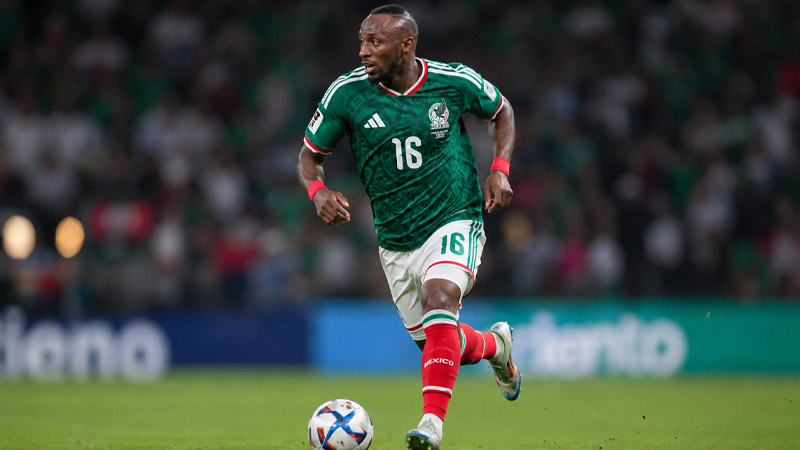
Julian Quiñones’ opening goal at the 2026 World Cup was more than just a moment of sporting brilliance; it was a profound statement of national identity that resonated across the globe.
Born in Colombia but wearing the iconic green of “El Tri,” Quiñones has become a focal point of discussion regarding international eligibility and personal allegiance.
His decision to represent Mexico is the culmination of a decade spent in the country, where he evolved from a teenage prospect into a continental superstar.
Understanding his choice requires a look at his professional journey, family roots, and the legal frameworks of FIFA.
The Legal and Personal Path to Mexican Naturalization
The transition from a Colombian-born athlete to a Mexican international hero was not an overnight development but a structured legal and emotional process.
Quiñones’ journey is a testament to how professional sports can reshape a person’s sense of home and duty.
To understand the “why” behind his jersey, one must examine the specific milestones that allowed him to legally and spiritually claim his place in the Mexican squad.
The Official Naturalization Process
In October 2023, at the age of 26, Julian Quiñones officially became a Mexican citizen. This was not merely a tactical move for his career but the final step in a long-standing commitment to the nation.
After residing in Mexico for nearly a decade, he met all the rigorous legal requirements for naturalization.
His Mexican passport was the key that unlocked his ability to represent the national team, signaling to the world that his future was firmly rooted in North America rather than his South American birthplace.
Navigating FIFA’s Eligibility Requirements
A common misconception in international football is that a player is permanently tied to their country of birth. However, FIFA statutes allow for a change of association under specific conditions.
Because Quiñones never made a senior competitive appearance for the Colombian national team, he remained “eligible” to switch allegiances once he obtained his Mexican citizenship.
This legal flexibility, combined with his long-term residence in Mexico since age 17, made him the perfect candidate for naturalization under the current global footballing regulations.
A Career Defined by the Mexican Football System
While many international stars move between European leagues, Julian Quiñones is a rare example of a player whose entire professional identity was forged within the Mexican league, Liga MX.
His development did not happen in the academies of Cali or Medellín, but in the training grounds of Monterrey and Guadalajara. This professional immersion created a bond with the Mexican style of play and the fans that few other players can claim.
From Youth Prospect to Tigres UANL
Quiñones arrived in Mexico as a 17-year-old, joining the prestigious Tigres UANL academy. Unlike many foreign players who arrive as finished products, Quiñones was “raised” by the Mexican system.
His formative years were spent learning the nuances of the domestic game, adapting to the high altitude, and understanding the intense pressure of the Mexican media.
This early arrival ensured that his professional debut and subsequent growth were witnessed exclusively by the Mexican public.
Championship Success with Atlas and Club América
The peak of his domestic career saw him lead Atlas F.C. and Club América to multiple championships. At Atlas, he was instrumental in breaking a decades-long title drought, earning him legendary status among the supporters.
His move to Club América further solidified his reputation as the most dangerous forward in the league.
These eight years of consistent excellence in Liga MX provided the “senior opportunities” that he later cited as a primary reason for his gratitude toward Mexico.
| Category | Career Highlight in Mexico |
|---|---|
| Arrival Age | 17 Years Old |
| Primary Clubs | Tigres, Atlas, Club América |
| Total Years in Mexico | 8+ Years |
| Key Achievements | Multiple Liga MX Championships |
| Citizenship Date | October 2023 |
The Rejection of Colombia and the Choice of Gratitude
One of the most pivotal moments in this saga occurred in May 2023, when the Colombian Football Federation attempted to call Quiñones up for their national squad.
At that time, his star was rising rapidly, and Colombia recognized the talent they were about to lose. However, Quiñones made the bold and public decision to reject the call-up, explicitly stating his desire to wait for his Mexican papers to be finalized.
This decision was rooted in a deep sense of “giving back.” Quiñones has been vocal about the fact that Mexico provided him with safety, professional stability, and a platform when he was an unknown teenager.
Choosing “El Tri” was his way of expressing gratitude to a society that embraced him as one of its own long before he was a household name.
This emotional connection outweighed the traditional pull of his birthplace, illustrating a modern shift in how athletes perceive national identity.
Family Roots and Deep Personal Connections
Beyond the stadiums and the training kits, Julian Quiñones’ life is inextricably linked to Mexico through his family. Personal stability is often the foundation of professional success, and for Quiñones, that foundation is entirely Mexican.
His domestic life serves as a constant reminder of why he feels such a strong allegiance to the flag he now represents on the pitch.
- Marriage: Quiñones is married to a Mexican citizen, further anchoring his personal life in the local culture.
- Children: His children were born in Mexico, making him the father of Mexican citizens and giving him a multi-generational stake in the country’s future.
- Community: Over his decade in the country, he has built a network of friends and mentors who are predominantly Mexican, making his social integration complete.
The Strategic Impact on the 2026 World Cup Squad
As Mexico co-hosts the 2026 World Cup, the inclusion of Julian Quiñones is viewed as a strategic masterstroke. He is not just another player on the roster; he is widely considered a candidate for the team’s best player.
His presence addresses several tactical needs for the national team, providing a level of athleticism and scoring prowess that has been missing in previous tournament cycles.
Elite Performance and the Saudi Pro League Move
Prior to the 2026 World Cup, Quiñones made a high-profile move to the Saudi Pro League, where he continued his dominance. He notably finished as a top scorer in that league, even outperforming global icons like Cristiano Ronaldo.
This experience playing against world-class talent in a high-pressure environment prepared him for the intensity of the World Cup stage. His transition from Liga MX to the international stage via Saudi Arabia has refined his “high soccer IQ” and physical strength.
Technical Attributes: Speed, Strength, and IQ
The Mexican coaching staff values Quiñones for his unique physical profile. He possesses a rare combination of raw speed and immense physical strength, allowing him to “wreck some havoc” on opposing defenses.
His “knack for goal” was on full display when he scored just eight minutes into the opening match against South Africa.
Beyond physics, his tactical intelligence allows him to operate effectively in various offensive systems, making him an indispensable asset for a host nation under immense pressure.
A Legacy of “Los Naturalizados” in Mexican History
Julian Quiñones is not the first foreign-born player to wear the Mexican colors, and he won’t be the last. Mexico has a storied history of welcoming naturalized citizens into its national team, a tradition that reflects the country’s diverse and inclusive nature.
Quiñones is part of a 2026 squad that features five foreign-born players, all “giving their all for the Tri.”
Following in the Footsteps of Icons
By joining the national team, Quiñones follows in the footsteps of legendary figures like Antonio Naelson “Sinha” and Guille Franco.
Sinha, born in Brazil, became a beloved figure in Mexican football history, while Franco, born in Argentina, represented Mexico in multiple World Cups.
These players paved the way for the acceptance of naturalized athletes, proving that a player’s contribution to the team is measured by their passion and performance, not their birth certificate.
The Evolving Identity of “El Tri”
The 2026 roster highlights how Mexico “reunites plenty of nations.” This diversity is seen as a strength rather than a weakness, bringing different playing styles and perspectives into the locker room.
Quiñones represents the modern era of this evolution—a player who is fully integrated into Mexican society and chooses to represent the country out of a genuine sense of belonging.
This shift is helping to redefine what it means to be a “Mexican” athlete in the 21st century.
Frequently Asked Questions About Julian Quiñones
Was Julian Quiñones born in Mexico?
No, he was born in Colombia but moved to Mexico at age 17. He is now a naturalized Mexican citizen.
Why didn’t he play for the Colombian national team?
While he was called up by Colombia in 2023, he rejected the offer because he had already decided to represent Mexico. He never played a senior competitive match for Colombia, which kept him eligible for Mexico.
How many goals did he score in the 2026 World Cup opener?
He scored the first goal of the tournament in Mexico’s opening match against South Africa, finding the net just eight minutes into the game.
What makes him eligible to play for Mexico?
His eligibility is based on his legal Mexican citizenship (obtained in 2023) and the fact that he met FIFA’s residency requirements by living and playing in Mexico for over five consecutive years without representing another nation at the senior level.
Which clubs did he play for in Mexico?
He had a highly successful career in Liga MX, playing for Tigres UANL, Atlas F.C., and Club América before moving to the Saudi Pro League.
Conclusion: The Future of Mexican Football
The story of Julian Quiñones is a powerful narrative of choice, gratitude, and excellence.
By embracing Mexico as his home, he has not only found professional success but has also become a symbol of a nation that prides itself on its ability to integrate and elevate talent from all backgrounds.
As he continues to lead the line for Mexico in the 2026 World Cup, his legacy will be defined by his commitment to the jersey and the goals he scores for his adopted home.
For Quiñones, playing for Mexico isn’t just about football; it’s about honoring the life and the country that gave him everything.