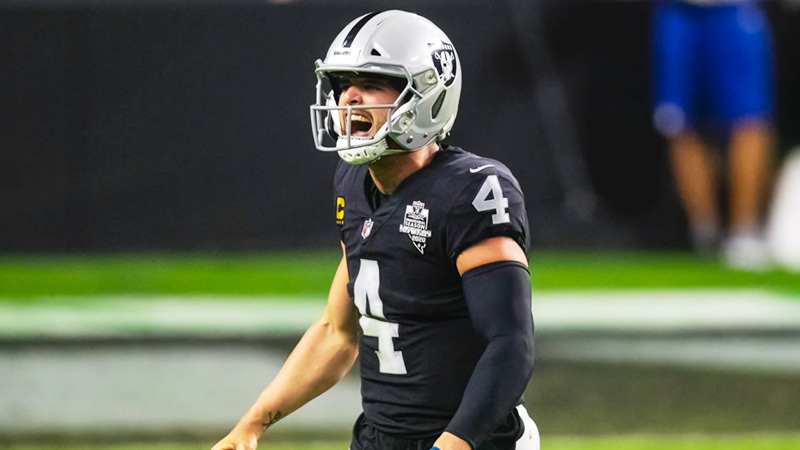
If you have ever tuned into a post-game press conference or listened closely to a sideline interview with NFL quarterback Derek Carr, you might have noticed something unexpected.
Instead of the standard West Coast cadence or the neutral accent typically associated with California natives, Carr speaks with a subtle, unmistakable southern drawl.
For years, this linguistic trait has sparked intense curiosity across sports forums, social media platforms, and search bars. Fans frequently ask: Why does a quarterback born in Bakersfield, California, speak with a distinct southern twang?
To understand this phenomenon, we have to look past the brief entries on his official player biographies and dive into the powerful forces of early childhood development, regional geography, and family heritage.
The story of Derek Carr’s voice is a masterclass in how our speech is shaped not merely by where we are born, but by the people we love and the environments where we grow up.
The Bakersfield Paradox: Birthplace vs. Lived Reality
On paper, Derek Carr is a California product through and through. Official athletic registries and team media guides list his birthplace as Bakersfield, California.
Situated in the southern portion of California’s Central Valley, Bakersfield has its own unique cultural history, often heavily influenced by historical migrations from the American Dust Bowl.
However, the standard Central Valley accent does not fully account for the classic southern features heard in Carr’s modern interviews.
This mismatch between a player’s official birthplace and their actual spoken dialect is what linguists refer to as a geographical paradox.
When fans hear Carr speak, their immediate expectation—based on his birthplace—conflicts with the auditory evidence.
This friction is precisely what drives so many people to search for answers online. The gap between his official bio and his actual voice can only be explained by looking at the specific moves his family made during his most crucial developmental years.
The Houston Connection: Formative Years in the Lone Star State
The first major piece of the puzzle lies in where Derek Carr spent some of the most critical years of his youth.
While he was born in California, a highly formative portion of his childhood was spent living and growing up in the Houston, Texas area.
In the study of sociolinguistic development, the years between early childhood and adolescence are considered the “critical period” for accent and dialect acquisition.
During this window, a child’s brain is highly sensitive to the phonetic inputs of their surrounding peers and community.
When a child is immersed in a specific regional speech community during these formative years, they do not merely learn the local vocabulary; they absorb the underlying rhythm, vowel shifts, and tonal qualities of the local language.
By living and growing up in the Houston area, Carr was exposed daily to the natural cadence of East Texas speech. This regional environment provided the auditory foundation for his speech.
The soft vowels, relaxed pacing, and melodic rhythm of the Texas drawl became deeply embedded in his natural way of speaking before he ever reached adulthood.
The Power of the Household: A Texan Family Unit
While regional geography explains his time in Houston, it only tells half the story. After all, many people move across different states during childhood without permanently retaining a strong regional accent.
The secondary—and perhaps more powerful—force shaping Derek Carr’s speech is his immediate household and extended family network.
Linguists have long observed that the “micro-dialect” of a home can easily overpower the broader regional dialect of a city, especially when family bonds are incredibly tight. In Carr’s case, his mother’s side of the family is entirely from Texas.
Growing up, Carr was not just living in a household with Texan parents; he was constantly surrounded by an entire extended family network steeped in Lone Star culture. His grandparents, aunts, uncles, and cousins are all from Texas.
Think about the sheer volume of linguistic input a child receives from their extended family. Holidays, weekend gatherings, family dinners, and phone calls were filled with the natural speech patterns of native Texans.
When a child’s closest role models, caregivers, and peers all speak with a specific accent, the child naturally mimics those sounds. This is a survival and bonding mechanism; humans are wired to unconsciously align their speech with those they love and trust to build social cohesion.
The Anatomy of the Twang: Vocabulary and Speech Patterns
An accent is not just about how vowels are pronounced; it is also about the specific lexicon and phrases that populate daily conversation.
Because Carr was constantly surrounded by Texan family members, he naturally adopted their regional vocabulary.
In particular, Carr grew up hearing his family members constantly use classic Southern phrases like “y’all” and “fixing to”.
- “Y’all”: A highly efficient, second-person plural pronoun that is the hallmark of Southern American English.
- “Fixing to”: A traditional Southern phrase used to indicate that someone is about to act in the immediate future.
When these phrases are used consistently within a household, they cease to be “regional slang” and simply become the standard English of the home.
By naturally picking up these speech patterns and vocabulary during his youth, Carr developed a genuine country twang that remained a permanent part of his identity.
This explains why his accent sounds completely natural and unforced—because it is the authentic language of his childhood home.
The Science of Dialect Preservation
Why does Derek Carr retain this accent today, even after spending his collegiate career at Fresno State in California and playing in various non-southern NFL markets?
The preservation of a childhood accent depends heavily on identity and emotional connection.
When an individual associates their speech patterns with fond memories of family, home, and comfort, they are far more likely to preserve those patterns throughout their adult life.
For Carr, his Texas roots represent a deep familial anchor. Rather than smoothing out his accent to fit into a standardized West Coast mold, his voice remains a reflection of his authentic upbringing, bridging his California birth with his rich Texas heritage.
Conclusion: The Authentic Voice of Family and Heritage
Ultimately, Derek Carr’s southern accent is a beautiful reminder that our identities are not dictated by a single line on a birth certificate.
While official records tie him to California, his heart, his formative childhood, and his family heritage are deeply rooted in Texas.
The next time you hear the quarterback drop a “y’all” or speak with that familiar Texas warmth in a press conference, you will know it isn’t an act.
It is the authentic voice of a kid who grew up surrounded by a loving Texan family, carrying their language and values with him all the way to the gridiron.