In the world of professional football, jersey numbers are rarely just random digits. They are identities.
The number 10 carries the weight of playmaking legends; the number 7 is reserved for the clinical winger; and for over a century, the number 1 has been the undisputed badge of the starting goalkeeper.
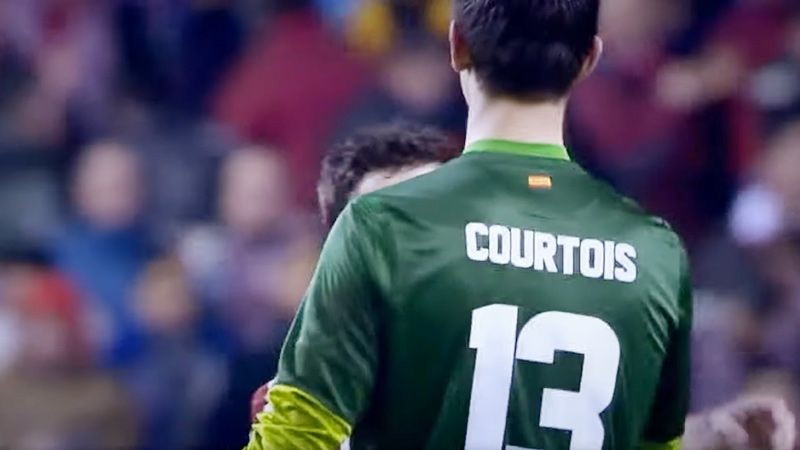
However, if you look at the back of Thibaut Courtois during a Champions League final or a crucial Madrid derby, you won’t see the traditional 1.
Instead, you see the number 13—a number often associated with bad luck in Western culture and usually reserved for the “second choice” keeper in many European squad hierarchies.
To understand why one of the greatest shot-stoppers in history prefers this “unlucky” digit, we have to look back at his formative years in Spain.
The Origin Story: An Assignment at Atlético Madrid
The story of Courtois and the number 13 did not begin with a conscious choice or a deep-seated childhood obsession. Rather, it began as a matter of professional circumstance.
Courtois was first handed the number 13 during his tenure at Atlético Madrid. At the time, he was a young, burgeoning talent on loan from Chelsea, looking to make his mark in La Liga.
In the Spanish league, LFP regulations traditionally dictate that first-team players must wear numbers 1 through 25, with 1, 13, and 25 specifically designated for goalkeepers.
When he arrived at the Vicente Calderón, he was given the number 13. While many young players might have viewed this as a temporary placeholder until the prestigious “1” became available, Courtois’ immediate and overwhelming success in the shirt began to change his perspective on the digit almost instantly.
From “Assigned” to “Lucky”: The Power of Winning
Psychology plays a massive role in elite sports. A piece of equipment or a specific routine can become “lucky” based on the results achieved while using it. For Courtois, the number 13 quickly shed its reputation for misfortune and became a talisman of success.
During his three-year stint with Atlético Madrid, Courtois didn’t just play; he conquered. He won a Europa League title, a UEFA Super Cup, a Copa del Rey, and a historic La Liga title in 2014.
These victories were not just team achievements but personal triumphs for a keeper who was consistently winning the Ricardo Zamora Trophy (awarded to the goalkeeper with the lowest goals-to-games ratio in La Liga).
Courtois considers the 13 his “lucky number” specifically because he won “quite a few trophies” while wearing it.
This highlights a key aspect of the elite athlete’s mindset: success redefines tradition. Once the trophies started piling up, the number 13 was no longer a sign of a substitute—it was the mark of a champion.
The Psychology of the Number 1 vs. 13
There is an undeniable prestige associated with the number 1. It is the “special” number that every aspiring goalkeeper dreams of wearing. Courtois himself admits that playing with the number 1 is a unique experience.
However, there is a distinct competitive advantage to sticking with what works. For Courtois, the number 13 represents his journey—his rise from a young prospect at Atlético to a global superstar.
By the time he moved to Real Madrid, the number 13 had become a part of his professional brand and his mental comfort zone.
His attachment to the number is now so strong that he is uncertain if he would ever want to change it. This suggests that for Courtois, the “luck” and the history he has built with the 13 now outweigh the traditional allure of the number 1.
The “Curse” of the 13: Why Courtois Defies Superstition
Triskaidekaphobia, or the fear of the number 13, is a real phenomenon that influences everything from skyscraper floor numbering to airline seating. In football, many players avoid the number out of a superstitious belief that it invites injury or poor performance.
Courtois’ career serves as a masterclass in debunking this myth. By embracing the 13, he has turned a “negative” symbol into one of the most feared sights for opposing strikers.
When a striker sees that number 13 coming off the line, they aren’t thinking about bad luck—they are thinking about how difficult it is to beat the man wearing it.
Impact on Global Goalkeeping Trends
Because of Courtois’ dominance on the world stage—most notably his Man of the Match performance in the 2022 Champions League final—the number 13 is seeing a resurgence in popularity among younger keepers.
Much like how kids started wearing number 23 because of Michael Jordan, Courtois has made the 13 “cool” for a new generation of shot-stoppers.
It is no longer seen as the “bench-warmer’s number.” Instead, it is seen as the number of a keeper who is confident enough to forge their own path and create their own luck.
Conclusion: A Legacy Built on Personal History
Thibaut Courtois wears the number 13 because it is a living record of his greatest achievements. What started as a standard assignment at Atlético Madrid evolved into a personal identity through a series of trophy-winning seasons.
While the number 1 will always remain “special” in the broader context of football history, for Courtois, the 13 is his true home. It represents the trophies he has lifted, the saves he has made, and the personal belief that you don’t find luck—you earn it.