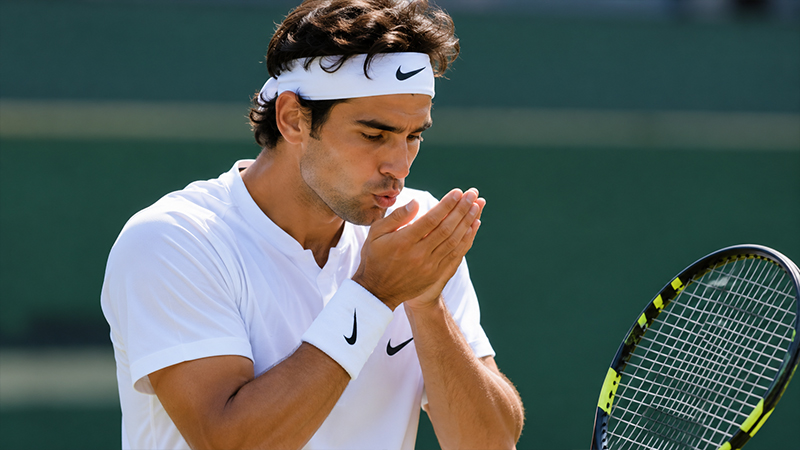
In the world of professional tennis, where matches are decided by margins thinner than a racquet string, every micro-adjustment matters.
If you have ever watched a high-stakes Grand Slam final, you have likely observed a curious, repetitive behavior: a player, standing at the baseline, brings their hitting hand to their mouth and delivers a sharp or prolonged puff of air into their palm or fingers.
While it might look like a simple nervous tic, this action is a sophisticated, multi-purpose tool used by elite athletes to maintain peak physical and mental performance. It is a gesture that bridges the gap between biological necessity and psychological discipline.
This deep dive explores the multifaceted reasons why tennis players blow on their hands, examining the physics of the grip, the biology of temperature regulation, and the silent “inner game” that governs every point.
The Mechanics of the Grip: Managing Moisture and Friction
The primary point of contact between a player and their performance is the racquet handle. At the professional level, the “feel” of the racquet—often referred to as “touch”—is paramount. Any interference with this connection can result in a shanked shot or a loss of control.
1. Evaporative Cooling and Sweat Management
Tennis is a grueling sport often played in punishing heat and high humidity. During long, high-intensity rallies, the hands become a primary site for perspiration. While players use wristbands and towels, these are not always accessible in the seconds leading up to a serve.
Blowing on the hands creates a stream of moving air that facilitates the rapid evaporation of thin films of sweat and humidity. This isn’t just about comfort; it is about the coefficient of friction.
A microscopic layer of moisture can act as a lubricant, causing the racquet to twist in the hand upon impact with a 120-mph serve. By blowing on their fingers, players ensure their skin is sufficiently dry to maintain a “tacky” connection with the overgrip.
2. Adjusting Skin Moisture Levels
Interestingly, the goal is not always total dryness. A hand that is too dry—common in arid climates—can become slippery on certain synthetic grips.
In these instances, a player may use the warm, moist breath from their lungs to add a hint of “tackiness” back to the skin, ensuring the fingers can wrap securely around the handle without requiring excessive muscular force.
3. Soothing Friction and Minor Injuries
The repetitive nature of tennis swings puts immense stress on the skin. Professional players often deal with “racquet burns,” calluses, and nascent blisters caused by the constant rubbing of the handle against the palm and fingers.
A gentle puff of air provides immediate, albeit minor, soothing relief for raw skin or friction-sensitive areas.
| Physical Factor | Benefit of Blowing on Hands | Outcome for the Player |
|---|---|---|
| Excessive Sweat | Accelerates evaporation of moisture films. | Prevents racquet slippage during high-impact shots. |
| Arid Conditions | Adds a micro-layer of moisture for “tack”. | Enhances the “feel” and connection with the grip. |
| Friction/Heat | Provides cooling relief for raw skin or blisters. | Reduces distraction from physical discomfort. |
| High Humidity | Breaks the seal of humid air trapped against the palm. | Maintains a consistent grip texture throughout the set. |
The Biological Thermostat: Temperature Regulation
Tennis is a global sport played in environments ranging from the desert heat of Indian Wells to the chilly autumn evenings of late-season European tournaments.
The hands, being extremities, are highly susceptible to ambient temperature changes, which directly affect fine motor skills.
Warming Stiff Fingers
In cooler weather, blood flow to the extremities can decrease as the body prioritizes core warmth. This can lead to numb or stiff fingers, which is disastrous for a sport requiring “soft hands” for volleys and drop shots.
A player’s warm breath serves as a quick-access heat source, warming the fingers to maintain dexterity and nerve sensitivity.
Lowering Skin Temperature
Conversely, on a sweltering day, the skin on the hands can become uncomfortably hot due to both the sun and the internal heat generated by muscle exertion.
A sharp, cool gust of air helps lower the surface temperature of the skin, providing a brief moment of thermal regulation that helps the player stay focused.
The Psychological Anchor: Mental Resets and Routine
While the physical benefits are undeniable, the mental component of blowing on the hands is perhaps even more critical for the success of professional athletics.
In a sport where you are alone on an island, routines are the lifeblood of consistency.
1. The “Mental Trigger” for Resets
Tennis is a game of errors. A player might miss an easy overhead or double-fault at a crucial moment.
The “blow” acts as a physical trigger—a ritualistic reset. It signals to the brain that the previous point is over and the focus must return to the present. This prevents “tilting” or emotional spiraling.
2. Releasing Muscle Tension
The “grip of death”—squeezing the racquet too hard—is a common symptom of nerves. This tension travels up the arm, stiffening the wrist and elbow, and ruining the fluid kinetic chain required for a powerful stroke.
The act of controlled exhaling onto the hands encourages a conscious relaxation of the finger and wrist muscles. A relaxed hand is a fast hand.
3. Managing the Pressure of the “Quiet Period”
Before a serve, the stadium falls silent. For many players, this silence is deafening and filled with pressure.
Engaging in a physical habit like blowing on the hands occupies the “active” mind, providing a rhythmic, familiar sensation that lowers the heart rate and grounds the athlete in their body rather than their anxious thoughts.
The Role of Superstition
In the high-pressure environment of professional sports, “superstition” is often just another word for a highly refined routine. If a player won a major tournament while frequently blowing on their hands, the brain encodes that behavior as part of the winning formula.
This habit becomes a comfort mechanism, a “match-day habit” that provides a sense of control in an unpredictable environment.
Comparing the Habit: Tennis vs. Other Professional Disciplines
To understand why this habit is so prevalent in tennis, it is helpful to look at how other professionals manage similar hand-to-equipment challenges.
- Basketball: Players often lick their fingers or wipe their shoes to increase friction/grip.
- Gymnastics: The use of heavy chalk is the standard for moisture management.
- Gaming (Esports): Professional gamers often use hand-warmers or blow on their hands to maintain the “twitch” speed of their fingers in cold arenas.
Tennis players are unique because they cannot use excessive chalk (which would ruin the racquet’s balance and grip texture) and cannot stop the match to use hand-warmers between every point. Breath is the only tool that is always available, free, and instant.
Strategic Insights: Why This Matters for Performance
For an athlete or an organization striving for excellence, the “hand blow” illustrates three core principles of elite performance:
- Micro-Optimization: No detail is too small. If 1% more grip leads to 1% more spin, that can be the difference between a ball being “in” or “out.”
- Sensory Feedback: The hands are a primary sensory organ. Keeping them in an optimal state (dry, warm, and relaxed) ensures the brain receives accurate data about the racquet’s position.
- Stress Management: Incorporating physical “anchors” into a routine is a proven method for maintaining high-level cognitive function under extreme duress.
Executive Summary: The Science of the “Blow”
| Category | Specific Action | Primary Objective |
|---|---|---|
| Environmental | Temperature Adjustment | Counteracting cold-induced stiffness or extreme heat. |
| Physiological | Moisture Control | Removing sweat films to optimize friction. |
| Clinical | Skin Protection | Soothing friction from blisters or “racquet burns”. |
| Cognitive | Mental Reset | Using a physical trigger to clear the mind and release tension. |
Conclusion: The Mark of a Professional
The next time you see a player like Novak Djokovic or Iga Świątek blowing on their hands before a high-pressure point, you are witnessing more than a habit.
You are seeing a world-class professional performing a 360-degree check of their physical and mental systems.
They are drying their skin for a perfect grip, regulating their body temperature for maximum dexterity, and anchoring their mind to the present moment.
It is a masterclass in using the simplest of tools—the breath—to solve the most complex of problems: winning under pressure.